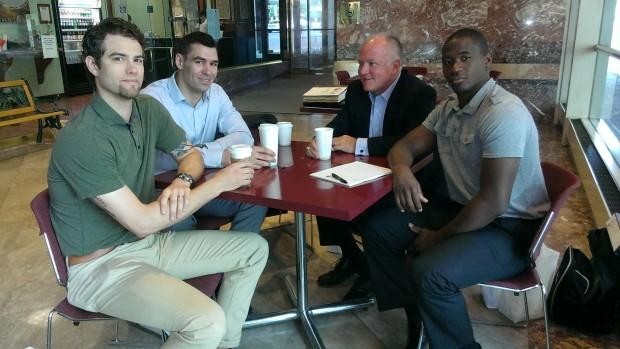
The PHPA and AHL recently announced a new 4-year Collective Bargaining Agreement, effective September 1, 2015. Part of the PHPA’s negotiation strategy was to incorporate as much input from AHL players as possible to determine the issues that mattered the most to them and their families. Joining the PHPA Negotiating Committee during bargaining sessions were members of the elected PHPA player Executive Committee including Drew Bagnall, Max Fortunus, Pierre-Luc LeBlond, Mike McKenna, Mike Moore, and Greg Rallo.
We sat down with members of the Executive Committee as they lend some insight into what went on during face-to-face bargaining sessions and how the negotiation process played out from a player’s perspective.
PHPA.com: What was it like being in the meeting room during CBA negotiations? Intense? Relaxed? Did you feel any pressure knowing you were representing all AHL players?
Max Fortunus – It was the first time I had been into a meeting like this. It was a great experience. I felt like the meetings always started relaxed and as we went on both sides were expressing their thoughts and differences about specific topics, which sometimes intensified the meeting.
Mike Moore – It was a relaxed atmosphere, but we were on one side of the table and the representatives from various AHL teams were on the other side with Dave Andrews at the head of the table, so you literally knew what side you were on.
Pierre-Luc Leblond – I would describe the meetings as respectful and relaxed. Every time the players or the league raised an issue, everyone took the time to understand each other’s position on the matter.
Mike McKenna – It was a great experience being able to directly negotiate with representatives of the AHL, along with fellow PHPA members and Executive Director Larry Landon. For the most part, sessions were relaxed and flowing. I can’t think of a time where voices were raised or threats were made. Everyone was engaged and part of the process.
I didn’t feel any pressure myself, but I did want to make sure we set up future PHPA members for the best working conditions down the road. CBA’s lead into one another and you always want to leave a positive mark and set a benchmark for future negotiation.
Greg Rallo – Surprisingly it was very calm. I didn’t expect things to go as smooth as they did. The league really listened to the players.
PHPA.com: Did you raise or speak to any specific issues? If so, what were they?
Max Fortunus – Personally, the topics I wanted to talk about were the playoff pool, the Veteran Rule, and Christmas break. I think the whole group had good points on every issue and we all worked well together. I think that was the key.
Mike Moore – We went through the list of around 14 possible changes to the current CBA and talked about each issue. We felt very prepared with those proposed changes and some went into depth, such as the changes to second medical opinion, while others were a quick “not possible”, such as the 401k partial employer matching.
Mike McKenna – I didn’t have a “cause” in the room: rather, I chose to focus on what our questionnaire responses showed as our most important issues. My personal belief is that if you target one goal too hard, you lose focus on the grand scheme of things and risk agreeing to a poor deal in other areas.
Greg Rallo – The Veteran Rule. Being a vet, I felt it necessary to do my best to help vets in the future.
PHPA.com: What surprised you the most about the entire experience?
Mike McKenna – I was surprised how open and honest the AHL representatives were with us. I never felt like they were intentionally hiding anything or trying to lead us down a bad path. It was a very frank and professional environment.
Max Fortunus – I was surprised at how much Dave Andrews cares for the well being of the players. He listened to what the players had to say and took it into consideration. I was expecting the negotiations to be a never-ending battle, but it wasn’t.
Greg Rallo – The respect the PHPA and AHL have for each other. We all benefit from such a great relationship.
PHPA.com: Did things ever get heated during the meetings? If so, what was the issue(s)?
Max Fortunus – The only time I remember the meetings being fired up was when we talked about the Veteran Rule and having young players play against older players.
Mike Moore – There were issues with second medical opinions, length of time at the rink during training camp, and issues like that. It was never heated but some questioning back and forth.
PHPA.com: How often did you provide status updates to your teammates and other players from around the League throughout the process? How did you keep them engaged?
Pierre-Luc Leblond – I was in constant contact with other players, former teammates, and training partners to get feedback and ideas.
Max Fortunus – A lot of the players contacted me throughout the negotiation process, which tells me that we were all in it together and that guys around the league wanted to voice their opinions and share their questions.
Mike McKenna – I did my best leading into negotiations to notify current and former teammates that I would be actively involved in bargaining and that all questions or comments were welcomed. After each session, I communicated with a core group of fellow PHPA members and also made myself available to anyone with questions. It was really cool to have old teammates reaching out to find out the latest. It was exciting to see how many members wanted updates on the process.
PHPA.com: How did the PHPA strategize and receive player input heading into CBA negotiations?
Max Fortunus – A good thing the PHPA does is that every year they send out a questionnaire to all players about topics of discussion for our Annual Meeting of Player Representatives. A lot of the topics we had talked about in the past were brought up during the CBA negotiations. It’s little things like this that helped us be ready for whatever was coming our way. After meetings, Larry always gathered the Executive Committee and we recapped. Before meetings, we would do something similar to give us a general idea of what is going to happen. We did this so that we knew which topics were going to be more prominent. Just to help us get ready.
Mike Moore – The PHPA used their mobile app to have players answer questionnaires, and a lot of conversation about the CBA took place at the Annual Meeting in Orlando last year. That was the most thoughtful meeting I had attended in my career and brought forth the most dialogue and ideas to think about. After that, the preparation by Larry and the entire team at the PHPA had prepared us for the first big negotiation session in Hilton Head during the AHL Board of Governors meeting.
Pierre-Luc Leblond – The questionnaires conducted during last season were key for us to know what the players really wanted. Going into negotiations knowing what our members wanted us to work on made it easier to keep our focus on what we had to accomplish.
Mike McKenna – Before negotiations commenced, members of the Negotiating Committee received a binder containing vast amounts of information on past CBA’s, potential financial ramifications, etc. Baron Bedesky from the PHPA did a great job collecting numbers and prepping us from an analytical standpoint. Over the course of negotiations we had several conference calls to stay informed of any updates or proposal changes.
PHPA.com: Once a tentative agreement was reached, what was the reaction from other players as you explained the elements of the deal?
Max Fortunus – With all the players I personally talked to, they were excited about it.
Mike Moore – I think most guys were happy to get a deal done and we were excited about the four years of security. Everything with the new CBA was an improvement including workers’ compensation provisions. The only issues raised were the possibility to examine the Veteran Rule and playoff structure after two seasons.
Greg Rallo – Players that I spoke to were very pleased with the outcome of the new CBA.
PHPA.com: What was the number one / top item players wanted to see addressed heading into CBA negotiations and why? What was the end result?
Max Fortunus – For sure the playoff pool bonus. I think guys knew there was a solution to give more to the Calder Cup winners. It’s hard to win and guys need to be compensated more.
Mike Moore – I think guys wanted to see an improved playoff structure. I think guys also want an even number of games across the league as well, and I know that’s an issue that will hopefully be resolved in the future.
Pierre-Luc Leblond – Playoff pool. It’s been fixed, boys are happy. The reason it was so important for all of us is that it affects half the players in the league. Not only is the money better, the players feel good about giving more power to the owners to bring fans to games. We all want to play in front of as many people as possible. The playoffs are hard fought battles, it’s a great show.
Mike McKenna – The playoff pool. Over the past several years, the pool plummeted and players were taking a huge hit. In the end, the AHL made it a priority to fix and made it happen. Kudos to them.
Greg Rallo – Playoff pool… It was an item that needed to be fixed and moving forward players will be rightfully compensated for their efforts in the playoffs.
PHPA.com: Was there an apparent mutual respect between both sides during the process, especially between PHPA Executive Director Larry Landon and AHL President and CEO Dave Andrews?
Mike Moore – Yes, mutual respect from all sides. Respect not only between Dave and Larry, but also between team management and the players. You could tell that representation from both sides truly want stability for minor league hockey. The respect for the players was apparent from everyone involved.
Greg Rallo – It was clear that Larry and Dave both have a mutual respect for each other and work in the best interest of both the players and the league at heart.
Mike McKenna – Definitely. Dave and Larry have done many of these in the past and it makes things flow smoothly. It also helps that some members of the AHL Negotiating Committee are retired professionals and former PHPA members. They know what it’s like to be in our shoes, and that helps cultivate a positive working relationship.
Pierre-Luc Leblond – Absolutely. One thing I have realized meeting GMs, coaches, owners and going to CBA meetings, is the passion that we have for the game as players is just as strong on the management side. They have a business to run but they are in it for the right reasons (love of the game). Larry and Dave go way back and their mutual respect is clearly based on their love of the game and the immense respect they both have for (minor league) hockey players.
PHPA.com: How did you enjoy the overall experience and what were some of the things you learned or took away from being part of the CBA negotiating committee? Do you think this experience will help you in some way in your post-playing career?
Max Fortunus – It’s an experience I will never forget and will definitely help me in the future. Someone once told me to “get involved with the PHPA, it will teach you a lot.” I did and it helped me understand the other side of the business. I am totally grateful to be a part of a group like the PHPA and the AHL.
Mike Moore – It was overall a great experience and very interesting to see the business side of the negotiations. You learn to try to see things from the other side and to represent your case in a fair and respectful way. It helps to have a great legal team on your side, and the PHPA has the best in collective sports bargaining. Their calmness and experience taught me a lot and we often turned to them for advice throughout the process and during every conference call. Larry, Ron (Jaros), Bob (Riley), Bert (Villarini), and PHPA staff who were involved deserve a lot of credit.
Pierre-Luc Leblond – The experience was awesome. I am pleased with the agreement we reached.
Mike McKenna – It was a great learning experience and something I had looked forward to for a long time. Despite being a long-serving Exec Board member, I had never been actively involved in a CBA negotiation. It’s hard to pinpoint specific items, but I think the most important thing I learned was the pacing and etiquette involved in bargaining. Words mean a lot when dollars and cents are on the table and you constantly have to filter your thoughts and speak in a controlled manner. I have no doubt that someday it will pay dividends off the ice.