LAVAL, Que. — As Arber Xhekaj was recovering from his shoulder injury in November and saw that Jordan Harris would also be out indefinitely, something clicked in his brain.
He needed to get back in the Montreal Canadiens lineup as soon as possible.
David Savard was already out with an injury, the Canadiens were giving opportunities to Johnathan Kovacevic and Gustav Lindström to play higher up in the lineup, and Xhekaj wanted those opportunities for himself. He had been working on making certain improvements to his game prior to his injury and felt they were working, that he was improving his defensive-zone play and becoming a more viable option higher up the lineup.
All he needed was his shoulder to get better.
Or, so he thought.
“So I’m trying to get it back as fast as I can, and when they told me I was going down, I was like, ‘Holy s—, this isn’t good. I can’t get hurt down here, re-injure my shoulder.’ That would just be tough,” Xhekaj said as part of a long conversation after Laval Rocket practice on Tuesday. “I don’t know, a whole bunch of things were going on in my head, so it was kind of tough, and I hadn’t played in three weeks, so that was also hard.
“Once I kind of brushed that off and let my game do the talking, then I started feeling better.”
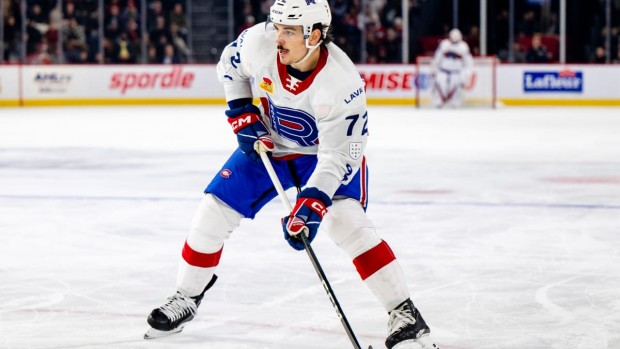
Xhekaj looked like a shadow of himself in his AHL debut with the Rocket on Dec. 6, tentative and confused, and now we know why. It was all those things going on in his head.
But since then, Xhekaj’s game is growing in Laval, and though he had difficulty seeing the benefits of going to the AHL a month ago, he can see them now.
“For me, I think it would be better to be working on my game up at the NHL level, personally,” Xhekaj said. “But I think in their situation right now, I wouldn’t be getting as many minutes, so I think being down here is definitely benefiting me, just getting more touches. You’re going to be out there in more scenarios, and it feels good to be the go-to guy down here.”
And while in his first game Xhekaj looked offensively handcuffed, unwilling to take the slightest risk to make a play with the puck, that has changed dramatically. Xhekaj will enter Friday night’s game in Utica on a four-game point streak and has eight points in 10 AHL games. But more than that, it is his mobility and ability to drive offence that has caught coach Jean-François Houle’s eye.
“The kid has upside for an undrafted kid, it’s incredible he slipped through the cracks. It’s really tough to understand,” Houle said. “He has some really nice offensive qualities. His wrist shot is elite, and for a big man, he can move. The Canadiens got lucky. That kid’s a first-rounder, so it’s like having a first-round pick fall in your lap. We had (Justin) Barron here, and he’s just as good as Barron, who was a first-round pick. I think he might even have more offensive skill than Barron. For me, when you look at them when they were both here, wow, this kid (Xhekaj) can be special.”
Houle recalled standing on the bench during a game recently and watching Xhekaj skate the puck through the neutral zone, and this thought came into his head.
“Man, if you take the reins off this guy, maybe he can even bring you more than we think,” Houle recalled. “And that’s why I say he has a lot of upside, because he’s 22, and at one point he’s going to feel very comfortable and he’s going to do stuff that we don’t think he can do.”
The reins are now off in Laval, and Xhekaj is enjoying the freedom to make mistakes — within reason, of course — and know he’ll be right back out there.
“I feel like (Mike) Matheson has a long leash up there, because that’s the type of player he is, he’s allowed to bring the offence. I think down here, they give me a long leash, so you have room for error,” Xhekaj said. “Obviously, to get back up I’m going to have to be sharp and consistent, but I think the more leash you give me, the better I do, because I’m just calm and I just play.”
This has always been a fascinating part of sending NHL players down to the AHL to work on certain elements of their game. Often times, and this might be one of them with Xhekaj, the reason things are not working out in the NHL is because of the speed of the game. So, they get sent to the AHL, where things happen a little slower, there is more time and space to operate, and things go better. But the initial problem of dealing with the speed of the NHL game doesn’t necessarily get addressed, because you are playing at a slower pace. How does that disparity get resolved? How do you make that leap without trying to play through the difficulties presented by NHL speed?
Houle has theories.
“You get to handle the puck a little bit more in the AHL than you would in the NHL, certain players do, and Xhekaj’s one of them,” Houle said. “I was watching his games in the NHL, and it was a lot of, he would touch the puck and then it was done. But here, he has time to control it, he has time to make plays. I think it’s good. It’s going to give him a knowledge of time and space in two different leagues, but hopefully he can bring that to the NHL a little bit, having more poise instead of just hitting the puck and get it out. Because he knows he can do it at this level, and I know the next level comes fast, but because he was able to do it, he knows in his head that I can do it.
“That’s where the next level is tougher, but if you’ve done it at one level, you should be able to carry it over. And he’s established himself really well on the team. He’s a presence, he’s well-liked by the players, he’s a funny guy, he’s comfortable right now with the players that we have and he’s playing some pretty good hockey. I don’t know how long he’s going to be here, but he’s taking all the right steps to get a call up.”
This is where the case of Xhekaj in Laval becomes more than that for the Canadiens, because there will be other cases like his in the coming years. As we can see now, the Canadiens are carrying eight defencemen on the NHL roster because they don’t want to risk losing someone like Gustav Lindström on waivers, and, because Xhekaj is not waiver-eligible and people like Jordan Harris and Johnathan Kovacevic are, he is easier to send down. But the catalyst for this is the fact that Jayden Struble is playing so well in Montreal.
Perhaps in a not-so-distant future, it will be Xhekaj who is playing too well to be taken out of the lineup, and it will be Struble getting sent down. Or it will be David Reinbacher taking a spot and forcing someone else down, or it will be Lane Hutson, or Adam Engström — the list goes on.
Or it will be Logan Mailloux, whose play has also improved in Laval after a difficult start. And the beauty of that for the Canadiens is Mailloux’s improvement has a lot to do with playing with Xhekaj, the current victim of the overcrowded blue-line situation in Montreal.
“He helps simplify the game. I feel like we’ve been good reading off each other, we communicate well, we’ve both been playing hard,” Mailloux said of his new defence partner. “We want to be hard to play against, we don’t want other forwards to enjoy coming into our end when we’re on the ice. It’s been great playing with him so far.”
Mailloux and Xhekaj have similar things they need to work on in their respective games, taking care of the defensive zone, understanding when to kill plays, not necessarily running at guys, proper stick positioning, a lot of things. They also have a similar edge to their game and, well, let’s say they similarly enjoy the theatrical aspects of gamesmanship.
“I think playing with Xhekaj right now really helps him. I think it calms him down because Xhekaj’s one of those guys who gets the puck, and he calms the play before making another play,” Houle said of Mailloux. “So both together, they’ve been very good.”
This is the benefit of all the quality defence prospects the Canadiens have in their system. Yes, there could be problems, starting with waiver eligibility and how that may force the organization to make some difficult decisions at some point soon, but this is an example of how having so much blue-line talent can have a trickle-down effect. Right now, it’s Xhekaj helping Mailloux’s development, but it could easily be someone else in the coming years, someone who is good enough to survive in the NHL but is better off thriving in the AHL and helps his AHL teammates reach the NHL level in the process.
“That’s a good challenge for me and for the players here,” Mailloux said. “They help to push each other every single day, and that’s how we’re going to get the best product on the ice. It’s by pushing each other in practice every day. I mean, that’s how the league works, that’s how hockey works, there’s guys coming and fighting for jobs.
“You’ve got to take a job at the end of the day if you want to play in the NHL, and once you take that job, there’s another guy coming behind you that wants to take it as well.”
It might have been jarring for some to see Xhekaj sent down to Laval a month ago, most of all Xhekaj himself, but looking at the Canadiens’ system from top to bottom, perhaps it is something players and fans will need to get used to seeing.
And perhaps it is ultimately a good thing.
“Obviously, there’s a lot of guys in the loop right now, but I try not to worry about that,” Xhekaj said. “I just look at it like, if they’re telling me that I’m a part of their future and I’m going to be a part of what they’re trying to build here, if I need time down here to work on it, I’m just going to do it. That’s how I look at it.”