The year of 2020 has been one that can be defined by one simple term: uncertainty. The entire world lives everyday looking to understand “the new normal”. The same holds true for former ECHL forward and budding entrepreneur, Colin Mulvey, as 2020 has been anything but normal.
The 30-year-old graduate of Norwich University has put over a year’s work into developing a brand-new leisure wear brand and underwear line. Mulvey had come up with the idea in the Fall of 2019 and has since put in the legwork to get his brainchild, “Vora” ready to launch.
As Mulvey describes it, Vora’s positioning in the market, “is to have clothes that look like Calvin Klein, but perform like Lululemon. It’s high-end casual clothing, with the performance of an athletic brand. A lot of casual clothing doesn’t fit quite right or they don’t perform. They’re purely aesthetic. I want to be a hybrid of those two market segments.”
Admittedly, 2020 has not been an ideal time to start a business. Some of the most established businesses are falling by the wayside in the current pandemic-induced economic climate and, as a brand-new company, Vora has certainly been met with some challenges.
“I’m trying to get everything started right as everybody else is in full marketing mode,” Mulvey admits. “The competition is really tight right now with Black Friday sales and the Christmas push. It would’ve been a lot easier to get my feet wet in June so at this point I’d have more experience and basis for my decisions. I’m in the thick of it right now. But I guess it’s better in some ways to jump right into the fire and face the challenges head on.”
An underdog for seemingly his entire hockey career, Mulvey is no stranger to facing challenges head on. Growing up in Worcester, Massachusetts, one of Mulvey’s first experiences in hockey was playing for a local team that was, “not only the worst team in all of Worcester, but the worst team at the worst level in the State.”
After a season of organized hockey under his belt, Mulvey “stumbled” onto the local elite-level Worcester Crusaders. But after just one season he was the only player cut from the Crusaders. It was an experience that, while devastating at the time, had a profound impact on Mulvey’s life.
“Being cut at age six, facing that disappointment so young, that motivated me,” Mulvey explains. “I learned I had to be better and try harder. From there on out hockey became my passion. The sport was basically my whole life for the next twenty years.”
As Mulvey climbed up the ranks of the Massachusetts minor hockey scene, he kept an eye on what he deemed to be the next step: college hockey. In his 2008-09 season, Mulvey played for the Valley Jr. Warriors of the Eastern Junior Hockey League. He scored 13 points in 42 games, but didn’t find any NCAA suitors recruiting him save for one. An assistant Coach of Norwich, a member of NCAA’s Division III New England Hockey Conference, had taken notice of Mulvey’s game.
“(Norwich University) was the only school that even recruited me. I didn’t have a very successful junior career. One assistant coach from Norwich met with me after a festival game that I did pretty well in. He invited me to the school on a recruiting trip.”
While Norwich showed some interest, Mulvey’s first interaction with the program during his recruiting trip left a bad taste in his mouth.
“On the trip, I was one of 12 players and each one had a 15-20 minute meeting with the head coach,” Mulvey remembers. “They all came out laughing and giggling. When I got in for my meeting the coach said, ‘Hey Colin, I’m not sure you’re good enough for my team. Maybe you will be in the future.’ But later that season, by chance, I played against another player from that recruiting trip. I outplayed him that night with Norwich’s coach in attendance. After the game he was waiting outside the locker room and said, ‘can’t wait to have you on my team next year. I’m really excited to get you up to Norwich!’”
Despite a rocky recruiting process, Mulvey accepted and attended Norwich, working towards a degree in civil engineering in the fall of 2009. This began a memorable four-year stint with the Cadets in which the team thrived with every season ending in a deep playoff run where Mulvey saw his hockey career really take off.
In Mulvey’s freshman year, Norwich went on to win the 2010 NCAA Division III National Championship. Mulvey chipped in with 10 goals in 27 games while playing a supporting role in his first season.
After a sophomore season that saw him fill another season as a bottom-six role player, Mulvey looked to make a jump. He met a skills coach out of Boston University named Pertti Hasanen and the two put in some serious work together over the summer of 2011.
“Hasanen’s the one who really helped me to develop my game and evolve into a professional player,” Mulvey recalls. “I was always able to skate. But I had huge deficiencies in terms of stickhandling and shooting. Working with Pertti I was able to develop an elite shot. If I had time and space I was able to hit the net more often than not. That’s what took me from a third line player at Norwich to First Team All-American and voted second-best player in the country.”
Following his first summer working out with Hasanen, Mulvey’s scoring output jumped to 12 goals and 20 points in 29 games in his junior season. He then turned in a dominant 2012-13 senior season that propelled his hockey career. Mulvey racked up a team-leading 19 goals and 38 points and was a driving force behind a playoff run that saw Norwich lose in the semi-finals of the college hockey playoffs.
Once the playoffs wrapped up Mulvey set his sights towards professional hockey. Admittedly, his chances of rising through the ranks from a Division III school were limited. He was given a shot with the Fort Worth Brahmas of the now defunct Central Hockey League. After his final game with Norwich, Mulvey got the call from the Brahmas offering a spot on their playoff roster and immediately shipped out to Texas for the playoffs.
“It was a rude awakening in pro hockey,” Mulvey recalls. “Especially in a veteran-heavy league like the CHL. I did OK, but not that well statistically. As the games went on my confidence and ice time improved.”
Mulvey chipped in two points in nine playoff games for the Brahmas before the team was inevitably bounced from the playoffs. But, after the team’s final game, Mulvey was thrown into a hectic situation that, in hindsight, was a reflection of the failing CHL.
“The Brahmas closed shop and folded before the final buzzer in the playoffs and created a bit of chaos. There was a mad-dash of trying to get paid for playoffs, trips home and anything like that. Fortunately, the PHPA (Professional Hockey Players’ Association) was good enough to step in and ensure everyone was reimbursed for their travel and fight with the team through to getting our final paycheck. So that was awesome of them. At the time I was still in college and needed the money and had no idea how I would get back to Vermont. They really stepped up and helped me out.”
When the dust settled, Mulvey was left looking for his next hockey home and anxious for a chance to prove he could play at the next level. Fortunately, while training in the 2013 offseason, he met a former NHL player who was able to open some doors.
“That summer there wasn’t much on the table for me in terms of professional contracts. Not until a friend of mine, Mike Grier who’s an NHL veteran of over 1000 games, had a conversation after an off-season skate. He ended up brokering my first contract in Wheeling so I owe him a huge amount of credit in getting me an opportunity to showcase that I can play.”
Mulvey played 31 games for the Wheeling Nailers in the 2013-14 season. In a limited role he scored eight points and was finding the adjustment to professional hockey challenging.
“It was a huge mental strain. Every day I felt I had to prove myself. In the ECHL there is no fluidity to the rosters so I could never take a day off. Whenever I got the opportunity to play, I had to be my best.”
The adjustments for Mulvey also extended off of the ice where players are offered more freedom and, by extension, more responsibility than they are used to up to that point in their careers. As Mulvey explains, “The free time off of the ice was also a big adjustment. It’s an aspect that often goes over-looked. In school you go to class, you go to the gym, there’s a lot of demands on your time. But once you turn professional, especially on a practice day, you practice from 10 to 11am then you’re done. There’s a lot of dead time in the day which can get boring at times. You have to find a way to make strides and make the best use of your free time.”
Nearing the end of his rookie 2013-14 season, Mulvey was traded from Wheeling to the Cincinnati Cyclones. For a young player looking to find his foothold in the professional hockey landscape, the trade reinvigorated Mulvey. He was afforded the opportunity to play a larger role for Cincinnati and delivered five points in seven games.
“Being able to go to Cincinnati to get a chance to play impactful minutes was huge. It gave me such a huge confidence boost going forward.”
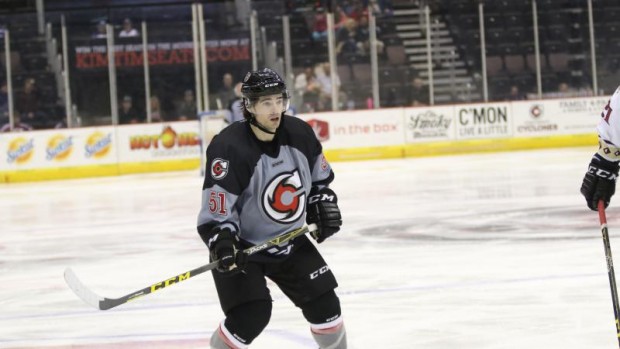
Following his first year in the ECHL, Mulvey decided to take an opportunity to travel overseas and play hockey in Germany for the Erding Gladiators. His 2014-15 season saw him pop off for 29 goals and 52 points in 40 games for the Gladiators. Mulvey enjoyed his first year in Europe so much that he re-signed with the team on a new two-year deal.
Unfortunately, the coach who recruited Mulvey was replaced by a coach who couldn’t speak English so the team cleaned house and got rid of the North American players. This led Mulvey back to the ECHL for what he thought would be a temporary amount of time.
“My intention was to always go back to Europe, but the following year I got off to a hot start in 2015 for South Carolina and ended up sticking around.”
Mulvey considers his time in South Carolina as one of the highlights of his career. Under Head Coach Spencer Carbury, Mulvey enjoyed one of his best stretches of hockey as a pro.
“I have to admire Coach Carbury’s passion. He would never get out-worked in video or practice. The guy was an animal, chasing people down as if he was in the lineup. I admire his work ethic and he made me a better player.”
Mulvey racked up 22 points in 37 games while playing a featured role in South Carolina’s first line. The experience was one that he looks back at as a highlight of his time in professional hockey.
“I ended up leading the team in goals which is something that I remember pretty fondly. It felt good to, at one point, be a ‘premier player’ on a professional hockey team. The ECHL is full of top-end talent, so as someone from my background, it was awesome to achieve some level of success and be on a level-playing field with some of these guys.”
Despite the early season success, Mulvey was traded to Cincinnati where he closed out the season with 20 points in 25 games for the Cyclones, and when he was beginning to consider hanging up his skates for good. Heading into the 2016-17 ECHL season Mulvey began to think about a post hockey career.
Declining minutes with Cincinnati in 2016-17 only intensified Mulvey’s thoughts on retirement. But what ended up being the final straw was midseason when the Cyclones traded Mulvey to the Indy Fuel. Within the week, the Fuel traded Mulvey again, this time to the Idaho Steelheads. Less than 24 hours later, while moving out to Idaho, Mulvey got another phone call informing him that he had been traded to the Fort Wayne Komets.
“I was driving out to Boise, Idaho and the team called and told me I had been traded again to Fort Wayne. So, I actually had to drive 10 hours back on the same road in the opposite direction. On that drive I had a lot of time to think. I knew that was it for me.”
For those keeping score, in the span of one-week Mulvey had been traded three times to four different teams without playing a single game in that span. This type of career uncertainty did not appeal to Mulvey, so in the 2017 offseason he officially retired from professional hockey.
“I was fortunate to graduate college with a pretty good civil engineering degree, so I did have that to fall back on. I ended up securing a job as a civil engineer, but it just wasn’t something that I wanted to do forever.”
Mulvey spent time as a civil engineer before leaving his job to pursue an opportunity buying and flipping houses. After flipping five houses in three years, the hours and labour started to weigh on Mulvey, which had him searching for something else.
While pondering his next steps, Mulvey circled back to an entrepreneurial idea inspired by his life as a hockey player. Mulvey had always experienced an issue buying clothing off of the rack. Years training for hockey had left him with an athletic build that was not easy to size. After years of paying to get his clothes tailored, Mulvey decided that enough was enough. He bought his own sewing machine and learned how to tailor his own pants. It was during this time at the sewing machine where Mulvey drew the inspiration for Vora.
“One day I was sitting at the sewing machine and thought, ‘wow I can make my pants fit but my t-shirts still hang off of me like garbage bags.’ They were wide at the shoulders, which I needed, but were way too baggy around my waist. I thought of ways to make a better fitting t-shirt for an athletically shaped man.”
To get his brand started, Mulvey looked to another member of the hockey community for guidance. One of the first connections Mulvey made was with another ex-ECHL player, Lee Moffie.
Moffie is the founder of State and Liberty, a popular clothing brand that specializes in high-end, dress clothes geared towards athletic builds. As a budding entrepreneur with many questions on how to take his idea and get it into production, Mulvey got some much-needed advice and direction from Moffie.
In November of 2019, on the recommendation of Moffie, Mulvey flew down to Columbia to meet with factories and production companies. While his focus had always been on releasing t-shirts as the first line of Vora apparel, Mulvey decided to pivot after meeting with designers.
“After talking to a designer checking out fabrics, I didn’t really like the t-shirt options but really liked the underwear. I had the idea to also produce underwear but didn’t intend on it being the focus of the company until I saw what we could do. So we went ahead and made men’s underwear as the first product for Vora.”
While underwear is the current focus, the plan is to eventually expand the product line.
“Right now, I’m focused solely on the underwear, and want to build out additional colours and materials. Once I get the underwear to the point that I have a pretty good market following, I want to expand and make the t-shirts and from there work towards jeans. The idea is to encompass someone’s everyday wardrobe in solid, primary colours. Classic looks that won’t embarrass you when you look back at pictures of yourself in 20-30 years.”
After his meeting in Columbia, Mulvey planned on officially launching Vora in the Spring of 2020. By early March he had prototypes of his first line and had placed his first inventory order. But almost in a twisted chance of fate, the entire world changed around him.
“It’s been about a year now in the making. Last October is when I had the idea. I ended up visiting the factories in Columbia in November. After the prototyping stage we were about ready to go in March… And that’s when everything hit the fan. The factory in Columbia shut down. It ended up taking six or eight months longer than it should have to get the products in.”
While it has been a battle to get to this point. Mulvey can’t help but feel somewhat relieved to finally have his product in and so he can focus on selling. He reached out to the PHPA to help promote Vora and provide a discount program to all Members as well as the PHPA Alumni Network. In these trying times of adversity, the 30 year-old entrepreneur can’t help but draw on his underdog mindset that had helped him carve out his career as a professional hockey player.
“I’ve always had a don’t quit attitude. You might not win today, but with hard work things will fall in line. I never started off as the five-star prospect. I just kept going and I got to the highest level that I could. I plan to apply the same mindset to building Vora.”