The following article originally appeared on PHPA.com August 22, 2014. The PHPA congratulates Executive Committee Member Drew Bagnall, who officially announced his retirement, on a tremendous career and wishes him all the best in his future endeavors.
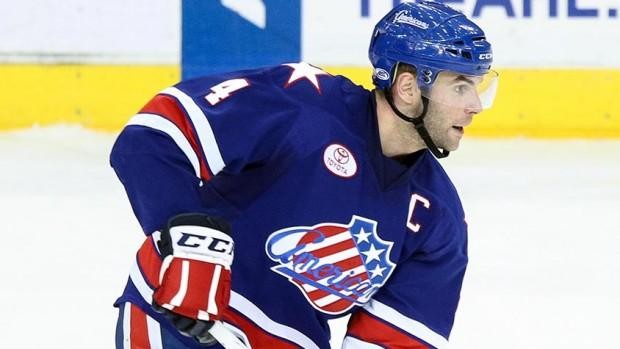
With the dog days of summer setting in, American Hockey League training camps are set to open in only a matter of weeks. For Rochester Americans captain and veteran defenseman Drew Bagnall, this offseason has been a productive, yet demanding journey.
A mid-March shoulder surgery forced Bagnall to alter his training regiment from the outset, but he has since regained his strength and is back to the traditional routine he has utilized every off season.
“I’m finally at a point where I’m back training with the rest of my buddies that I normally train with in the summer, so it’s good,” said Bagnall. Typically now at this stage of the summer, over six days a week, two of those days are straight VO2 bike rounds, which are typically around 45 minutes to an hour on the bike. “Four days a week is weight training, and we skate three times a week and maintain that through the rest of the summer.”
The primary focus of his training is to increase and maintain power and explosiveness, as opposed to strength. “Strength isn’t the real question. It’s how do I get faster and first step quickness. It involves a lot of track work.”
Bagnall’s off-season training hasn’t changed much over the years, dating back to his early beginnings at St. Lawrence University, where he spent four seasons with the Saints Varsity Hockey program.
He credits his early development to St. Lawrence and the maturation process he underwent, not only as a player but also as a person, during his time there. “I think with the college route you go in as a boy and come out as a man,” explained Bagnall. “St. Lawrence has a storied history and it’s been around for a long time. We had a coach, who players loved and he demanded that you compete everyday and that’s all he really cared about. We didn’t focus too much on individual skills and team systems. It was hard work. It was putting in what he called the man-hours and foot power. That’s really what I left there with was just a really strong work ethic.”
While in his senior year at St. Lawrence, on a highly successful team that finished first in the ECAC before losing to Boston College in the NCAA Regional Semi-Finals, Bagnall was nominated for the Hobey Baker Award, awarded to the NCAA most outstanding player.
“I think my praise probably should have just been team-praised. That being said, I’m just flattered to get it. I remember watching at the NCAA Tournament, they had clips of all the finalists, these guys scoring pretty goals and I was blocking shots and making hits.”
Fast forward nearly seven years and Bagnall is still highly regarded for his ability to provide a physical and stabilizing presence on the back end.
Prior to signing with the Los Angeles Kings at the conclusion of his college career, Bagnall came close to signing with the Minnesota Wild. However, he viewed the Kings as a better opportunity to crack the depth chart, who at the time in 2007-08, was thin on the blueline. “No one has a crystal ball. You look at their depth chart and where you have the best shot. It wasn’t necessarily about money, it was where I could go and actually compete for a job. I signed with LA, however they added some veteran journeymen shortly thereafter to fill those holes.”
Despite moving on from the Kings, Bagnall has fond memories of his time spent with the Kings’ AHL affiliate Manchester Monarchs. “It was an awesome experience in Manchester. It was just a team of a lot of first year guys. We had Teddy Purcell, Brian Boyle, Joe Piskula. I lived with Kevin Westgarth. Jonathan Quick was down there with us. We had all of these guys before they were absolute studs.”
Bagnall witnessed the Kings foundation being built before they achieved their current success of two Stanley Cups (2012, 2014) in three years. “The Kings were all about development and now they’re reaping the rewards. We had a really good environment to be a young pro. We all grew up together and it was awesome. I have very fond memories of my three years in Manchester.”
Another memory Bagnall with never forget is his first NHL call up with the Minnesota Wild. While most players don’t have the opportunity to suit up for their first NHL game in their hometown in front of family and friends, Bagnall was fortunate to live out a childhood dream, playing against the Edmonton Oilers at Rexall Place.
“It was unbelievable. It was my fourth year pro. I signed with Minnesota that summer and had a good training camp. I was the last guy assigned to Houston. I got a call from our General Manager in Houston, Jim Mill, and he said ‘you need to get on a flight. Flight leaves in two hours. You’re going up to Edmonton and you’re playing there tomorrow night.’ So, I went to the airport trying to make my flight which is an hour and a bit in good traffic from where we lived there and he had called me basically in rush hour. I got there 20 minutes before my flight left. They must have held it for me and rushed me through the security lines. The whole time I’m trying to call my family so they can make arrangements to see my first game.
Bagnall, who turns 31 in October, played two games for Minnesota that season registering 4 penalty minutes. Throughout his career he has thrived in high pressure situations and embraced leadership opportunities where his teammates rely on him for guidance.
“I think I’ve always been a team leader wther it’s being vocal or leading by example. I’ve never had the skillset to be elite. I’ve always had to bridge the gap with work ethic and do the ugly stuff that no one wants to do. I was in a leadership position in college and in junior as well, but then once you get into pro there are guys that have been with the team or have played pro for ten years. It’s their room and their job to manage it.”
He dealt with adversity in his first opportunity as a captain, but he credits that towards making him a better person the next time he wore the ‘C’ on his chest. “That’s what I struggled with (as a captain) in Manchester. I cared so much about what everyone else was doing and how well this team was doing that I didn’t focus enough on my individual game. That’s what I learned my from first stint of being a captain in pro.”
Bagnall looks forward to working with teammates and assisting young defenseman in the Sabres organization with Rochester in their eventual transition to the NHL. He acknowledges that not only as a captain, but also as an experienced veteran in the league, it is his duty to provide guidance for the next wave of talent. “If I want to be playing in the American League as a captain, I have to make everyone better and play on successful teams. No one wants a leader who’s not a winner. My job is to make players better. Everyone values the fact that you’re in the development of tomorrows NHL players. It’s fun for me and also maybe a way for me to stay in the game.”
Buffalo Sabres prospect and former eighth overall pick, Rasmus Ristolainen, mentored under Bagnall last season, who relied on the veteran for advice to develop his game and learn how to carry himself as a professional off the ice. “To be able to teach a young guy like Rasmus Ristolainen what I have learned throughout my career to date I think is a huge advantage for him and part of the development process. I just try to tell him, with your skillset, when you get called up to the NHL, you never come back. You can easily do that but you have to put in the time now. He was a great student in the sense that he really wanted to improve.”
At the end of the day, no matter where the next few years take him, Bagnall is extremely fortunate for the opportunity to play hockey for a living and it has taught him important values as a person. “The opportunity to be able to do something that you love is awesome. I want other people to have the experiences that I have through hockey and become better players.”