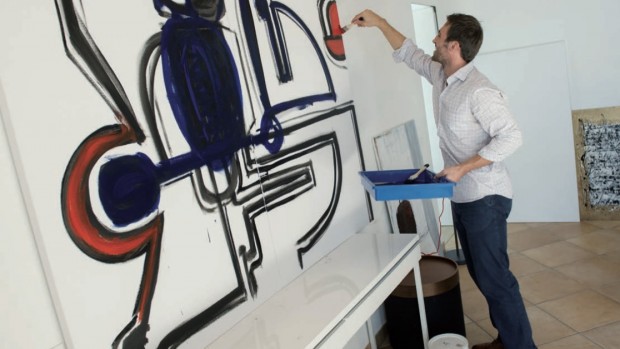
Discovering a new passion after a long career in professional hockey can be a daunting challenge for players. For some though, the fortunate presence of other passions beyond the sport eases their transition into life after hockey. Former professional hockey player, Eric Walsky, discovered solace in the world of art and painting, guiding his transition into retirement and opening the door to an entirely new career path. As Walsky navigates this new journey, he demonstrates that hard work, dedication, and passion can create endless possibilities for a post hockey career.
Growing up in Anchorage, Alaska, Walsky demonstrated exceptional talent in hockey from a young age. While his family didn’t fit the mold of a typical hockey-loving household, Walsky quickly discovered his passion for the sport through community members and neighbors inviting him to play on frozen lakes and outdoor rinks. In 2003, Walsky’s talent began to shine through as he clinched the coveted title of State Player of the Year while representing East Anchorage High School.” 
“I lived my days on the frozen lakes and at local outdoor rinks and hockey became a passion really quickly,”recounted Walsky. “I was lucky enough to grow up with some really great players, many of whom made it to the NHL. There was such a great culture around the sport growing up in Alaska.”
Though Walsky’s parents did not foster his interest in hockey, they played a crucial role in shaping his trajectory toward a career in the arts. His Swiss-native mother brought a wealth of European artistic traditions into the family, while his father, a dedicated sculptor and contractor, became the primary catalyst for Walsky’s passion for the arts. Every summer Walsky actively worked in construction alongside his father, discovering a keen interest in hands-on craftsmanship.
“My father had a big yard and workshop which gave me the space to try anything I wanted. So from a young age, I was building furniture and then later that evolved into doing sculptures.”
Because hockey continued to be Walsky’s primary passion, his artistic pursuits took a backseat when he relocated to Omaha, Nebraska in 2003, to embark on his hockey career, representing the River City Lancers in the United States Hockey League (USHL). Chasing a professional career, he knew he needed to transition away from minor hockey in Alaska to a higher level of competition. Although he notched 25 points in 45 games that season, it became apparent that Omaha wasn’t the ideal fit for him. As a result, Walsky made the decision to return home and play for the University of Alaska-Anchorage.
“I decided to commit to Anchorage because, at that time, everything seemed to be lined up to revive the program,” said Walsky. “They had some really great players, I really liked the coach, and I thought it would be special to come home and help build up the university’s hockey team.”
Following two years at Alaska-Anchorage, Walsky faced a challenging choice, opting to transfer to Colorado College with the hope that it would enhance his path to a future professional hockey career. Despite having to redshirt a year due to eligibility rules, Walsky’s choice proved to be a wise one. In his senior season at Colorado College, he came into his own, finishing second in team scoring with an impressive 12 goals and 24 assists for 36 points in 38 games.
“I knew if I stayed one more year it would have been a dead end for me. I felt the window of opportunity closing and all the things that I hoped for seemed like they were moving backwards,” recounted Walsky when asked about his decision to leave Alaska Anchorage. “Signing a professional contract was my main objective and I was really motivated to make that step.”
While at Colorado College, Walsky rediscovered his passion for the arts. His aunt, a painter residing in Colorado Springs, provided him with a studio space to practice painting during his free time. It was there that Walsky ignited his love for the art of painting. From that point onward, he made a conscious decision to pursue painting alongside his hockey career, aiming to hone his skills to a level where his art could be showcased to the public.
“Although I always loved painting, I had never really given it a try. I remember starting during my free time, heading to her studio in the morning. That’s truly how my painting journey began. As I moved from place to place, painting became my constant. It was the easiest thing to carry with me, allowing me to create from anywhere. Whether it was in my apartment or any new location, I always made sure to set up a small studio so that I could continue doing it.”
On March 20th, 2009, days after his last game with Colorado College, Walsky signed an NHL contract with the Vancouver Canucks, and began his professional career with the Canucks’ American Hockey League (AHL) affiliate at the time, the Manitoba Moose, at the conclusion of the 2008-09 season. “I remember my last game with Colorado College, we got upset by Michigan State. I think it was that night or the next day that I signed with Vancouver. I was just so excited,” said Walsky, joyfully reminiscing on the moment. “There were one or two other teams very interested, but Vancouver just felt like it was going to be the right fit.”
Embarking on his professional career with the Manitoba Moose, Walsky openly acknowledges the challenging transition he faced. Not knowing what to expect, he grappled with finding his way in the world of professional hockey. As someone accustomed to consistently holding a prominent role on the top two lines of teams, Walsky struggled with the reality that his professional career would be marked by a series of highs and lows.
“In so many ways, I didn’t know what it meant to be a professional. If you are not producing, you’re not necessarily doing your job. On an internal level too, your relationship with the game changes a lot when it becomes your job.” said Walsky, reflecting on his time in Manitoba.

Following a season in the AHL with Manitoba, which also included a brief stint in the ECHL with the Victoria Salmon Kings, Walsky was offered a three-year contract with Genève-Servette in the Swiss National League. As a Swiss-American dual citizen with Swiss heritage from his mother, his choice to play overseas seemed like a natural fit. “Playing in Switzerland was never really on my radar as I was so fixated on making it to the NHL. But eventually, given my age, it became a pragmatic decision to sign with Geneva.”

Walsky’s career unfolded with seven remarkable seasons in the Swiss National League, representing Genève-Servette HC, HC Lugano, and Lausanne HC. Despite struggling with various injuries during this time, he found success as a strong offensive player and embraced the lifestyle fostered by the less demanding European hockey schedule. His exceptional skating talent also played a pivotal role in his performance. “I was a really good skater, so I was able to take advantage of the space provided by the bigger ice surface.”
While playing professionally in Switzerland, Walsky continued his pursuit as a painter. After six years of navigating the challenges of the artistic process, he reached a level of proficiency that warranted sharing his work with the public. In 2013, Walsky organized a successful and fortuitous exhibition in Geneva, marking a turning point in his artistic career.
“After the exhibition in 2013, it was in my mind that painting was something that I really wanted to transition into after my playing career,” expressed Walsky. However, his strong determination to prolong his professional hockey career remained a focal point.
Walsky’s journey took a sharp turn at age 33 when a career-ending concussion forced him into retirement from professional hockey. The aftermath brought years of grappling with intense concussion symptoms and a struggle to find his personal identity beyond the game. However, in the amid these challenges, Walsky made a determined effort to reignite his love for painting.
“After the concussion, I was in really bad shape. I was suffering from a huge variety of symptoms. The one thing that I did was force myself to start painting again. And so I began painting and then started to work on a few more.”
When asked about one of his initial paintings named “Concussion” which features an image of a chair, Walsky discussed the connection between his hockey career and his artistic expression. “The painting called Concussion had a lot to do with isolation. Because with a concussion, none of your pain and suffering is visible,” he said.
While the painting serves as a reminder of a challenging period in his career, Walsky reflects that the act of creating it was therapeutic and empowering. It stands as a representation of enduring difficult times—something universal that everyone has experienced in their own way.

2018 – CONCUSSION
The chair serves as a representation of the isolation experienced during the throes of a concussion. It encapsulates a sense of confinement, similar to a metaphorical prison sentence. The markings at the top convey a narrative of someone counting the days, visually capturing the enduring struggle and the passage of time through this challenging situation. Meanwhile, from the bottom emerges a subtle depiction of rising fog, creating the impression of being gradually enveloped by a weight, evoking a sense of struggle and introspection.
Today, Walsky draws significant inspiration for his art from the ingenuity of man. He expressed his fascination with how man-kind constructs cities, shapes environments, and forms the physical world around us. The creation of objects and the establishment of our relationships with them serve as elements that drive his artistic vision.

“Architecture was a huge passion of mine inherited from my father, and I find it fascinating—our relationship with our physical space, the objects within it, and how we assess their value, if we value them,” said Walsky.
Following the conceptualization of his artistic vision, Walsky delves into the complexities of his creative process—a dynamic journey that propels his art forward until it seamlessly comes together as a final piece.
“I start with an idea which turns into a back and forth between what I want and what the painting is telling me. Operating outside of the logic of language I fix the puzzle of problems the painting presents. Mostly failing throughout, but not hiding from the challenges I arrive at an honest result which is always different than I intended.”
Although Walsky fully immersed himself into his artistic journey after the conclusion of his hockey career, he acknowledges that pursuing painting did not mitigate the void resulting from the absence of hockey. The lack of hockey in his life created a vacuum, altering his relationship with art, which had always been counterbalanced by his love for the sport. “It took a lot of time to redefine my relationship with art without hockey.”

For Walsky, a big part of redefining this relationship was re-introducing hockey into his life, this time as a coach. Over the past few years, he has embarked on a new journey, taking on diverse coaching roles around Switzerland, including coaching the Under-18 Swiss National Team. Currently, he holds the position of a skills coach for Geneve-Servette, the very team he once played for in the Swiss National League.
“I have now found this great balance. This is the first role where I really feel at home working with the professional guys,” said Walsky. “My biggest motivation is to get guys to fall in love with the game again. After being a professional for a long time, the daily routine can become monotonous, with many highs and lows. It’s easy to lose touch with your love for the sport. If there’s 30 minutes a day where you’re happy on the ice, it can act as a spark for the guys, reviving their love for the sport and maybe even prompting them to want to get better and extend their careers. It can have a significant impact, and I’ve really been enjoying it so far.”

When prompted to reflect on his transition from professional hockey to art and coaching, and to offer advice to athletes venturing into new passions or post-playing careers, Walsky emphasizes the significance of being prepared. He underscores the importance of being mentally prepared for the challenges associated with the void left by the absence of the sport. “If you have another passion, take the risk to follow it. Be patient with the void created by the absence of hockey and all that it entails. It takes time to fill that void again. However, do not passively expect it to resolve itself, broaden your horizons and try to experience as much as you can. There is a lot of value in trying and experiencing things we normally would not.”
Walsky has found a home in Montreux, Switzerland, a small-town near Geneva, where he resides with his wife and two sons. After a long journey, Walsky has now found the perfect balance, being able to commit significant time to his art while still being involved in the game of hockey. His artistic endeavors have also expanded beyond painting to include sculpting as well as the design and construction of furniture. He is now taking the next step of getting his art out to the public through art exhibitions and social media platforms and encourages anyone to
visit his official website at https://www.ericwalsky.com/ and follow him on Instagram at https://www.instagram.com/eric.walsky/.