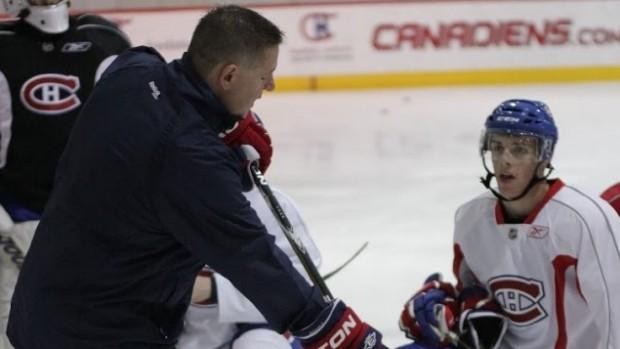
This is a two-part series on long-time NHL Shooting and Skills Coach Tim Turk. In part one, Tim shed light on his beginnings in hockey, his development and growth as a shooting coach, the services he offers to help improve a player’s skill set at any level, and his road to the National Hockey League.
Part-two of our sit down with Tim Turk looks at the technical side of shooting, including tracking and measuring progress, creating power in a shot, advice on selecting the proper stick and gloves, and what it’s like to work with P.K. Subban of the Montreal Canadiens.
For more information on Tim, visit www.timturkhockey.com.
To read Part I Click Here
Part 2
Tracking and Measuring Progress
“To track and measure progress of students, I use an application called the Coaches Eye. It allows a coach like me who does technical training to take a video of a player doing an action. It provides different focal points, super slow motion replays, spot lights, and angle tools. For example, with someone who is very compact, when you try to push power to a side, your spine starts to turn a little bit. As your spine starts to turn, the harder it is to generate power in your shot. What we try to do is keep the spine as straight as possible and get your shoulders to bend a little so you can torque your body with more power to create downward pressure. That would keep you in an uncompromised, balanced, and ready position for you to react faster and have more power and strength in your shot while being able to release the puck quicker.”
Creating Power in the Shot:
“The only way to enhance power in your shot is to get downward pressure through the puck. This means when you shoot you are kind of pushing down and flexing your stick to make it bend as you are taking your shot. For example, if you are a lefty, your bottom hand is your left hand. That is where the power comes from. You want to make sure your elbow locks in a downward trajectory. A lot of guys will shoot and their elbow will unlock causing the puck to not get the proper spin.”
Ability to Shoot While Stick Handling
“A lot of players feel that if their lower body (legs and feet) is doing a certain action then the upper body has to be doing the same action. That is the furthest thing from the truth. If you separate lower body from upper body it doesn’t matter what the body does, the top can do anything while the feet are moving. For shooting while stickhandling, players need to get used to the timing of what their feet are doing to be more deceptive in their action and their moves. So instead of lifting the foot off the ice to take a shot, we try to get the player to shoot the puck as the stride is going. We are synchronizing that motion and deceiving the goalie because the shot is happening while the player is taking their stride.”
Importance of Adding Different Body Configurations While Shooting in a Variety of Situations
“There are 10 different ways to shoot a puck because your feet can do so many different things while you are in motion. There is a reason goalies develop a book on shooters. For example, if you stop your feet from moving, take a shot and then start them again, that is telegraphing to the goalie that something is going to happen. Or when you are skating and you lift the foot up and take your shot then put your foot back down. These are tendencies that can be picked up by observers and make your shot predictable. We tell players, as soon as your foot comes up start shooting the puck right away and get the foot down before the puck hits the target. That way you have reaction time going forward. Then there is adding different types of body configuration to all the different types shots which is what helps you deceive the goalie.
Some of the problems with players is that they are doing the same things over and over. This is because it is their comfort zone. Again, goalies can pick up on this. That is what the films do as well. You can shoot the puck with the same type of shot five different ways but if you don’t have the ability to change configurations or you don’t know that there are other ways to shoot a puck because that’s the way you have been doing it so long and it feels natural and comfortable; then you make yourself predictable. That is why my service is in such high in demand because I am showing players, management, and coaches that there are different ways to shoot pucks. The only way to get better though is through practice and repetition.”
Advice for Where to Position your Stick When You Skate
“Regardless of the level you are playing, I try and challenge players to think about having one thought process. If you are a righty, keep the stick at 2:00 o’clock instead of between 12 and 1. If you are a lefty, try and keep it at 10 o’clock instead of 11 and 12. It works if you have a purpose when you are training and you can think about it, but you have to understand that when you are forced and pressured into situations and you have to change direction, sometimes it doesn’t stay where you want and you revert back to your comfort level which is OK too. It’s all about repetition and consistency.”
Fundamentals of Choosing a Stick
“When it comes to choosing a stick, the stick has to be an extension of your body. When you are releasing a puck, you shouldn’t have to force it to spin really tight. The action and the timing that you have in your wrist shot or your snap shot really dictates what the puck should do. However, if the flex is off or the angle of the lie is off, if curvature pattern in the pocket of the curve doesn’t support the type of timing that your shot requires, it can affect your shot. Maybe your wrists open up really quickly in the beginning of your pushing motion, while for some players their wrists open up at the end of their shooting motion and the puck goes over the blade quicker. That would mean the stick would need more blade for the puck to travel on for that kind of shooter because that speed in their wrist gets the puck to go over their blade and it doesn’t spin properly. The stick has to match the person.
Firstly, the rule of thumb I have is for the height of the stick with the person’s skates on should be somewhere between their bottom lip and bridge of the nose. Secondly, each individual, no matter what their age is, needs to be able to bend the stick at least one inch. I tell people the number of the flex is related to the pounds of pressure they can exert on the stick to make it move that amount of space. So if the stick is a 60 flex for a 12-year old and that kid can flex the stick easily one inch then they can easily put 60 pounds of pressure into that shaft. If they bend it two inches or three inches they are doubling or tripling the pounds of pressure into the stick respectively. Three inch flex is really good, because that is where the kick points of the stick are engaged. Choosing a stick is also technical depending on variables like how the shooter moves their wrist or how much strength they have. Getting the right stick is vitally important. I also believe in getting the highest lie possible. The reason I say that is because it brings the puck closer to the body. The closer it is the more power you can generate when you are shooting and you can get the puck off quicker. It brings me back to ‘everything in hockey ends in a shot.’ So make your stick the best possible tool to shoot better, and worry about control and reach or your protection afterwards.”
Tip for Choosing Gloves
“Most gloves only have two sets of knuckles which could fatigue the player’s hands and restrict the player when they need to open their hand when they are getting ready to shoot for instance. A secret I have is to get gloves with three sets of knuckles. This helps with range of motion, causing less fatigue and creates a better feel for the puck.”
Working with PK. Subban. You Will Be Able to See Tim Turks Work When you Watch Subban on TV.
“When I first met PK Subban in 2007 or 2008, he was using a stick that was in the middle of his chest. One of the things I needed to do to develop his shot into the one he has today (and that he still enhances) is to get that stick extended. Now it has been almost seven years, his stick has gone from middle of the chest to about his forehead. We are talking almost a full 10 or 12 inches he has added in a seven year period. That is like enhancing it a couple millimeters at a time so it’s not making him feel uncomfortable. Making minor changes to the curve or the pocket he had, giving him a huge heel curve that opened up at the toe of the blade so he could quickly get it up when he needed to.
We also worked on the power side of his shot and the timing of his one timer. When he loaded up his arm and he took it back to wind up, his arm was kind of bent in the elbow. If you can visualize, his elbow was bent in that wound up loaded ready to shoot situation. What I mentioned for him to do and if you watch him play now, you will see that he tries to get that arm as straight as possible when he is loading for the heavy shot. It works like a pendulum. So when you load up to execute a slap shot or a one timer, keep your elbow completely locked and your arm completely straight. That way you generate the most power and velocity. After hitting the puck in your follow through, keep the elbow locked and the follow through goes a little bit to the target afterwards. That is one thing that Subban did really well and it looks like it is working.”
Explaining Technique behind Followthrough of the Shot
“If I am pointing my stick to my target after my shot, then the stick is pointing one way but my power side of my body would end up across my body jeopardizing spin and power of my shot. Instead, I like to adjust my arm to the target so that my blade is still facing the target, but this way the spin process of the shot is unaffected in the follow through. The only way to get as close to the target as possible is being able to find your target. You have to keep your head up and see it to find it.”
Strengthening Muscles in Forearm and Wrist to Help with Stronger Shot
“One thing I have players do all the time even at the NHL level is work on strengthening their forearm muscles to support and help develop quick strong movements with their wrist. There are many drills for this such as planks and reaching out quickly in twitching motions to grab something like a ball, the wrist role up device among other methods.”
Working with Lance Bouma of the Calgary Flames
“One of biggest success stories in my teaching career as of late is working with Lance Bouma of the Calgary Flames. He had been more or less type casted as a third or fourth line grinder kind of guy who always gets a lot of hits and blocks more shots himself than the entire opposing team has. Lance has tremendous drive and passion to improve his skills and overcome the label that has been placed on him. He relentlessly works on improving his game and has enormous work ethic. He was one of those players that had that one foot release in his shot. He was standing up and losing power in what I thought could be a more powerful shot. I went up to him, and I remember the year prior, in a full season he had only 5 goals. We worked on a whole bunch of different things. One was that release with the stride foot back. As he released his shot, I was asking him to make sure he pushed his left leg back as he was shooting the puck, keeping his posture low. The more distance he got with his legs apart on the ice, the lower he got to his center of gravity which created power in his release. He practiced and practiced and it was hard for him to do at first but he worked on it a lot the whole week I was with him. Later I came back and revisited Lance towards the end of the summer and gave him some homework. Lance has had tremendous success since then and finished the season with 16 goals. The unique thing was he was a 4 to 7 minute per game player and a fourth liner. Then he elevated himself to the second line and was playing upwards of 18 minutes a game and scored those 16 goals. It is a really nice story and a player like that deserves that success for many reasons. One of the main reasons was that he paid attention to detail and he wanted to get better and took the challenge of getting 5 extra goals by doing a lot more shooting instead of passing or grinding to the corner to try to sweep it to the net. Instead he took the shot and shot it really well and for that matter made me look really good. I will never forget this success story.”
Working with Veteran Players
“The stage those guys are at in their career requires only minor adjustments. It’s not a big change. Sometimes its just a matter of saying ‘your technique is really good but I think there might be some sort of discrepancy in your stick’. That could be changing the lie by a quarter of a degree or one tenth of a degree in the lie area or opening up or changing the blade of the stick. Sometimes, maybe it even isn’t their stick maybe it is their gloves. Sometimes taking out a little of the extra padding or maybe make the palm of the glove a little thinner so they can feel the vibrations from the puck a little more. Sometimes the smallest change can have the biggest difference and sometimes it is trial and error to find the right feel. I have the ability to observe, assess, and dissect what the motions are in the shooting process. I have done it for so long that for someone like me I can make those assessments and recommend possible changes that are needed. For the regular person it is a trail by error.”
Importance and Special Focus on AHL and ECHL Players
“Whenever I work with an NHL team, the main focus is at the prospect level in helping those players either develop or redevelop or enhance. The goal is to help their prospects advance to the NHL. It brings me back to being in Montreal for seven years and having certain players at the American League level go through what we are doing now. It is not just shooting alone, it is a combination of having a skating coach that trusts what the shooting coach is doing and vice versa. That way we can combine what our thought processes are, and enhance certain players and what their needs are based on what the management team was asking for. Are they a fourth line player that will drop their mitts or are they a second or first line player that needs to get their shot off quickly to score more? Or do we need to enhance their skating to become more explosive. There is big communication that must go on but I think that my success has been rated and has been seen at the prospect level in helping those players develop and improve. A few of the players that come to mind are PK Subban, David Desharnais, and Brendan Gallagher who we I worked with during their time in Hamilton who are now performing well with Montreal at the NHL level.”
Online Service to Help Everyone Shoot Better and Have More Fun
“As mentioned earlier, I provide an online training course which can be found at www.turkssnipers.com. By watching the step by step in depth videos, it will help any player enhance their technique. The lessons work on a monthly basis and consist of techniques separated into components and by the end of module you will have the technique down if you practice and do the actions 50-100 times every second day. There is the option where you can write emails to me and your questions will be answered. You can make suggestions or recommendations of what you want to learn and I can shoot a video to teach that skill and put it up on the website for everyone.”
Conclusion
Tim Turk has a lot to offer from even the most veteran NHLer to young players all around the world. Regardless of age or skill level, any player working with Tim will receive the necessary technical training and hands on approach to improve their game. Tim is an expert in his field and his experience and credentials speak for themselves. More importantly, Tim is a great teacher with a deep love for the game. His mission is to positively impact as many players as he can towards the ultimate goal of having more fun playing hockey. That feeling of the perfect pass, or rocket of a shot is something all players relish. Tim Turk has dedicated his life to helping players enjoy more of those experiences. He also teaches players what it takes to push and challenge themselves to pursue a goal, as we saw with Lance Bouma example. Everyone has that potential in themselves.