Every team and dressing room needs it. Only certain players can ever bring it. You can’t win without it.
Heart and Soul.
Eric Neilson is all heart and soul.
Neilson’s unique journey in the game of hockey could be written as a Hollywood script. When it comes to Eric Neilson nothing is scripted, he speaks from the heart.
From humble beginnings in the game to a twelve-year professional career, Neilson’s passion and love for the game of hockey and the role he played within it is truly one of a kind.
Neilson will be returning as a celebrity guest at this year’s Maritime NHLer’s For Kids event on July 25-26 at Digby Pines Golf Resort and Spa in Nova Scotia. The Maritime NHLer’s For Kids, helps remove the financial barriers preventing young boys and girls from playing minor hockey in NS, NB and PEI.
The Foundation Years
Family was Eric Neilson’s foundation, it still is.
Neilson’s father Kevin, owned a ventilation and heating company for thirty years, while his mother Joyce was a nurse for almost four decades. “There was no forty-hour work weeks with Dad, you worked until the job got done,” Neilson said proudly.
“I started working with him when I was thirteen and still remember eating sandwiches and hanging duct work at the same time. Dad was a very hard worker, he always supported us, he taught me that you had to work hard, but to also have fun when the work gets done,” Neilson said.
Neilson learned right away what life was like having a mother as a nurse. “There wasn’t too many sick days from school with mom,” joked Neilson. “She taught me kindness, how to be polite and how to treat others with respect and the way I would wanted to be treated,” Neilson added.
Given Neilson’s future role in the game of hockey, his mother not only was a pillar of strength, but also became his personal nurse. “She was great for all the injuries, bumps and bruises, especially given my role,” Neilson said.
From tireless unwavering support to the power of prayer, Neilson’s family was always there by his side. “Mom said a lot of prayers, especially right before a fight, she didn’t like that part of the game, she never watched,” admitted Neilson.
“She would just look at Dad to see if I did ok or not by his reaction.”
Neilson’s younger sister Stephanie was also very supportive throughout his career and the two share a very close bond and relationship to this day. However, she could be directly responsible for limiting Neilson’s offensive output. “Stephanie was a goaltender for UNB, and a pretty good one at that,” explained Neilson.
“She would crush my confidence every summer when I would shoot on her, maybe that’s why I never scored too many goals,” said the long time supporter and celebrity guest of the Maritime NHLer’s For Kids.
Eric Neilson’s journey in the game of hockey as a hard-nosed honest enforcer and energy player has it roots firmly embedded in the life lessons he learned from his family in small town New Brunswick.
The Twenty-Minute Drive
The lessons learned on the rural routes through Western New Brunswick would ultimately shape Eric Neilson’s journey in the game. “My cousin Clay Harrison was one of my childhood heroes, he was ten years older than me and he used to drive me to practice because my dad would be working,” Neilson said.
“Clay would come on the ice and help out at practice as well, he was my idol.”
“Clay always put a Gatorade or a juice in the dash of the truck, so five minutes into the drive home after practice, he would say; ‘So Eric do you think you worked hard enough at practice today to deserve that drink?’
“Obviously, I was dying of thirst, and would always say yes,” joked Neilson.
“Clay was always the judge to see if I deserved a drink, and there would be times where I thought I was working hard, but I wasn’t, Clay would always explain that to me,” recalled Neilson.
The quiet conversations between cousins would always revolve around work ethic and it’s value in the game.
Sometimes those drinks wouldn’t be consumed until Neilson walked through the front door. “If you work hard you get rewarded, I think those drives home instilled that attitude in me,” Neilson said.
The Journey
Eric Neilson’s introduction to the game of hockey resembled that of any other young Canadian’s early experiences, minus the unique bond he shared with his elder cousin.
From the road trips to mini sticks, Neilson has very fond memories of his foray into competitive hockey. “My fondest memories are the tournaments, my mom, dad and my sister would all make a trip out of it. Staying in hotels, swimming in the pool all day, playing three games in one day, and still being able to run around the hotel at night and creating chaos, that’s what I remember, I just have so many of those stories,” explained Neilson.
Neilson’s love affair with the game and his workman’s mentality was a match made in heaven. The skilled feisty forwards ascension through the ranks of competitive hockey was definitely noteworthy.
Passion, dedication and drive to be the absolute best player he could be fuelled Neilson’s minor hockey life. At that time he wanted to test his limits as a player and he would find himself playing for a coach and mentor at the Midget AAA level that would change is life.
“Kevin Pottle was the one that took a ‘rough around the edges’ kid who didn’t really know what their strengths were, and put me in situations where I would flourish as a first year player,” Neilson said.
Pottle prepared Neilson for the jump to the next level. “I owe a lot to Kevin, I have the utmost respect for him,” Neilson added.
Eric Bissonette also played a critical role reinforcing what Neilson had already learned on the sometimes-parched drives home. “Bizz was the only one in Fredericton at the time that did off ice fitness for hockey players. He took me under his wing and really showed me hard work, dedication and commitment in his own way,” Neilson said.
“He really helped and guided me in the early stages from fourteen to sixteen years old,” Neilson said.
The Rimouski Oceanic selected Neilson in the 7th Round 99th overall 2001.
The Next Level
Dreams do come true!
Did Eric Neilson ever think that he would get to the major junior level and have that much success over a four-year career with the Rimouski Oceanic?
“To be honest, I did,” Neilson said confidently.
“You have to believe it at a young age. It has a lot to do with the mental part of the game,” suggested Neilson.
“If you don’t think you belong there and if you think in your head that you aren’t good enough, set a goal, stick to it, and accomplish it. If you can’t do that, I think you are just wasting your time in anything, not just hockey,” stressed Neilson.
“I was fortunate enough to get that early,” said the four-year veteran of the QMJHL.
Neilson would arrive in Rimouski for his first “Q” camp with a chip on his shoulder and something to prove.
Never one to shy away or back down from a challenge, the young Maritimer knew exactly what was in store for him.
First Impressions and French Lessons
Long before Eric Neilson solidified himself as an regular energy player and enforcer in the Oceanic line up, Neilson had to break through the language barrier to ensure he left a good first impression with Rimouski’s brass and coaching staff.
Long-time Rimouski Oceanic Scout Rick Melanson told Neilson that he had to be willing to fight if he wanted to crack the Oceanic roster. “I had never gotten into a fight in my life before that time, on or off the ice,” recalled Neilson.
“I was a physical guy and I always finished my checks, I hit everything that moved,” Neilson said.
“I’ll never forget that first fight.”
“I couldn’t speak a word of French and he couldn’t speak a word of English,” Neilson said of his first ever combatant.
Neilson would pick the biggest guy on the ice and square off against him in the first intersquad game in front of three hundred Oceanic faithful. “I asked one of my French buddies up there how do I ask him if he wants to fight.”
“All I heard in return was something about batte, so I said, “vous batte”, he looked at me with a confused look on his face, so I shook my gloves and away we went,” laughed Neilson .
“I blacked out and just started swinging for the fences, the next thing I know, I’m in the penalty box and the three hundred fans that were there were standing up cheering, hooping and hollering at me.”
“I had this huge adrenal rush and a feeling all over my body while sitting in the box, I just remember saying wow, this is amazing,” explained Neilson.
“It kind stuck from there, I got that feeling and I kept doing it.”
“So that was my first one,” Neilson said.
Eric Neilson had accomplished his dream of playing in the QMJHL. The young gritty energetic forward from small town New Brunswick realized that he would have to keeping fighting to stay at that level in more ways than one.
Fulfilling the Role
Eric Neilson credits Oceanic Asst. Coach Donald Dufresne for keeping him on the tracks. “Donald won a Cup with Montreal, he was a 5th or 6th D-man,” said Neilson.
“He wasn’t the most skilled type player, but he was always the hardest working guy and the best shaped guy in Camp,” Neilson said of his former coach.
“He kept saying that hard work will pay off, to stick with it and believe in it,” Neilson explained.
Another Oceanic Coach was instrumental in Neilson’s progression and development as a player at the junior level and beyond was current Ottawa Senators Head Coach Guy Boucher. “Guy was another guy that really helped me. We would be watching VHS tapes of me fighting at eighteen years old, under the stands in a 4X6 office, at the then un-renovated Colisee de Rimouski.”
“You couldn’t stand up in there or you would hit your head on the stands,” explained Neilson.
Over and over again, Boucher and Neilson would rewind the VHS tapes in efforts to improve every aspect of the young inexperienced fighters craft. “He would stop the tape and say watch this left or right, and watch your feet here,” Neilson remembered.
“Guy wasn’t a tough guy in the NHL or never was a fighter, but he worked with me and studied the game and players. He instilled in my head that we can do this and that we just have to put the work in and you can accomplish some great things,” said Neilson.
Serve and Protect
Neilson embraced his role; he was a glue guy, all heart and soul, always looking out for his teammates, never backing down. “I knew all the heavyweights and who the tough guys were, I had fought them all,” Neilson said.
“It’s one of those things again when I look back on it now, it’s insane,” Neilson said about his role in the junior ranks.
“I was a teenage boy fighting and playing hockey, I was preparing for fights not hockey games,” admitted Neilson.
“I wasn’t thinking about being F1 on the fore check or where do I have to be in the D-Zone, I’m thinking, do I have to throw left or a right.”
“I was visualizing fights, not the game. Above and beyond that you better not get scored on as a fourth line guy in major junior hockey, you are going to be sitting on the bench,” Neilson said.
Neilson definitely had a knack for throwing the knuckles, but it was another former coach of the Oceanic that taught him the most important lesson of all. “Doris Labonte, came to me and said; ‘Neiler your job is tough, its hard, but he said a player that does it really well is like a police officer with his gun in his holster,’” Neilson remembered.
“Labonte went on to say ‘the police officer wears his gun on his belt so everyone knows that he is willing and able to use it, but he doesn’t always necessarily have to use it to be a really good police officer.’
Neilson realized that he had to continue to play with energy, physicality and toughness, but he didn’t have to initiate that aspect of the game every night. “I had to make sure my players were safe and that things were going well on the ice and guys weren’t being taken advantage of,” Neilson added.
“When you are living it, and in the moment you don’t realize what was going on, but looking back on it now your like, holy shit, that was a pretty tough job to do on a night in night out basis,” confessed Neilson.
Little Brother
After two full seasons in QMJHL with Rimouski, Eric Neilson had thought he had seen it all. Before the start of the 2003-2004 season, the Oceanic front office asked the veteran forward if he was willing to live with and mentor a talented Maritime kid from Cole Harbour.
“I had no idea who Sidney Crosby was at that time, I knew that he was suppose to be a great hockey player from Nova Scotia, and that he was suppose to be Drafted 1stoverall,” Neilson recalled.
“Right from the get go, he wasn’t anything special to me, he was a rookie and a Maritimer.”
“I was going to treat him like anybody else, and I wasn’t going to treat him any different,” stressed Neilson. The first night Crosby moved in with Neilson they talked for three hours. “We talked about everything like a bunch of teenage boys would,” remembered Neilson.
“We talked about girls, and hockey, everything really, but at the end of the conversation that night right before we went to bed, he looked at me and said; ‘I’m going to be best hockey player in the world.’”
“I looked at him and said ok, good luck man, I’m here to support you and help in anyway,” Neilson explained.
Neilson and Crosby’s friendship and bond runs deep to this very day. “I consider Sidney to be my little brother and part of my family,” confessed Neilson.
“The level of care for one another, it all stems from back to the days in Rimouski, when he was sixteen and I was nineteen,” Neilson added.
“I don’t treat him like a superstar hockey player, I still chirp him about people asking him for his autograph, it’s like why do they want your autograph,” joked Neilson.
“It’s just a really cool relationship.”
Neilson would spend his entire junior career with the Rimouski Oceanic, and finished his career on top winning the President Cup Championship as an overager in 2004-2005. He amassed 58 points in 229 career games and finished his tour in the QMJHL with 917 PIMS.
Neilson was selected by the Los Angeles Kings in 5th Round 143rd overall in the 2004 NHL Entry Draft.
From police officer to big brother, Eric Neilson wasn’t just a prototypical tough guy, he was a leader, a mentor and above all a great teammate.
He was all heart and soul.
Neilson’s junior career had come to an end, however the dream to play professional hockey was within reach.
The Pro Game
From Lincoln, New Brunswick to Rimouski, Quebec Eric Neilson always dreamed of playing professional hockey.
The enforcer’s dream came true in 2005-06 when he joined the Bakersfield Condors of the ECHL. The beloved enforcer and fan favourite would apply his craft in the East Coast Hockey League for three seasons before signing on with the Peoria Rivermen of the American Hockey League. “I fought guys that played the majority of the careers in the ECHL and guys that fought in the NHL as well, I can tell you right now the guys are a lot tougher when you get up to the three letter leagues,” Neilson stated.
“I think the transition from major junior to the ECHL and the west coast where typically guys weren’t has tough as the east coast teams, they all had three or four tough guys at that point,” Neilson said.
Neilson made the transition to the pro game look seamless, however it didn’t come without sacrifice, dedication and hard work. “It’s like anything you see kids going from the ECHL, AHL and NHL, you just adapt, you learn and you make mistakes and hopefully as a fighter its not as much as turning the puck over right or getting knocked out,” joked Neilson.
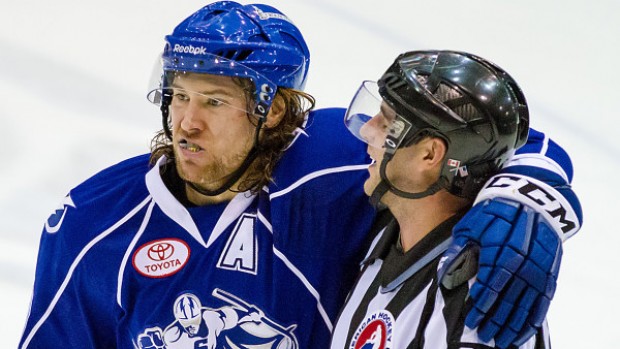
Neilson made the jump to the AHL in 2007-2008 and would spend the following eight seasons there. “You just have to adapt and change, you take it as you go,” Neilson said of making the jump to the American Hockey League.
“Sooner than later you make to the American league, unfortunately I didn’t make it to the NHL, but even the jump from the ECHL to the AHL was a big one.” (Photo Credit Syracuse Crunch)
“I don’t think you let yourself think about, oh these guys are bigger, tougher stronger, you know it, but you don’t address it, you just have to train and prepare that much harder knowing your competition is doing the same,” explained Neilson.
Neilson played 165 games in the ECHL amassing 18 pts. and 447 PIMs. Neilson totalled 253 career AHL games amassing 14 pts. and 772 PIMs. Neilson won the Calder Cup with Norfolk Admirals in 2011-12.
Neilson finished his career playing for the Manchester Storm of the EIHL in 2016-17. The hard working kid from Lincoln, New Brunswick would finish his professional career with 451 games spanning twelve seasons.
The Transition
What do you do when all you know is hockey?
After twelve professional seasons, Eric Neilson wasn’t entirely sure he was ready to hang up his skates and call it a career. “It was Canada Day week so I was thinking in my mind that ok, maybe this might be it,” said Neilson.
“My body wasn’t doing to great at that time, it wasn’t out of the question, I didn’t commit fully to hundred percent retiring.”
Neilson joined his family at their cottage in the northern part of New Brunswick for the long weekend. “I had mentioned it to my family at that time, that I was thinking about retiring and going on to chapter two, but I still had it in mind and I wasn’t totally convinced and I still had it my heart that I wanted to play professional hockey,” confessed Neilson.
The love and passion for the game was still in his heart and soul.
Then the unthinkable happened.
The Accident
Everything can change in a blink of an eye. “I get choked up just thinking about it now, obviously it was pretty emotional part of my life,” said Neilson of the accident.
Neilson was burning some brush, the pile exploded, Neilson sustained second-degree burns to both shins, burns to his hands, forearms and face.
His family had left earlier in the day and Neilson stayed behind, all alone he managed to use his cell phone and call for help. He was rushed to a near by hospital in Edmundston.
A short time after the accident a lot of former teammates reached out to check on their beloved friend. “I was talking back and forth with Daryl (AKA Sidney Crosby, a nickname that Neilson gave the young phenom back in their junior days, which #87 hated), just asking him how he was doing and everything, he was asking those little tiny questions to see how I was doing that everything was lined up,” said Neilson.
The Sunday following the accident Erik Tremblay (AKA “Tremmer”) a former Rimouski Oceanic teammate told Neilson he was making the eight-hour trek to see his teammate and friend. “Tremmer texted me saying he was right outside, so there I am laying in my hospital bed and I see “Tremmer” and his big face coming in and right behind him, Daryl.”
“It just goes to show what kind of person he is,” Neilson said of Crosby.
“He’s so busy, he has a schedule like a rock star, he’s non-stop on the go, but for him to take the time and fly up and even spend the afternoon with me when I was down and not in good shape, it really meant a lot to me,” said an emotional Neilson.
“I just go back to the friendship and bond we had back in Rimouski, I think that just speaks volumes for it.”
When a player is all heart and soul, everyone rallies around them. Neilson had always had their backs, on and off the ice, it was time for them to step up and be there for friend and former teammate.
The bonds shared amongst players and teammates in the game are truly awe-inspiring.
Neilson still didn’t know what was in store for him, hockey was his life. Thoughts of retirement quickly shifted to recovery.
With rehab and recovery, the potential return to professional hockey seemed highly unlikely. “The doctors told me that it would take about six months to a year to fully heal, that was the realization that my pro hockey career was over,” Neilson sadly admitted.
Neilson couldn’t leave the game he loved on his own terms, a thought that haunts many professional athletes. “If the fire never happened, I’m going to be back in the gym working out and training, maybe my body couldn’t have handled it, you can’t talk about the maybe’s,” Neilson added.
“The transition out of the game became a little easier, I hate to say it, but everything happens for a reason, God works in mysterious ways and maybe I needed a little more push towards retirement and your done, get on to chapter 2,” explained Neilson.
Chapter 2 and the Struggle
The 2nd chapter in any professional athletes career is usually one faced with uncertainty. “For any type of tough guy, team guy or enforcer to fulfill that role you get very emotionally attached to your players,” Neilson said.
“As that type of player you put your body on the line, so they feel comfortable and do their job, so you create this unspoken bond, attachment and relationship with your teammates,” a reflective Neilson said.
Neilson believes when enforcers are taken away from the game and can’t surround themselves with those relationships it definitely takes a toll on their psyche and mental health. “I’m not going to lie, I went through a hard time at the start of this year,” confessed the former tough guy.
Neilson realized he had to stay attached to the game in someway. The fiery competitor jumped on board with the St. Stephen Aces of the Maritime Hockey League, a Junior “A” circuit as an Asst. Coach this past season and recently was the Asst. Coach of the New Brunswick U-16 Selects at the QMJHL Gatorade Challenge in Blainville-Boisbriand.
“Being able to go to the rink every day and be involved in the game and have that aspect really helped me mentally through that transition,” confessed Neilson.
“I’m still going through it, I find myself missing it and going back and saying maybe I should, but honestly I think that takes time, I think it’s at a different rate for everybody,” admitted Neilson.
“I’m getting better and better every day and excepting it and moving on and digging deeper into chapter two,” said Neilson.
Even though the National Hockey League and the American Hockey League do have programs in place to help player’s transition into retirement. Neilson believes these programs need to be used more regularly by players and maybe some perimeters set around mandatory use so the player and team work on that process together.
“There is availability out there, even for me, I didn’t use it or accept it and I thought mentally, oh I’m good, I’m ok, that’s just for other people, you have to know it’s the real thing,” Neilson said.
“You have these thoughts, it’s how you control them, everyone deals with them differently, there is help and there are programs,” said Neilson.
“I don’t think that the players are using those programs to the full benefit of what they could be, it’s sad, it’s too bad.”
Neilson filled out a survey that he recently received in the mail from the PHPA the players union for the ECHL and AHL. The survey was another indicator that Neilson was struggling mentally with his own transition out of the game. “I wasn’t sure if it was my head, if it was mental or if I was depressed, or what was going on, I’m not really that type of person of what I was thinking,” Neilson confessed.
“After I filled that survey out, I accepted it, that yeah, I have had some concussions and blows to the head there was definitely something there, its not just me,” Neilson said.
Neilson understands that everyone is different with how they address their own mental health. “For me it’s that mental concept of staying positive and being a good person and doing the right things and treating others well,” Neilson said.
Neilson believes leagues and individual teams could do a better job reaching out to certain players, knowing the player and their past history with concussions and possibly making these programs mandatory for players to ensure they are going to be ok moving forward.
Giving Back
Eric Neilson has always given back to the game he loves. Throughout his American Hockey League career the enforcer was very active in every city in which he played.
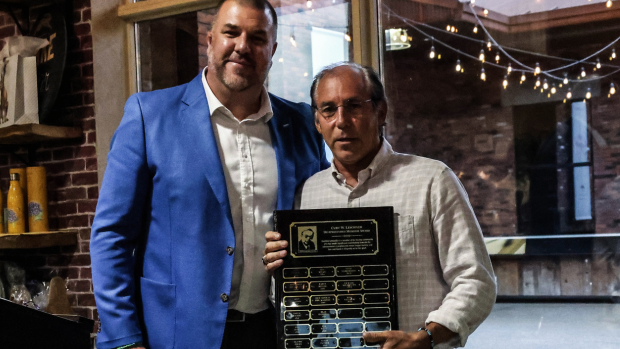
Neilson was nominated six consecutive years for the Yanick Dupre Memorial Award, which is given to the American League player who best exemplifies the spirit of community service. The Yanick Dupre Memorial Award is also known as the AHL’s Man of the Year Award, Neilson won the prestige award in 2014.
The 33 year-old understands that hockey will continue to be a part of his life and wants to give back to the game he loves, but his transition out of the game as a player still remains difficult. (Photo Credit AHL)
“Right now, Eric Neilson has to find out personally who he wants to be as a person after hockey, because this product that played in the AHL and in the minors so long and transitioning into the real world and taking the pros and cons and adjusting,” said a candid Neilson.
“The person I am in my heart will never change, but there are certain things that I have to clean up in my life, I want to be a better person, a better role model and leader,” Neilson stressed.
Neilson believes it’s very self-rewarding to work with young kids in the game, but still remains uncertain of what his calling maybe within the game. “I can’t see me staying away from the game and pursue something else, hockey was such a big part of my life, I still have so much passion and respect for the game,” Neilson said.
The Maritime NHLer’s For Kids holds a special place in Neilson’s heart. “Giving back to the kids and putting a smile on somebody’s face gives me so much joy,” said the former tough guy.
“I just had a blast at my first Maritime NHLer’s For Kids event. It’s the kids, the joy, excitement and energy they bring they just love it,” Neilson said.
“It was an incredible feeling to be there and being a part of that and just give back.”
“I was one of those kids from the Maritimes that had the dream to play in the NHL that didn’t come from a wealthy background, it really means a lot to me to be part of the organization,” Neilson concluded.
Neilson will be a part of an outstanding group of 34 Maritime celebrities from all aspects of the hockey world including past, present and future stars, all helping to remove the financial barriers preventing young boys and girls from playing minor hockey in NS, NB and PEI.