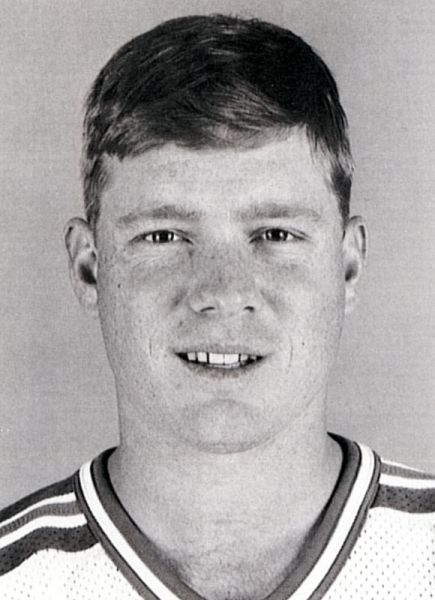
Truth be told, some professional hockey players experience an easier transition to a post hockey career than others. Then again, it may be a long journey filled with uncertainty for others. Former PHPA Member Jon Hillebrandt was part of the latter group. But after finding a new career path which he feels passionate about, he’s offering to help other current and former players who may be in the same boat through the PHPA Alumni Network.
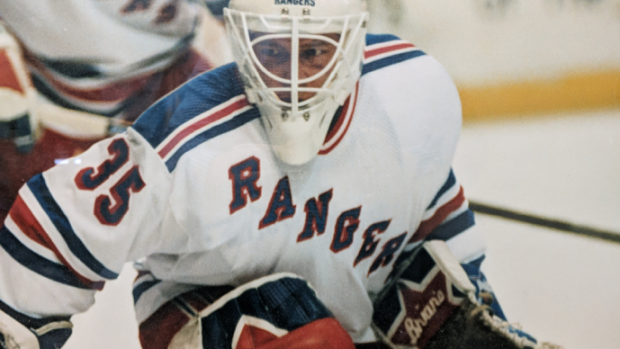
Hillebrandt experienced a rather unique journey throughout his hockey career and beyond. Although he was drafted by the New York Rangers in the 1990 NHL Entry Draft, he already had an idea of where his next stop would be, somewhere the Rangers agreed with.
“I had already signed with Madison (Capitals) of the USHL with the goal of going to college after that. The Rangers were fine with that plan which was great,” said Hillebrandt. “Part way through that first season I signed a letter of intent to play at a NCAA Division 1 school at the University of Illinois-Chicago. Again, the Rangers instrumental with helping make that happen. They even arranged to have their Goalie Coach at the time, Bob Pross, to meet with me once a year and train me for an entire week.”
Hillebrandt spent the next two years in the NCAA with the UIC Flames manning the pipes for 64 games during that span. Although the team would struggle to produce wins, he credits this experience with his development as a goaltender.
“I loved it. It was a great city to be in and we had the (Chicago) Blackhawks right down the street from us. They actually practiced at our facility quite a bit, so we got to see them up close and learn from them whenever we could.”
One of Hillebrandt’s crowning achievements came in 1994 when he represented the United States at the Winter Olympics in Norway. This was the last Olympic Games before NHL players would participate. Many of the athletes chosen then were amateur players from numerous collegiate teams. This experience was one that he would never forget.
“That was really my goal growing up, to play for the US Olympic team. I didn’t catch many NHL games on TV as we didn’t have cable. But I always loved watching the Olympics. To be asked to represent your country was surreal for me.”
That year, Hillebrandt also began his professional hockey career playing with the Rangers’ affiliates in both the American Hockey League (AHL) with Binghamton and in the ECHL with Erie. During this season, the New York Rangers, lead by Mark Messier, Mike Richter, and several other future Hall of Famers ended a 50 year drought by winning the Stanley Cup.
Hillebrandt did participate in a few NHL training camps with the Rangers. Even though he never made the big club, he has only fond memories of sharing the rink with some of the league’s greatest talents.
“You would go down and eat breakfast with guys like Kevin Lowe and Mark Messier and just be in awe. It’s jaw-dropping at that age. However, I must say the New York Rangers organization was amazing at making sure no one felt left out.”
“There was a time I was sitting alone and Brian Leetch came up and asked what I was doing. I said ‘nothing’, so he said ‘Alright, let’s go to lunch.’” It was amazing how some of those top players treated younger guys like us.”
As Hillebrandt looks back on his 7-year pro career, there are many things that stand out to him. He split 209 career games between the AHL, ECHL, International Hockey League (IHL), and UHL, making stops in 11 different cities across the continent. What he values most was the opportunity to become part of hockey history and wear one of the most iconic jerseys.
“Back then in Binghamton we wore New York Rangers jerseys. It’s not like today where every team has their own jerseys. To put that on every night truly meant something to us.”
The 1999-2000 season would be Hillebrandt’s last. Often players can control when they step away and explore other opportunities, but what made it tough for him was that it was not his decision.
“I had off-season knee surgery and it was determined that I wasn’t going to be able to play hockey again. I had to retire due to injury. I coached high school hockey in Michigan for a bit after that and from there different opportunities came and went, but nothing stuck.”
“There were definitely times where I had no idea when I was going to settle down and find a more stable lifestyle or career path. It was very hard to feel lost like that.”
Many players, like Hillebrandt, find it tough to transition to a post hockey career for a variety of reasons. Some may lack the proper education or business network or experience to become a viable candidate for certain job openings. However, when an opportunity with a company called Rose Paving came about, Hillebrandt jumped at it.
“My son was in a spring hockey showcase tournament in Chicago and ended up playing on the same team as the son of the CEO of Rose Paving, Ed Campbell. We got to know each other, and about two years later a job opportunity became available. He called me up to see if I was interested and ten days later I was hired.”
Hillebrandt now serves as Rose Paving Canada’s Director of Operations and notes that they are a lot more than just a typical paving company. “We specialize in parking lot management for a number of big box companies and major businesses, but more than that it’s the project management, sales, estimating, and a number of other aspects, plus we’re expanding across Canada and the US.”
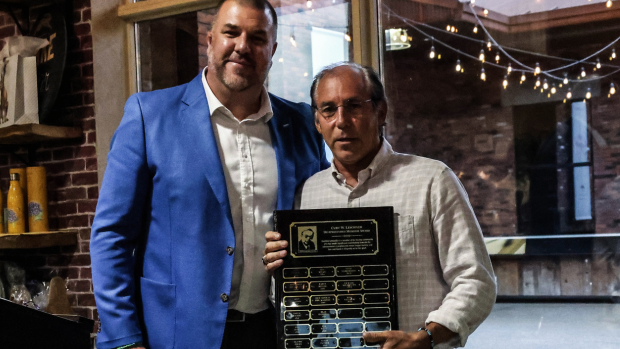
Last November, when Hillebrandt became aware of the formal launch of the Professional Hockey Players’ Association (PHPA) Alumni Network being led by one of his former teammates, Rob Striar, he quickly volunteered to help mentor any other current or former players who may be in need of support or assistance, especially having gone through uncertain times himself .
The PHPA Alumni Network was designed to assist any former PHPA Member in their post hockey career, whether through offering mentorship support, business contacts, or unique access to PHPA resources and corporate partner programs. Hillebrandt is a big supporter of the initiative.
“I thought it was fantastic. Around the time I first heard about it I had been talking to a former teammate about how tough retirement was on us. It was a ‘what do I do’ moment, and you don’t realize how connecting with people plays such an important role in your life moving forward. Connections gained from places like the PHPA Alumni Network can help you long after your hockey career is over.”
Hillebrandt is even taking things one step further and extending employment opportunities to former players. “We have many former athletes working within the company right now and several different opportunities from your basic operations crew to project management to sales to estimating all over the United States and Canada. We currently have opportunities in Toronto and soon we’ll be hiring in Western Canada.”
At times, Hillebrandt admits he thought finding a career after hockey that he would love would be impossible and realizes that many other former and current players are probably thinking the same thing. However, while the thought of a post hockey career may appear challenging, it’s not impossible, and he encourages anyone who may need assistance to reach out.
“Don’t be afraid to ask for help. It seems like the PHPA Alumni Network is there for this reason. It is a huge asset for these players to utilize. Not everyone’s career transition will be perfect, but at least this resource is putting you at the door so you can knock on it. You never know what may be on the other side and where your journey could take you next.”