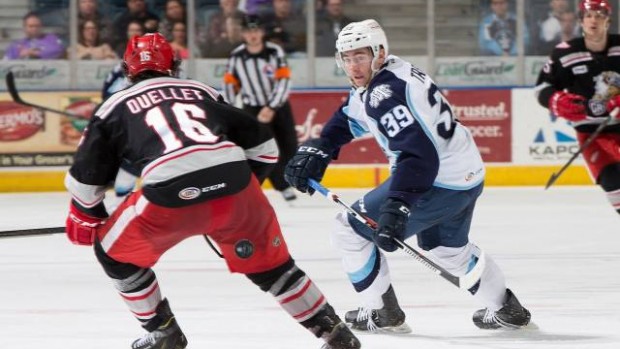
Milwaukee Admirals forward and Nashville Predators prospect, Yakov Trenin has the potential to one day emerge as a power forward in the National Hockey League (NHL). Currently in his second season with the Admirals of the American Hockey League, Trenin has a solid 6’2, 200 pound frame who looks up to and is striving to be like fellow Russian Evgeni Malkin of the Pittsburgh Penguins as the kind of modern day skilled power forward that can dominate the league.
Trenin’s hockey journey started in the hockey hot bed of Chelyabinsk Russia, where many of Russia’s top players hail from including Evgeny Kuznetsov, Sergei Gonchar, Evgenii Dadonov, Valeri Nichushkin and many more. “When I was a year and a half old my parents had already put me on skates. By four years old I went to play in the community league and soon thereafter was admitted into the Traktor Chelyabinsk system.”
As he progressed through hockey, Trenin opted to go the Canadian Hockey League (CHL) route as a 17-year old instead of staying in the Junior Hockey League in Russia (MHL). “I wanted to play in the North American system to prepare me for the NHL. Coming over to North America early means you get acclimated to the style of hockey and the smaller ice surface faster as you develop. Plus, you get more opportunity to be noticed by scouts.”
Trenin’s premonition proved to be correct. He played three seasons with the Gatineau Olympiques of the Quebec Major Junior hockey League (QMJHL) from 2014 – 2017. “At first I had to adjust to the language and learn English but after that everything fell into place. I lived with a billet family and with me there was a Canadian player, Jake Coughler who quickly became my friend and he helped me with everything.”
In 2015 following his first season of Junior, Trenin was selected in the second round of the NHL Entry Draft, 55th overall, by the Nashville Predators. “Hearing my name get called is a moment I will remember forever. I was nervous leading up to my selection and when my name was called, instantly nerves turn into relief and pure joy. My family and agent was with me at the draft which was really special.”
During his three seasons in Gatineau, Trenin experienced a number of highlights. “I remember how in my first year we went from 14th place in the standings to winning the first round of the playoffs against the third place team.”
On the international stage, Trenin represented Russia in the Canada – Russia Super Series in both 2015-16 and 2016-17. Just a month ago Russia won the Super Series after several years of the tournament being dominated by the Canadian side. The tournament from a Russian player’s perspective, however, is quite unique.
“The Canadian system across the CHL is pretty much the same in my opinion. The first game is the toughest for the Russian squad to adapt to the Canadian style and then from there you adjust pretty quick.”
Trenin also explains why the tournament is very important for the Russian National team coaches, managers, and the players. “This tournament is a prelude for the World Junior Championships and it gives coaches a good idea of their players leading up to the tournament. It also gives the players a chance to shine and get themselves prepared for the World Junior Camp to earn their spot on the roster.”
Trenin represented Russia in the 2016-17 World Junior Championships where the team earned a Bronze Medal. He explains the pride of representing his country and atmosphere during the World Junior tournament. “You play in a whole new element. Your mentality is much different, everyone plays for each other, all for one and one for all, united by your Country, and with the whole nation cheering you on. The experience is quite surreal, electrifying, and still gives me goosebumps.”
Trenin gained his first taste of professional hockey at the end of the 2015-16 season once the Olympiques were eliminated from the playoffs, when he suited up for the Admirals for two playoff games. He joined the Admirals again at the conclusion of the next season playing five regular season games, scoring one goal and notching two assists.
In 2017-18, his first full season at the professional level he played 44 games, scoring five goals and tallying 11 assists. Trenin commented on his first season in the AHL and what the adjustment from junior was like. “I would say the main difference is that your ice time and number of scoring chances during the game is reduced. You can get about one or two scoring chances a game at the AHL level and that is where as a player you need to capitalize. That is what I am working on. Also, for me it was hard to be the only Russian player on the team. There were times in my first season where it was lonely for me without a fellow Russian player however the team had Russian speaking coaches who would review video with me and touch base with me every day.”
“Now in my second season, I feel that I am a faster player and more dominant than I was when I first broke into the league. I am leveraging my size and skill to create more chances and using my increased speed to drive to the net. The improvement came from a productive offseason of training. Even the coaches and managers said they noticed a considerable difference in my speed from one season to the next. As a result, I have increased ice time and more trust from my coaches.”
Confidence is a tricky thing for many young hockey players and even seasoned veterans and super stars in the NHL. “Sometimes you just have to have faith that when things don’t go your way you just have to work hard and be positive and not think about anything else. When a player loses confidence they can start to doubt themselves and antagonize over every play, worrying about making mistakes. That is when plays become forced and mistakes happen. Every player goes through this and it is the mental strength and work on that front that is invisible because it is not in the gym like physical strength but in the mind.”
A pillar of support for Yakov is his family who is always there for him. “I communicate with my family on a daily basis. My mother watches every single one of my games and with the time difference in Russia it means she wakes up in the middle of the night to watch me play. It can be very emotional as she watches. Joy from my goals and sometimes she even cries. She phones me right after the game and lectures me on any mistakes I made and praises me for the solid plays I made.”
Trenin notes that he has adjusted well to being in Milwaukee both on and off the ice. “I am much more independent now that I have got used to everything.” He likes the city as it is close to Chicago and enjoys hanging out with teammates away from the rink. “I go out for dinner with my teammates but mostly I spend time after hockey with my girlfriend. Outside of hockey, I like to watch YouTube videos and relax between practices.”
Trenin has heard about Russian Heritage Night in the NHL which is happening on six occasions this season and believes an initiative such as this is important for the players, the Russian community, and North American fans as well.
“Being the only Russian player on a team is difficult. Having the support of the Russian community is very important and makes me feel warm and welcomed and that a little bit of home is here. Russian Heritage Night helps to break down stereotypes and show that hockey is for everyone and that our culture is warm, inviting and full of art, history and beauty that we want to share with everyone. There are many Russians in the NHL and in the AHL and lots of those players play leading roles on their teams. It is important for fans to know about Russian culture and their star players on a deeper level.”
Now in his second full season at the pro level, Trenin has been impressed with the work that the Professional Hockey Players’ Association (PHPA) does on behalf of AHL and ECHL players that it represents. “They are working on a new collective agreement with the AHL and asking for our input which is great. They always seem to be striving to make working conditions better for the players. Russian players may not be the most active PHPA Members because of language barriers but we try to get involved and use the resources when needed. I know I appreciate the services and programs they provide.”
At only 21 years old, as Trenin continues to develop and fill out his 6’2 frame, Nashville Predators fans have a lot to be excited about. For the time being, Trenin is poised to continue to help the Milwaukee Admirals maintain top spot in the AHL’s Western Conference standings.
Note – this interview was conducted in Russian and translated to English by Evgenia Stroganova