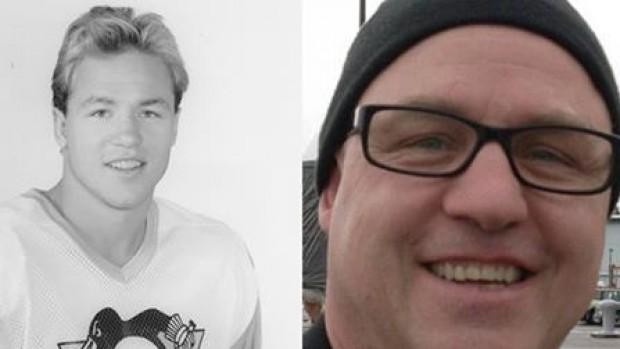
When the staff at the Professional Hockey Players’ Association (PHPA) accepted the ALS ice bucket challenge, they did so in support of one of their own, former PHPA Member and Player Representative, Mitch Wilson. Wilson, enjoyed a 10-year professional hockey career split between the American Hockey League (AHL), National Hockey League (NHL), Central Hockey League, International Hockey League, and ECHL, and was known for standing up for his teammates both on and off the ice.
“I thought the PHPA ice bucket challenge was awesome,” said Wilson after viewing the video. “I appreciate my name being mentioned and the support I’ve received from the hockey community, as a cure for ALS needs to be addressed.”
After being diagnosed with ALS this past July, Wilson was the feature of articles written by Elliotte Friedman for the CBC and Mike Morreale for NHL.com. Both articles have helped raise awareness for ALS, while taking an in-depth look into Wilson’s career and what he has endured since his diagnosis.
“I’ve always considered myself a minor league guy and a lot of help for me has come from the hockey community including the NHL, which is a true testament to the sport. Both Elliotte and Mike did a great job outlining what I’m going through.”
Standing 5’8 and known for his aggressive style of play, Wilson found success helping protect his teammates, never backing down from a challenge. “I played an aggressive style and tried not to let anyone stop me. If I was being roughhoused, I’d do it right back to them,” explained Wilson. “I’m not saying I didn’t throw the odd elbow.”
Wilson would also help protect fellow players off the ice. Near the end of the 1985-86 season, while playing for the Maine Mariners, Wilson became his team’s union representative and attended that summer’s PHPA Annual Meeting of Player Representatives to voice some concerns.
“I wanted to see things get a lot better for players. I had been playing pro hockey since 1982 and thought I could bring forth some ideas to help see things go further such as medical benefits for players. In Maine, we were playing in front of full buildings every game and thought there should be more benefits going to players. I felt something should be done which is why I wanted to get involved. I continued to be a Player Rep while playing for Baltimore and again in Muskegon.”
Wilson’s dream of playing in the NHL was achieved on opening night of the 1984-85 season, after his play in Maine from the previous season had impressed the New Jersey Devils brass.
I still recall my first NHL game, playing in front of 18,000 fans in the Meadowlands in New Jersey against the New York Islanders who still featured players such as Trottier, Bossy, Potvin, and Gillies from their dynasty. Just skating around in warm-ups I remember experiencing a big wake-up call, realizing that finally I’m here in the NHL playing against guys I once watched and admired on TV. We won the game 7-2, but I just remember the pre-game feeling, all through the National anthems thinking, OK let’s drop the puck already, my heart is pounding in anticipation.”
Wilson went on to play 26 NHL games split between New Jersey and Pittsburgh, but found success in hockey’s development leagues, playing on a number of powerhouse teams, while earning some championships along the way.
“I was truly blessed to play pro hockey for as long as I did. I won a Calder Cup in the American League, a Turner Cup in the IHL, advanced to the Turner Cup final twice. We had a really good team in Maine and we were in the hunt each year I played there. We had great clubs in Muskegon as well. In my one year playing in the ECHL with Louisville, we made it to the Kelly Cup Finals against John Brophy’s Hampton Road Admirals where I almost fought Broph in between the benches,” he chuckled. “I was that close to have won a Championship in all three of those Leagues which could have been some sort of unique record. I was very fortunate to have always played for some great clubs which stands out as some of my best memories from playing hockey.”
Following the 1991-92 season and after suffering a shoulder injury, Wilson knew he could no longer play the physical way he had been accustomed throughout his career, and began looking towards a post hockey career.
“I moved to Seattle and had some experience working on tugboats which I liked. I began aggressively knocking on doors asking around for work. Once I began working on tugboats and being out on the ocean, I realized how fortunate I was to be getting paid to travel the same route to Alaska that people are paying cruise lines. I became a licensed tugboat Captain, and really enjoy it.”
Since Wilson’s diagnosis, similar to his plight to see improvements made to playing conditions for hockey players in the 1980’s, Wilson has been determined to help find a cure for ALS.
“We need to look into this more. Lou Gehrig was diagnosed with this disease in 1939 and was told he had 2 years to live. I am diagnosed with this in 2014 and told I have 4 years to live. You’re telling me in over 70 years since Lou Gehrig was diagnosed that we’ve only improved life expectancy by 2 years? With ALS, when you go to a doctor, it’s not like they tell you to take these pills and the symptoms will go away. There hasn’t been enough improvement in finding a cure. Maybe through the additional funding and awareness a breakthrough could be just around the corner.”
Through all of this, Wilson has not sat back feeling sorry for himself, but rather remains optimistic about the future.
“I feel like this is a hockey game, where we’re about to start the third period trailing by a good margin, but I’m not going out there to just make it a close game and be happy with that. I’m going out there to win the game.”
“I’m on a new diet now and figuring out what I can and can’t do. But I’m always looking to do something. I still travel with my family and do things. I’m not sitting back. This is a fight I’m setting out to win.”
To help raise awareness and funding for the cause, Wilson has set up a Facebook page and GoFundMe account. “I’m hoping to raise money for awareness and research. I’m not sure what this will cost, but I’m just hoping this will help find a cure.”
And just like he did throughout his playing career, Wilson is taking an aggressive approach, not letting anyone (or anything) stop him, and roughhousing back, even if it means throwing the odd elbow in the face of ALS.