Every hockey fan will tell you the game is filled with twists and turns, not only literally but also emotionally and figuratively. It’s simply the nature of what takes place on the ice. Shifts in energy, flow, and momentum.
What many fans are not aware of are how those twists and turns can also take place off the ice. And if you are goaltender Gordy Defiel, you are far more familiar with this phenomenon than you ever anticipated.
The 28-year-old Minnesota native finally felt as though he gained some footing in the ECHL. After three seasons of junior hockey north of the border in the Superior International League and British Columbia Junior ranks, Defiel bolstered his resume with a solid three-season career at Lake Superior State in the NCAA where he was named a Third-Team All-Star and made the All-Academic Team in 2015-16. He also happened to graduate cum laude with a degree in Business Management.
Life as a professional goaltender, however, presented a different set of challenges. It began with a stint in the Southern Professional Hockey League plying his trade for the Pensacola Ice Flyers in 2017-18. Along the way were several ECHL auditions taking Defiel to Utah, Orlando, Fort Wayne, South Carolina, and Indianapolis. All he was hoping for, all he really wanted was chance to show what he could do.
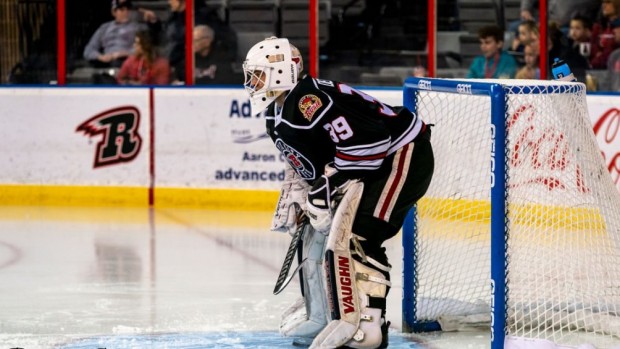
That finally arrived with the ECHL’s Rapid City Rush when he signed as a free agent in January of 2020. Given a legitimate opportunity between the pipes, Defiel shined in a 13-game stint fashioning a 5-3-3 record and a 2.58 GAA along with a stellar .925 save percentage. But in the heat of a drive to make the playoffs, the world suddenly changed in mid-March. And just like that, Defiel’s run was over. Hockey’s run was over. For how long, no one knew.
“I was really excited at the end of last season,” said Defiel. “I had been in Indy for the first half of the season and, granted, I enjoyed my time there but I wasn’t getting much of an opportunity. In Rapid City I had a chance to prove myself and showcase myself. I felt really good about it and was happy for the opportunity I got.”
Amidst all the global uncertainty, pro hockey quietly prepared for an eventual return and Defiel re-upped with the Rush last June. The ECHL announced its intent to resume play by December and even though approximately half the league’s teams opted for “pandemic suspension,” Rapid City committed to play. Defiel was anxious to build on his success. Once again, however, life intervened in the most random way possible. While having breakfast with his fiancé at a restaurant one October morning, he suffered a seizure.
“I didn’t know anything about seizures. I’d never had one before so that was a pretty scary moment, especially so for my fiancé. She saw it first hand and had to call the ambulance so that was kind of emotional. From there, my season was delayed because we were trying to figure out my medical clearance.”
In light of all the uncertainty, Rapid City released him from his contract but the two sides remained in touch. Defiel went through a battery of tests. He was unaware of any hockey-related incidents that may have caused the condition. Conditions such as epilepsy were ruled out. There was speculation his seizure may have been related to a complication dating back to his birth. Medication was prescribed and despite feeling strong and ready to play, Defiel returned home to contemplate his future.
“I wasn’t happy at that time,” admitted Defiel. “At that point, I was just trying to play and I knew I may have had an opportunity back in Indy but I chose to stay and stick it out because the Rush coach, Tetsy (Daniel Tetrault) kept saying they would bring me back in a month or so.”
True to their word, The Rush re-signed Defiel on January 11.
“It was a little delayed but I felt I wanted to go back to Rapid City because of my prior opportunity there. Once I was officially cleared, I was really happy to go back and be a part of the Rush again. I was pretty pumped and all the boys that were still on the team from last year were all pretty excited. There was a lot of speculation if I was ever going to come back and I was just so grateful to be out on the ice.”
Defiel was part of a three-man rotation for the Rush, sharing duties with fellow Minnesotan Adam Carlson and Arizona Coyote prospect David Tendeck, currently in the first year of his three-year NHL entry level contract. Tendeck was moving back and forth between Rapid City and the Coyotes’ AHL affiliate in Tucson so there was work for all three netminders.
“Gordy is one of my favourite teammates I’ve ever had,” says forward Peter Quenneville, the club’s leading scorer. “He brings a big energy to the rink every day and the boys are always excited to see him. He’s a good goalie (who) the boys always battle for because he always competes and never gives up.”
With his health matters seemingly in the past, Defiel continued to feel strong. He suited up for nine games over the next several weeks with a 4-4-1 record, and life as a pro goaltender was good. By the middle of March, he made a decision some of us may have made under similar circumstances.
He stopped taking his medication.
“The fact is that after my first seizure, I didn’t think it was that serious and I thought it was kind of a fluke incident. I mean, anyone can have a seizure and a lot of people have just one seizure in their life and that’s it. I was on the medication and everything was going well. There weren’t any side effects but I just felt like I didn’t need it and I felt fine. I felt why I should put something in my body when I didn’t need it?”
Rapid City was hosting Utah for a two-game set on March 19 and 20. Defiel had backed up Adam Carlson for the first game. He noted that he had a bad night of sleep and was once again serving as the back up for the game on the 20th. The Rush were already energized for that game and jumped out to a quick 3-0 lead within the first 13 minutes of the first period.
“I was on the bench and I started to feel a little nauseous,” recalls Defiel. “I started seeing an aura just like I did the first time and I looked at my equipment manager (Gavin Bechtol) and I said, ‘Hey Gavin, got get Cody (Head Athletic Trainer Cody Lindhorst),’ and he said, ‘What?’ and I said, ‘Gavin, go get Cody. I think I’m going to have a seizure.’ These were the exact same symptoms as the first seizure. It came on just as fast so I knew it was coming. I was trying to breathe and stay calm, and I took a big inhale through the nose, then just exhaled and ‘fell asleep.’ I passed out. And that’s all I remember.”
The game came to a screeching halt as Defiel slumped over while medical personnel urgently provided attention. He was quickly taken out of the arena via stretcher. His stunned teammates, his opponents, and a full house of nearly 4,000 fans waited quietly and anxiously with no idea as to how serious the situation might be. There was speculation about suspending the contest but after approximately 25 minutes, it was decided play would resume.
“I woke up in the ambulance and they brought me to the hospital where I go through the whole nine yards,” recalls Defiel. “They gave me an IV with the medicine I hadn’t been taking. I was only in the hospital for an hour so I made it back to the arena for the end of the game.”
Partly inspired by what had happened and, no doubt, partly frightened, the Rush overwhelmed their opponents 7-0 that night with Carlson registering the shutout. When named one of the stars after the game, Carlson rushed onto the ice donning Defiel’s number 39 jersey and eliciting a huge response from the crowd.
An already tumultuous night was about to take another joyous turn. Having heard little about their teammate’s condition, the Rush players remained concerned. That’s when Defiel, still sporting a hospital bib up top along with his breezers and knee pads sauntered back into the dressing room.
“When I walked in, all the boys were waiting for me and it was probably the most emotional hockey event I have been a part of because they thought I may have died. No one knew what happened. One of the players, Kevin Spinozzi, he sits on my side of the bench and he saw me when my face was white and my lips were purple and I was shaking. He was really shook from it so it was pretty emotional coming back into the locker room and seeing everyone.”
With Defiel’s immediate medical condition still in a state of flux, a profound emotional high was followed by yet another jolt to the system less than a week later. Once again, the Rush released him.
“They were worried about my health… I was frustrated that I wasn’t on the team anymore because I wanted to play.”
Once again, Defiel returned home to Minnesota, and once again he regrouped and took stock of his situation. A follow-up medical appointment was arranged for early April and at that point, he was cleared to return to play hockey without restriction provided he remained on his prescribed medication.
“I don’t know what the exact percentage is but they said it is a really high percentage, the majority of people who have a second seizure, it’s because they quit taking their medication. To them, this was a minor case in their world because they see this stuff every day. They see way worse conditions where people are having seizures multiple times per day. They did not seem worried so I left the doctor’s office ecstatic.”
Meanwhile, the Rapid City Rush elected to mobilize their hockey community in an effort to provide whatever financial assistance they could. Both the club and individual players donated equipment, jerseys, and signed pucks. Fundraising tickets were sold, and the Rush booster club donated auction items. Several of the team sponsors also provided merchandise and gift certificates from their individual businesses. All the items were auctioned and raffled on the Dash app with proceeds going to Defiel.
“Gordy is a part of the Rush family and the Rapid City Community,” explained Todd Mackin, President of the Rush and Spire Hockey. “Our team and our community will always rally behind our own when they are in need. We wanted to do anything we could to help within the guidelines put in place by the ECHL and the PHPA.”
“I couldn’t be more thankful for everyone who has helped contribute to the fund and to raise money for me,” says Defiel. “That was a class act thing to do. I’ve had conversations with members of the Booster Club asking how I’m doing. Their support, both financially and emotionally has been great. I’m so thankful and blessed, and again, things like this make me want to play hockey. The hockey community is just so cool when you see everyone come together.”
In a season filled with highs and lows, Defiel is simply looking for some stability and a return to normalcy and he’s optimistic life as a professional goaltender remains part of the equation. He’s been skating, working out, diligently taking his medication, and remaining in shape in order to take full advantage of the next opportunity.
Meanwhile, Defiel says he still roots for the Rush and that he continues to feel connected to the organization and his former teammates. In fact, he and Peter Quenneville have even gone so far as to continue a tradition they had earlier in the season. The two used to take a few moments on game days to sit on the bench together before warm-ups and talk shop. They found the exercise mutually beneficial.
“When he had to leave the team, I made sure to continue our pre-game routine,” says Quenneville. “Usually, 30 minutes before warm-ups, we would go to the bench, watch highlights and chat. Now I FaceTime him on the bench at the same time before every game. I’ve always expected him to return so I wanted him to feel like he was still connected to the team. I think Gordie has a lot of life left as a professional goalie and I hope he gets an opportunity to show that.”
Defiel maintains the rink continues to be his happy place and that his teammates and people he has met through the game is what motivates and drives him.
“Lately, I’ve felt great. If a team needed me, I’d be in. I feel like the tank is full. The pro hockey thing has been good and bad because I haven’t had a bunch of opportunities. I feel I have a lot to prove still. Mentally, I feel really good. I don’t want any teams to think I’m incapable of continuing with my career.
“I’m ready to rock. It doesn’t matter what team it is. I’m ready to go so, if anything happens and they need a goalie, they know where to find me.”