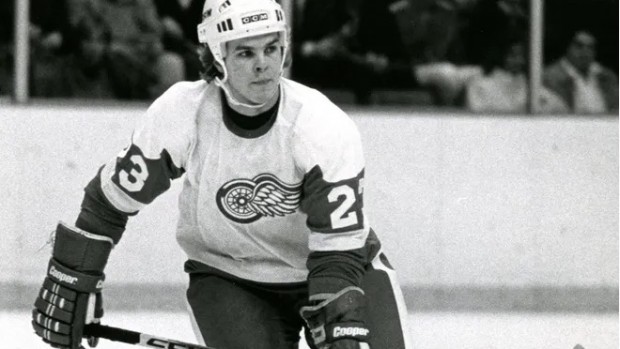
“You can laugh or cry about this,” Kirton said. “I decided for myself, I’m not going to change. I’m going to stay the person I’ve always been. I am not going to be negative. I’m going to do everything I can to stay the same and I expect people to treat me the same way.
“I don’t want anybody feeling sorry for me. I played a lot of years on a lot of teams. My teammates, they don’t want to see me sad and upset and I don’t want to see them sad and upset. For the most part, 99.9% of the time, they approach me like nothing is wrong and I prefer that.
“The real impact is on your family, your caregivers. Those guys are the front liners. With ALS, as I weaken, they almost become an extension for me. It’s unfair in a way. It’s not just that I have ALS. It’s like they (his wife, Lisa, and three adult children) have it too.
Kirton has a suspicion that the concussions he suffered as a hockey player may have caused him to contact ALS. But he has no medical evidence of that. He’s not blaming anyone for his situation, forever thankful for the 746 pro hockey games he played, but he believes one-day medical science will connect ALS to head trauma in sports.
“There’s no doubt that there’s a risk factor (playing contact sports),” he said. “But also, so many non-athletes have got this and have never had a concussion in their lives. I truly believe in my heart there is evidence that warrants further studies, studying elite athletes with ALS. But there’s so much still to learn about this.
“The disease is 80 years old and you look at how quickly they’ve come up with a vaccine for COVID, you wonder if enough research has been done about ALS since 1941, when Gehrig died.”
Kirton worries that the ALS cycle creates advocates for fundraising and medical research who then get ill and pass away before any kind of change can be made. In Canada, Kirton said, under normal circumstances, it takes two years or more for a drug of any kind to be studied and accepted by government authorities.
“What good is that when the lifeline of an ALS patient is 2-5 years?” he said. “ How does that help anybody? We’ve had some great, fearless leaders working to make this better, and before they can finish the job, they pass away. And it starts again and again.”
This is baseball’s entrance into ALS education, albeit late. Kirton hopes the National Football League and the National Hockey League will come through with pronouncements of their own in the future.
In the meantime, he continues to sell real estate in the Oakville area, the pandemic being his professional friend for the past 14 months. Houses are being sold primarily online. He’s doing business. He’s able to continue and has a personality you can’t dislike. And he wants so much to give back, with whatever time he has to give.
“I go way back with (the late) Roger Neilson and I remember seeing him when he had cancer and had this long list of names. I asked him: “What’s is that?”
“He said ‘These are cancer patients I have to call.’ That stuck with me. He was dying and he was giving back to people who needed help.
“Now I’m getting all these calls from people (who have been diagnosed with ALS). They’re scared to death. They don’t know the shortcuts about what’s available and what equipment to get. They don’t know what treatments are out there. But to be honest, the one good thing, I haven’t met too many ALS patients that don’t have the hearts of lions … And I’m just playing my part, the way Roger did.”
Kirton admits to being clumsy now, to dropping things, but he’s thankful that his brain is still functioning, that he’s still able to swallow without difficulty, that ALS hasn’t gotten to his chest the way it has gotten to his legs and arms. Kirton said there are 3,000 people in Canada suffering from ALS: 1,000 diagnosed annually, 1,000 who pass away.
But this Wednesday is a reason to celebrate this dreadful disease. “This is the greatest opportunity we’ve had in 80 years,” said Mark Kirton. “Every team in baseball is going to be doing some kind of event for this. We have to run with this. We have to take advantage. It’s our time.”