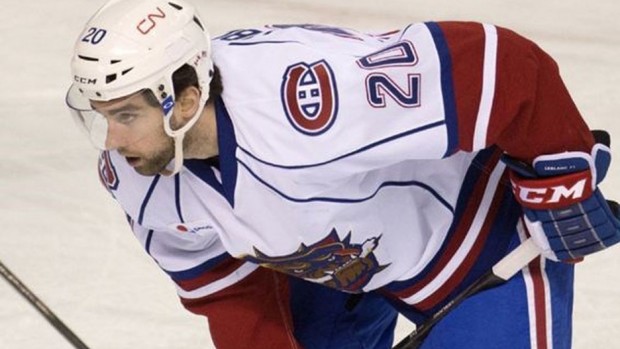
The eventual transition to a post hockey career can understandably be a touchy subject for many professional hockey players to discuss while still playing. Unfortunately, the reality is there will come a time when a player can no longer play the game at the highest level, and it is crucial they set themselves up for the best possible success afterwards. Former Montreal Canadiens first round draft pick Louis Leblanc wisely used some of the resources offered through the Professional Hockey Players Association (PHPA) to put himself in a good situation for his post-hockey career and suggests other players should do the same.
Leblanc played minor hockey in the Montreal, Quebec region, and then played his NHL draft eligible year with the Omaha Lancers of the United States Hockey League where he would be named Rookie of the Year in 2009. Later that summer he attended the 2009 NHL Entry Draft which was being hosted in Montreal, along with family and friends. The arena erupted when the French-Canadian heard his name called 18th overall by his hometown Montreal Canadiens.
“It was an unreal experience to share with my family, friends, and coaches who were there with me,” said Leblanc. “I had talked to a bunch of teams including the Canadiens before the draft, but I had no idea where I’d go.”
The following year, having previously committed to Harvard University, Leblanc decided to officially enroll and play for the Crimson. Following his first season where he recorded 23 points in 31 games, he was named Ivy League Rookie of the Year. However, he then decided to sign a professional contract with the Montreal Canadiens, forgoing his college eligibility which resulted in him leaving Harvard.
“There was some pressure from management to turn pro. They thought it would be better for my development to play junior hockey since there’s more games and a schedule that more resembles professional hockey. But I did feel like college hockey was a bit tougher. There were older and more physically mature players, and there were way less games than junior hockey, so every game felt a bit more do or die.”
The following year, Leblanc was assigned to the Montreal Juniors of the QMJHL where he would go on to record 58 points in 51 games, including 100 penalty minutes. That season, Leblanc was also selected to represent Canada at the 2011 World Junior Hockey Championship in Buffalo, NY where he had an incredible experience, earning a silver medal. “It’s always an honour to represent your country and it was great for my development getting to play with some elite players and learn from each other.”
Leblanc began his professional hockey journey in 2011-12 with the Hamilton Bulldogs, the Canadiens’ American Hockey League (AHL) affiliate at the time. He was eventually called up to Montreal after having notched 10 points in his first 14 games. After making his NHL debut and scoring his first NHL goal on December 15th, he would split the remainder of the season between the AHL and NHL. The next two seasons were similar for Leblanc as he continued to try and earn a full-time role with the Canadiens.
“Playing your first game, scoring you first goal, those are amazing experiences that you can’t really prepare for. I’m not going to lie, it was an emotional rollercoaster over those years being assigned to the AHL, then called back up, and sent back again.”
In the summer of 2014, Leblanc was traded from the Montreal Canadiens to the Anaheim Ducks after struggling to establish himself on the Canadiens roster.
Leblanc explained, “It was expected. I think it was good for me to get a change of scenery. I played with plenty of great players in Montreal and I have nothing but love for my time there.”
Leblanc played the 2014-15 season with the Ducks’ AHL affiliate, the Norfolk Admirals, where he had a strong campaign. During the season, however, he sustained a wrist injury that eventually required surgery.
He tried out for the New York Islanders the following year, however, after failing to crack the roster, the team agreed to release him. He was then made an offer that he couldn’t refuse and joined HC Slovan Bratislava of the Kontinental Hockey League (KHL).
“The idea of getting to explore Europe and then receiving a good offer to play there was something I didn’t want to turn down. My professional career had not gone as planned up to that point and I wanted to try and make the best of it.”
After playing for three teams in three different European leagues during the same season, Leblanc decided to call it a career and go back to school to finish his degree. “I decided it was time. There wasn’t anything more that was going to come out of playing and I decided that going back to school would be the best option for me.”
In 2016, after officially retiring, he turned his focus towards his post hockey career. Scrolling through the PHPA’s website one day, he researched the PHPA Career Enhancement Program (CEP) which helps players prepare for their post hockey career.
“The PHPA can be a great resource and has so many programs and opportunities available to help players. But if you don’t pay attention or bother to look around or contact them, you’ll never realize what they can help you with.”
Through the CEP, Leblanc was put in touch with BFL Canada, a prominent insurance broker based out of Montreal with deep ties to hockey, where he obtained a summer Internship before returning to Harvard in the Fall.
“The PHPA helped get me the opportunity with BFL where I was able to have the chance to gain real world experience and work in a professional office environment for the first time in my life.”
The CEP conducts personality tests to help guide players in determining the line of work or industry that aligns with their career interests. Leblanc’s test results indicated management and coaching as areas for a future career path, which have been deemed to be accurate as he currently works for a management consulting company. He also volunteered as an Assistant Coach for the Harvard Men’s Ice Hockey Team as a way to stay involved in the game when he returned to school, helping mentor the likes of current NHL players John Marino (PIT), Alex Kerfoot (TOR), Adam Fox (NYR), and Ryan Donato (SEA) among others.
“Having a Harvard degree or one from any other prominent school is great, don’t get me wrong, but you still need to put the work in. I looked for opportunities to help myself and I found that with the PHPA, it was a great place to start when I had nothing,” said Leblanc.
Another resource that Leblanc used through the PHPA was the ability to file a workers’ compensation claim for the nagging wrist injury he sustained while playing in Norfolk. Again, he turned to the PHPA website for the steps and procedures that should be taken when an injury occurs and contacted the office to discuss his options.
Once he filled out the questionnaire for a potential workers’ compensation claim, the PHPA then referred him to Ben Boscolo, a member of both the PHPA and NFLPA Workers’ Compensation Panel of Attorneys. Boscolo helped guide Leblanc through the workers’ compensation process where he successfully reached a settlement. Although the claim took multiple years to reach its conclusion, Leblanc’s patience paid off as he was finally able to be properly compensated for the injury that occurred.
“It was never about money, it was about protecting myself for future problems. It was about having medical care for my wrist covered for life. To this day my wrist still bothers me from that injury.”
One thing that surprised Leblanc during the process, other than the length of time it took to reach an outcome, was the amount of paperwork and documentation required. He also recognized the challenges of being a player in the moment and having the mindset they may have.
“I definitely think that in the moment it’s hard to understand that the process will take time. Players want their money or compensation now and it doesn’t work like that. It will take some time, that’s just the reality of it.”
Having utilized the PHPA Career Enhancement Program, workers’ compensation process, benefits program, and various marketing partnerships and discount programs over the years, Leblanc offers up some advice to current PHPA Members about the resources that they have available.
“The PHPA is on the players side. Use them as much as you can. If you don’t want to that’s okay too, but just know they have the resources and experience if you need them. If you don’t take the initiative, you’ll never know.”
He also stressed that the resources the PHPA has to offer doesn’t necessarily cost money, only time. “I played and understand that as players when you have time off you want to rest and enjoy it. But if you can do something in you spare time while you’re playing to help set-up your career after hockey, it will go a long way. Then when you are done, you will have a footing to build off and be positioned in a good place.”
Leblanc shared some regret and wished that he had followed his own advice earlier in his career. “There were so many times where I had a few hours here and there that I could have used to help myself that I didn’t take advantage of. I could have used the time to learn a new language or something else that could have been of use to my career after hockey.”
Louis Leblanc is a perfect example of how players can utilize the resources available to them for their advantage. Now as a member of the PHPA Alumni Network, he wants to do nothing more than to help other players succeeded. For those interested, take some time to visit https://phpa.com and see how the PHPA can be a resource for you.