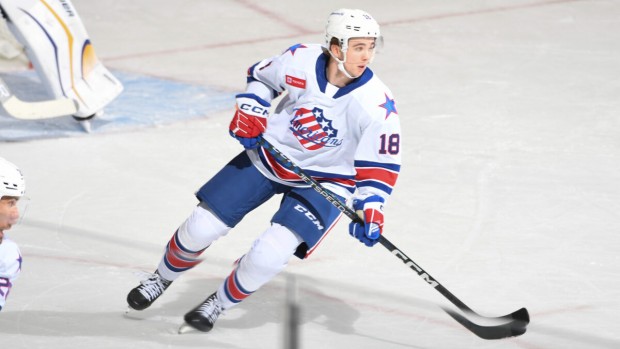
An introduction to the bus rides, body checks and unforgiving nature of the American Hockey League tested Isak Rosen in a way he couldn’t have imagined a year ago when he was preparing for another season in Sweden.
Each experience was eye-opening.
His transition began in September with the Prospects Challenge in Buffalo, an event in which Rosen skated with fellow Sabres prospects in exhibition games against their peers from other organizations. Then came the crash course in what it’s going to take to ascend to the NHL.
Rochester Americans coach Seth Appert and his assistant coaches, Michael Peca and Mike Weber, have spent the past two seasons helping other prospects through the same process. Talented forwards like Rosen must learn what it takes to score and defend in North American pro hockey.
Backchecking isn’t optional. Scoring chances often begin by prying the puck away from an opponent along the wall. Rosen is a dynamic winger with an elite skating stride and impressive left-handed shot. Neither could be game-changing attributes unless he learned how to get to areas of the ice where he could use them.
“It’s about confidence and I’m winning more battles on the ice,” said Rosen, now bearded ahead of the Amerks’ playoff opener Friday night in Syracuse. “At the start, I think I did sometimes, but I was maybe afraid a little bit sometimes. … I’ve just grown throughout the year and I’m real skilled in the middle of the ice with the puck. Now just keep going to the hard areas and try to do that and become more comfortable there to score goals in front.”
This is the opportunity Rosen envisioned when he signed his entry-level contract with the Sabres in May. He’s an impact player for the Amerks as they enter a best-of-five playoff series against the Syracuse Crunch. Games 1 and 2 are on the road, then the series shifts to Rochester next weekend.
Rosen, 20, averaged only 7:38 of ice time across 28 games with Leksands IF of the Swedish Hockey League during an injury-shortened season in 2021-22. Now he is following in the footsteps of current Sabres and former Amerks, Jack Quinn and JJ Peterka, who used their playoff experience last spring to learn what it’s going to take to make an impact in Buffalo.
“There’s gonna be failure and success in these playoffs from experience, but both will be great learning moments,” said Appert. “What he’s really done is Isak is starting to embrace, in the last 25 or 30 games, using his skill and speed to get to the interior of the ice. And, as you guys know, that’s where goals need to be scored against goalies of this caliber, but also goals need to be scored there at this time of the year. You’re not scoring on the perimeter very often in the playoffs and so his willingness and ability to get to the inside has just grown exponentially with the puck. And then without the puck, his commitment to play the right way. Backtracking stopping at parks, winning puck.
“There are still times he’s gonna get pushed off of it. He’s just not strong enough yet. That’s OK. Now it’s not because of lack of commitment or want to do it. Sometimes it’s just a strength issue, which that’s easily corrected. The strength issue is easily correctable. The will and the want and the commitment to do it are things you need to change first, and he’s changed those things in spades.”
Rosen, who the Sabres drafted 14th overall in 2021 with the pick acquired in the Rasmus Ristolainen trade, had 11 goals and 21 points in the final 37 games. He finished with 14 goals and 37 points in 66 games but counting stats don’t properly illustrate his impact as a rookie in the AHL.
We heard Appert make similar comments about Peterka last season, when the German winger showcased his remarkable speed but needed time to understand how playing a complete game would lead to more offense. Peterka had a breakthrough in the second half of the season, then piled up seven goals and 12 points in 10 playoff games with the Amerks.
The change for Rosen began in January upon his return from the IIHF World Junior Championship, where he totaled two goals and six points in seven games to help Sweden win a bronze medal. His confidence was surging. The tournament was a reminder that he has the talent to do it at the pro level and the coaching staff in Rochester put him in situations to grow.
It was an important step after he didn’t get enough ice time last season because he was in a limited role on a veteran team and suffered a broken hand in February 2022.
“I think that’s what I needed,” said Rosen. “Just to play this many games, too. World juniors and then 60-something games for me here in the league, too. It’s been like over 15 minutes every game, and I don’t think I played maybe 30 games last year and not over 15 minutes in lot of those games.”
Rosen, like the other six rookies in Rochester this season, showed marked improvement as they pieced together a 10-game point streak in the final weeks of the regular season. The rest of the group will go through the same difficult test in the series against Syracuse.
Winger Jiri Kulich, a first-round draft pick in 2022, had one of the best seasons by an 18-year-old in the history of the AHL. His 24 goals and 46 points rank second and fourth, respectively, in league history. Kulich, who turned 19 last week, is dealing with a lower-body injury that forced him to practice in a non-contact jersey Wednesday, but he’s trending toward probable for the weekend, said Appert.
Winger Filip Cederqvist, a 6-foot-1 power forward drafted by Buffalo in the fifth round in 2019, entered last weekend with five goals in 52 games and scored four in the final two games of the regular season.
Tyson Kozak, a tough center selected in the seventh round two years ago, developed into a reliable center who kills penalties and wins important faceoffs. At 20 years old, Kozak plays a heavy, physical game and he’s learning how to do it against opponents who are typically older and stronger. Winger Alexandr Kisakov, a second-round pick in 2021, has flashed his skill and on-ice instincts while amassing six goals and eight points in 48 games.
Insulated by veterans like captain Michael Mersch and West Seneca’s Sean Malone, Rosen and others are developing by playing in a variety of situations. It’s the opportunity he wanted when he chose to leave Sweden last spring, and he has impressed leaders on the team with the way he’s persevered.
“Rosie is an incredible talent. I think anyone who watches the game can tell his skating ability is pretty elite,” said Malone. “You know, breaking pucks out and using his speed to generate chances offensively off the rush, too. It’s awesome to see. … He’s a great player. I’d like them to use his shot a little more because I think his shot is really good, similar to Kuli. All those guys bring a different element and it’s been fun to watch.”