No matter the sport, much is always made about the importance of leadership, and how it remains essential, if not vital, for the success of any team.
There are different styles of leaders. Some are vocal and dramatic. They garner plenty of attention from their teammates, opponents, and the media. They can be lightning rods for accolades when circumstances are favourable, or criticism at times of failure. Some have broad shoulders and can withstand the intensity while deflecting pressure away from those not equipped to handle it.
Then we have the quiet leaders, the individuals who have no interest in being in the spotlight. They prefer to simply do their job, and do it well. They know their teammates are watching, and if all goes according to plan, those teammates will follow the example and be inspired to learn and grow.
Not all leaders fit neatly into either category. There are plenty of hybrids; players who choose to be vocal on occasion, but who know when to simply set the stage.
Hershey Bears defenseman Mike Moore may just be the ideal example of this type of leader. Leadership seems to always have come naturally to the veteran, having served as a team captain in the college ranks as well as with three different American Hockey League (AHL) organizations. This season he is serving as an Assistant Captain backing up incumbent Dane Byers. How does he consistently end up with such responsibilities?
“The one thing I try to do is just lead by example and conduct myself in a manner that people can look towards, that you can look yourself in the mirror knowing that you’ve done your best and given your all with a positive attitude and helped out your teammates,” explains Moore. “Those are the things you try to do every day. It’s a long season and there are going to be ups and downs. You try to ride those out and be positive and help contribute towards your team any way you can.”
Those words may initially sound clichéd to some but there is an inherent wisdom behind them. Wisdom stemming from experience, not only as a professional player but also as a youngster growing up in Calgary, Alberta, Canada.
Moore watched and learned as his father, Ken, helped each of his sons get involved in the sport before expanding his efforts to include a much larger community. “My dad played Junior A and Junior B hockey and he had a passion for it,” says Moore. “We were fans as well. We grew up watching the Flames and the Oilers and skating on the outdoor rinks of Alberta.
“When we were younger, my old man used to flood the grass between the house and the garage and it wasn’t that big of an area. For a couple of years he did that until he figured that’s enough and we moved to a new house in a new community and had an outdoor rink right across the street. I think that was planned, and we spent a lot of hours out there with my brothers. It was perfect.
“My father enjoyed getting involved in coaching and volunteering. All through the years that my brothers and I were moving up, he was always involved, either behind the bench when we were younger or helping to organize. He actually volunteered to become President of Calgary Minor Hockey so that’s a position in which you put in a lot of hours.
Seeing how his father took the initiative and consistently made things happen by getting involved helped prepare Moore in forging ahead with his hockey career, especially when the inevitable obstacles presented themselves. Despite his passion for playing, Moore was unable to crack any rosters in the Western Hockey League (WHL) and that’s when his resourcefulness kicked in.
“I was invited for tryouts to WHL teams like Lethbridge.” recalls Moore, “and I ended up getting cut and kind of figured out that as an older guy trying to crack into the WHL, I might be better off going into the NCAA. Looking back at that decision, I’m really happy it worked out for me, going in that direction.”
Before going that route, however, Moore utilized his contacts and connections with local hockey coaches and was able to earn a spot with the Surrey Eagles in the British Columbia Junior League’s Tier Two Junior A loop. He spent two seasons distinguishing himself in the rough-and-tumble, yet high-skilled league and eventually began attracting more attention.
“I had done a little bit of my own recruiting,” admits Moore. “I tried sending some hockey resumes to Ivy League schools to get my name out there. Fortunately I got some correspondence back and they ended up working me into their recruiting trips. We were in Chilliwack and that’s a big rivalry with Surrey and it was a rough game. I ended up having a pretty good tilt and it was competitive.”
It was a recruiter from Princeton who not only attended that game, but he also took note of Moore’s play.
“Even though there’s no fighting in college,” explains Moore, “they said they liked my intensity. They mentioned my name, got me on a ‘fly down’ to Princeton and I ended up applying and getting in there.”
You could say the Ivy League environment agreed with him. In four seasons on the ice, Moore was named to the ECAC All-Academic Team each year. In his senior year in 2007-08, he was named team captain and helped lead the Tigers to an ECAC championship. Not only that, he capped the year by being named First Team All-American, First Team All-Ivy League, First Team All-ECAC, and ECAC Best Defensive Defenseman.
“It’s fair to say my game improved by leaps and bounds while I was there,” says Moore. “The team had some great players and it was definitely fun to be part of that program. To be a part of that growth and to be with my teammates and the coaching that I had there, it definitely helped my career more than you can appreciate. Guy Gadowsky was the head coach and I’d definitely say he was a huge help for all of us both on and off the ice. He’s moved on to Penn State, and what was a loss for the program at Princeton is definitely a gain for the Penn State program, which is just starting out.”
Off the ice, Moore majored in mechanical and aerospace engineering, though he hasn’t decided how and when to apply that knowledge just yet. “I’ll keep that in my back pocket,” he says. “It’s something I sometimes like to talk about in the dressing room . You can see some people yawn and walk the other way whenever I try to talk about that stuff but it’s fun and it’s a passion of mine. I enjoy it and it could definitely be something in the future for me.”
Despite all the accolades at Princeton, Moore remained undrafted by an NHL organization. But given his track record, a penchant for resourcefulness, not to mention his inspired play, he once again forged ahead and took advantage of the next opportunity. Moore signed on with the San Jose Sharks late in the 2007-08 campaign. At long last, he was a pro hockey player.
“It kind of came in stages,” recounts Moore, “and it had been an incredible journey but I ended up talking to some scouts from San Jose and they said they would like to sign me to an ATO (Amateur Tryout Agreement). After your team has success, some individual success can follow. I was fortunate enough that they were talking to me and offered me a contract. Going into that senior year, it wasn’t necessarily something I knew was going to happen but I knew I wanted to continue on and try to play and fortunately, that opportunity came.”
After suiting up for three AHL contests with Worcester that year, the Sharks were impressed enough to ink Moore to a two-year contract. It was the start of what turned out to be a four-year stint in New England. Naturally, more accolades and responsibilities followed. He was named the club’s Rookie of the Year in 2008-09, as well as Man of the Year in both 2008-09 and 2009-10. By 2010-11, he found himself in a familiar situation when he was named team captain and his roots in the community grew deep.
“The community that you’re playing in… they’re supporting you and if you can try to give back in any way, that’s definitely something you can try to contribute toward,” explains Moore. “There are so many interesting sides to the hockey world, and so many programs you can get on board with. I got involved with Hockey Players for Kids and some of the reading programs that were already there and it was an easy transition to get involved with the community.”
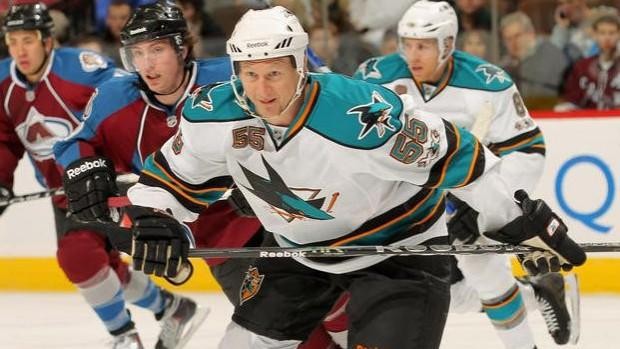
And along the way, something very special happened. Moore had a chance to make his NHL debut when he dressed for six games with San Jose during the 2010-11 season. They remain his only NHL games to date, and included a couple of memorable moments. One occurred on November 17, 2010 when his snap shot from the point beat Colorado goalie Peter Budaj in a 4-3 loss to Colorado.
“It definitely wasn’t my hardest shot,” says Moore with a laugh, “but your first NHL goal is always special. I like to think that I tried to get it on net and sometimes you get lucky so you do the basics and hopefully it works out for you.”
The other incident Moore will never forget is a brief but spirited scrap with Dallas blueliner Mark Fistric the very next night. Moore acquitted himself quite nicely against his larger opponent and won a clear decision.
Watch: Mike Moore vs Mark Fistric
“I haven’t talked to Mark Fistric since then but we did both play Midget hockey together so I knew him from there,” says Moore. “He’s a big strong lad, a farm boy from Alberta and he’s as tough as they come. To get involved in a fight, to contribute in the game makes you feel like you’re helping your team out. That’s a great feeling and it was fun to be with those guys on that NHL stage.”
As is the case with a number of AHL veterans, Moore has since moved around to different organizations in recent years including Milwaukee in 2012-13, Providence in 2013-14, and Hershey this season. There is always room for a player of his skill, stature and character, someone who can adapt, mentor, and lead both on and off the ice. As is typically the case, he wore the “C” with both Milwaukee and Providence. Through it all, Moore simply tries to stay within himself and do what he does best.
“You try to play your game because that’s why the organization has brought you along,” offers Moore. “They’ve seen you play. They expect certain things out of you. At the same time, off the ice you try to contribute, be a positive guy in the dressing room and help out the younger guys coming in. That’s definitely a role you move into if you’ve been around the league and with different organizations.
“It’s a long season and there are going to be highs and lows. A lot of guys that come up are extremely talented. I tell them to keep doing what they did to get themselves here because that’s what allows them to have success. Work hard and take care of yourselves both on and off the ice. You don’t have to tell them too much. I just try to lead by example and offer advice and answer questions if anyone has any about on or off-ice issues.”
While Moore’s off-ice contributions are up to his usual standards this season, his on-ice performance has been hampered by a substantial upper-body injury, one that has limited him to dressing in just 10 contests before the AHL All-Star Game. Needless to say, it has been an exercise in frustration but the good news is he has returned to game action as of early February.
“It’s always tough,” admits Moore. “A couple of years ago I ended up breaking my hand and missed a good chunk of the season from that. Then earlier this season I took a clean hit and ended up with an elbow dislocation. It’s just another unfortunate injury that you’ve got to ride through and do your best to rehab and get back to compete.
“Any athlete will tell you the hardest part is when you can’t help out your team. Sometimes it’s a long road to recovery. It is what it is. It could have been worse. That’s always the best way to look at it. But I can see the light at the end of the tunnel and that helps get me get through the rehab and going to the gym and working out. All that stuff is your motivation to get back. I’m getting stronger every day so that’s a good sign.”
It should also come as absolutely no surprise that given Moore’s leadership abilities, and his instincts for getting involved, if not fully immersed, in his hockey environment, he has emerged as his team’s Player Representative with the Professional Hockey Players’ Association. His inspiration stems from acknowledging the trail blazed by all those before him.
“It’s part of appreciating what the previous generation has left for you and trying to contribute to it and keep it strong,” explains Moore. “I think it comes naturally to build off of what is already here. You want to leave the world in a better spot than when you found it and do the little things to help find the resources and programs that are there.
“The PHPA definitely helps the players on a lot of levels whether it is the Career Enhancement Program or the benefits you get off the ice. If you want to help teammates out when they have questions, then obviously you are going to look towards the previous guys and what they’ve done. There’s a great union in place and it’s there to help and support each other. You just educate yourself and then help out anyone who needs it.”
Such insight has not only qualified Moore to capably represent his teammates, his duties and realm of influence extends throughout the entire league. Moore also serves as a member of the PHPA Executive Committee, an exclusive group of 12 players with responsibilities that include the receiving and approval of committee and financial reports, agendas and budgets. Among his additional off-season duties, Moore attended the annual AHL Board of Governors meetings at Hilton Head Island in South Carolina last July and left encouraged about the future success of the league.
“You walk away with a good sense that the relationship between the League and the players and the PHPA is really strong,” says Moore. “There are some disagreements but all in all, I took away the fact they want the best for the players and minor-league hockey and that’s definitely what we want as well. Just to see it from the other perspective was really informative. It was held at a nice location, a great place to swing the golf clubs and hold the meetings, and we appreciated that they invited a few of the players.
“I was impressed with the willingness to work together. That’s something that is appreciated, I think on both sides. There are always things that come up, whether it’s a new Collective Bargaining Agreement or franchises possibly re-locating. Overall, I think both parties are always willing to work together and try to forge the best solution possible.”
Now a veteran of eight seasons and nearly 400 games as a pro, Moore is able to put his accomplishments in perspective. Even though he has not used the most-traveled path, he has made the most of every opportunity.
“It was a lot of hard work over the years,” he says. “The end goal for any young hockey player is to play in the NHL. I worked around the back door, I guess, to try and get there and I just kept getting chances, which was fortunate, and then I worked hard when I got those chances. So far I’ve enjoyed the journey.”
And speaking of journeys, away from the ice, one of Moore’s hobbies reflects themes already familiar to most hockey players, namely travel and exhilaration.
“I’m actually a pilot,” says Moore. “That’s a fun hobby and another possible future career choice because I really enjoy that. I’ve been flying for about five years now, just single-engine planes. There are actually several players who are involved in it so it’s a cool community to be a part of.”
Moore plans to keep lacing up the blades as long as possible knowing that it remains the aspect of the game he enjoys best. “There’s nothing like being in the grind with the guys on the team, and hopping over those boards,” he says.
As for after his playing days, don’t be surprised to see him remain involved in the game, whether it’s behind the bench coaching or in a front-office capacity. Given Moore’s passion for the sport, his networking and leadership skills, and a propensity to make things happen, there should be no shortage of opportunities.