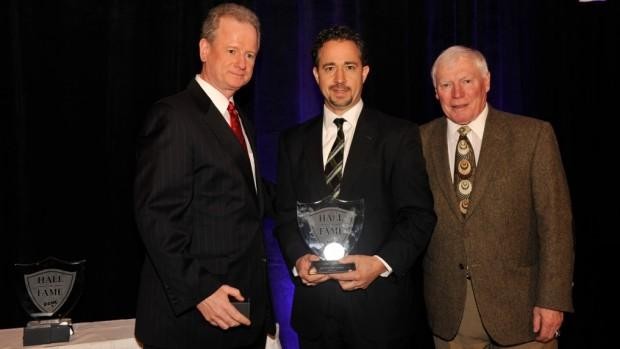
On January 21, 2015, the ECHL inducted the eighth class into the ECHL Hall of Fame in Orlando, Florida. One of the enshrined members, Louis Dumont, who last played in the ECHL in 2006, remains to this day the League’s all-time leader in assists (566) and points (891), is tied for third with 325 goals, and ranks third all-time with 771 games played.
Dumont’s professional career started off slow, however, and took many twists and turns through different leagues, countries, as well as off ice involvement before landing a spot in the Hall of Fame.
After a successful Junior career with the Regina Pats where he played 245 games totaling 342 points, and which was capped off with winning the Memorial Cup with the Kamloops Blazers in 1994, Dumont headed to Germany to begin his professional career.
After a month and a half though, he wanted to return home and give North American Pro hockey a try. He skated with the Canadian National Team which was based out of his hometown in Calgary, Alberta until he was released after a number of NHL players joined the team during the 1994 NHL Lockout including Paul Kariya, Brian Savage, Petr Nedved, and Chris Kontos among others.
Upon the advice of his agent, he gave the ECHL a try, eventually landing with a new team, the Tallahassee Tiger Sharks. “I felt it was a good opportunity to play so I went down there and made the team. It seemed like a long road to get there but I settled in nicely in the ECHL,” said Dumont.
However, during his second season of professional hockey while playing with the Wheeling Thunderbirds, ECHL players, who were not represented by the Professional Hockey Players’ Association (PHPA) at the time, began initiating the process for the PHPA to become the certified collective bargaining representative for ECHL players.
“The conversation of a players union started being discussed in my second year of pro in Wheeling. We were treated great in Wheeling and thought all players throughout the League should have it the same way. However, some teams were mistreating players. There was no voice for the players and a definite need for the union to come in.”
In 1995, ECHL players voted in favor of the PHPA becoming the certified collective bargaining representative for ECHL players.
Over Dumont’s career, he played 12 seasons in the ECHL for Tallahassee, Wheeling, Louisiana, Augusta, Pensacola, Mississippi, and Utah, making the playoffs every season. His career involved living in a new city almost every year as he pursued his passion. “I didn’t really want to move to a new city each year but there was always a reason. Whether it was a hurricane, or a team ceasing operations, or an ownership change. Looking back I liked everywhere I played and each place had something unique to offer.”
Although Dumont never won a team championship, he still has some fond memories of the teams that he has played on. “Winning the Henry Brabham Cup with Louisiana for being regular-season point champions in the ECHL was special. We made some deep playoffs runs but never won the Kelly Cup. That just shows you how hard it is to win.”
Following the 2005-06 Season with the Utah Grizzlies, his final in the ECHL, Dumont signed with the Memphis Riverkings of the Central Hockey League. And once again, Dumont was playing in a league where some players were seeking to be represented by the PHPA.
In April, 2008, players voted for the PHPA to become the certified collective bargaining representative for CHL players.
“It was a carbon copy,” recounted Dumont on the similarities between ECHL and CHL players voting in favor of PHPA representation. “There were some that didn’t want the union to come in, but the need was there for the players. There wasn’t as much of a lopsided vote in the CHL as there was in the ECHL. There was a team or two whose players were reluctant to be a part of it, but as players, we knew it was going to happen.”
At various times throughout his career, Dumont was a PHPA Player Representative and was later elected to serve on the PHPA Executive Committee. “I wanted to learn the business side of hockey and hold myself accountable for important things that players experience off the ice throughout their careers.”
Dumont emphasizes the importance that there is more to the game that just playing. “Players tend to just want to play hockey and don’t want to deal with being a pro athlete. My advice is that there is more to the game and young players should get involved and learn what goes on off the ice. I really enjoyed being a Player Representative.”
Learning throughout his career is what helped Dumont with his transition to life after hockey. He spent 5 years in the CHL, 4 of those seasons with the Mississippi RiverKings, before retiring after the 2010-11 season. In his time with Mississippi, he worked in the team’s front office, assisting with corporate sales, ticketing, community relations, and promotions, learning various aspects of the team’s operations.
Fortunately for Dumont, upon his retirement, a General Manager vacancy opened up in Louisiana, where his wife was from. He is currently in his 4th season as the General Manager of the Louisiana IceGators of the Southern Professional Hockey League. “There are so many challenges of running a minor professional hockey team. I learn something new each day.”
Although Louisiana isn’t typically portrayed as a hockey hotbed, Dumont believes the support is there. “It was a phenomenal place to play back in the 1990’s to have 12,000 fans every game. We have a solid fan base and average 2,500 per game but around 4,000 on weekends. It’s comparable to big junior hockey markets in Canada.”
The career of Louis Dumont has been remarkable and his induction into the ECHL Hall of Fame is well deserved. Current players can learn from his leadership and experience.
“To be a part of what the ECHL has become is so special. The league has grown exponentially since I was younger. I’m proud to have been a part of the ECHL and honored to have been selected to the Hall of Fame.”