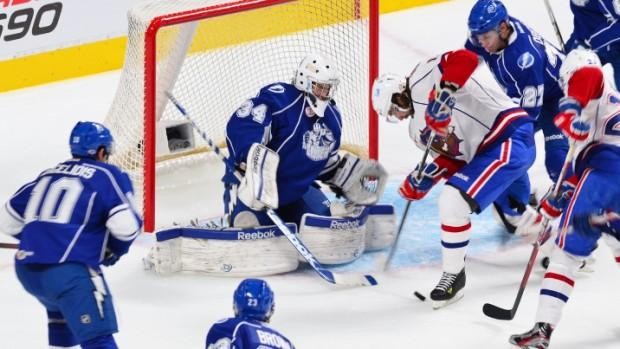
Syracuse, N.Y. — The Syracuse Crunch seemed to be handling the natural rhythms of the American Hockey League schedule quite well on Thursday.
The team trundled out of Cicero Twin Rinks, where it also practiced Monday and Wednesday after returning Sunday from two games in Norfolk. Friday the Crunch hosts Albany and Saturday Binghamton comes a calling. Sunday, Syracuse travels to a game in Rochester.
Monday the team will likely be off, in advance of a practice on Tuesday another game in Rochester on Wednesday.
A grind, indeed, but one that AHL teams have learned to milk for all the developmental benefits such work has to offer.
Until next season.
That’s when five NHL teams are breaking away and forming a new AHL alliance out west.
The group is calling itself the Pacific Division.
Considering the philosophy behind the move, however, it might as well be labeled the Practice Division.
There’s strong rumblings that the five teams will play fewer than the current 76 regular-season games, maybe all the way down into the 60s.
The teams’ core belief is that fewer games means less travel time and more hours for practice. And lots of it.
Ignore, for the moment, the reality that three of those teams (Calgary/Glens Falls, Los Angeles/Manchester, San Jose/Worcester) are leaving successful markets that are already very short bus rides away from frequent opponents.
Out with scoreboards and fans. In with more whistles, drills and tutorials.
Yawn.
While the AHL is predicated upon the foundation of development, that goal is reached via the right blend of games and practices.
And Crunch players and coaches, among presumably many others in the AHL, said they think the benefits derived from actually playing games should be valued as much as those that grow out of practice.
If not moreso.
Regardless, they think there is still plenty of time in the 76-game schedule to do both.
“I like the practice aspect of it. But there’s also a time where you can almost overdo things in practice. The games are fun. It also gives you a different aspect of the game because there’s actually defenders,” said forward Cody Kunyk.
“That’s what your job is, is to play games. You get better when you play games,” said forward Mike Angelidis. “You’ve got to step up in the moment. You’re not going to simulate a 1-0 faceoff draw at the end of practice and have the same intensity where you’re in a game. You can work on it, but to find that exact feeling, it’s not there.”
Both Angelidis and defenseman Joey Mormina noted that they’ve seen players who’ve looked great in practice but have been exposed in games.
“I think practice gives you an opportunity to work out some details of the game, a lot of footwork stuff. But at the same time, I think guys sometimes can look better in practice when they know they’re not going to get hit, there’s no threat of a fight, or having to respond for something,” Mormina said. “I think games allow more situational play, to see how a guy reacts when there’s live bullets going on. In my career, I’ve seen a ton of great practice players that once the lights come on they don’t really show up in games.”
Crunch coach Rob Zettler appreciates the equal opportunities for learning afforded by both windows of ice time. As such, they should complement each other instead of being viewed as competing ingredients of growth.
Practice sets a foundation for what players need to do in games. Games are the ultimate test of whether players can carry out the roles that will get them to the NHL.
“You teach and develop more in practice. Then, come game time, guys are into it. And they are focused on what’s going on in the game,” Zettler said. “Your information comes during practice, and the meetings prior to practice about what you want to work on, the skills, the details of the drills, the details of the game. But, every time they come on the bench (during games) you can’t expect to correct everything they do. I mean, you’re going to have a frozen hockey player out there, a guy who won’t be able to move or be creative.
“The goal is to give them the foundation with which to play inside of, and then allow some creativity inside that foundation, allow them to be hockey players. At the end of the day, they get to this level for a reason. They’re smart. They’re skilled. They’re creative. And you want to see that side of it as well.”
The one change that almost all players and coaches think would improve the development process is the elimination of three-in-three weekends. By the time the puck drops on that third game, players are often too tired to implement their lessons and the quality of play suffers.
“I think the amount of games (in a season) is fine. I just think we need to get rid of the three in threes. I think that’s the problem,” Mormina said. “When you get to a Sunday game, you’ve played two games, plus travel, I think a lot of times those games are a little sloppy. Guys tend to get hurt in those games. More of an NHL schedule would work better for us.”
But even the three-in-three wringer can offer the type of challenge that makes a better player.
“I enjoy them a lot,” said Syracuse forward Tanner Richard. “I think Sundays, you kind of have to use your brain a bit more. The games aren’t as quite high-tempo because everyone is a bit worn down and your legs are tired. It makes you go to your second nature, your habits.
“Me, personally, I like to think I’m a bit of a smarter player on the ice, with a higher hockey IQ. That’s probably one of my strengths, so I kind of like where I can just use a bit more of my head.”