Any fan of minor-league hockey can quickly identify the two most important North American leagues, namely the AHL (American Hockey League) and ECHL.
There was a time when “ECHL” was an acronym standing for “East Coast Hockey League.” Of course, when the league began establishing franchises away from the actual American east coast, the league name became more of a misnomer. However, it would have been a shame to waste decades of branding by changing the name so the league decided to retain the “ECHL” moniker despite moving westward. Technically, the letters no longer stand for anything.
These days, most hockey people either refer to the league as “The E” though many others (players included) ironically often refer to the loop as “The Coast.” The point is the league has plenty of history behind it in its 27 years of existence, enough that a number of all-time records now incorporate a “wow factor.” Wes Goldie and his 370 career goals, or the 566 career assists and 890 career points of Louis Dumont.
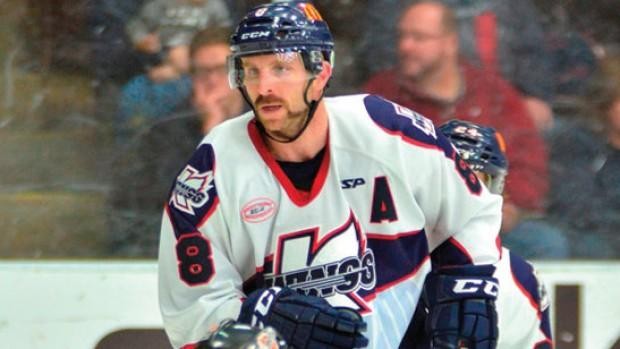
That’s where Kalamazoo Wings defenseman Sam Ftorek enters the fray. When he skated in his 790th career ECHL contest this past December 13th, he entrenched himself as the league’s all-time leader in games played passing Cam Brown. Brown, a stalwart with the likes of the Erie Panthers, Baton Rouge Kingfish and Gwinnett Gladiators, had held the mark for nearly 10 years after hanging up the blades in 2006.
It was a mark that generated plenty of excitement among fans, league officials, and the media… everyone it seems except for Sam Ftorek. It wasn’t until he received substantial feedback from all sides that he was able to better appreciate the significance of the milestone.
“It was something that I didn’t dwell on,” admits Ftorek, “but with everyone asking me about it, I kind of thought I’m real lucky to have been able to do it, especially at the minor-league level where you don’t play as many games. It just takes that much longer and to be healthy and be able to contribute, for me, I’ll always look back on it and think it’s really special.
“There was a ton of positive feedback, from guys I’ve played with in high school and college and all throughout pro. People were emailing and texting me, and saying, ‘Great job. I can’t believe you’re still playing.’ I think once the actual night came, it kind of hit home that, yeah, it’s a lot of games, it’s a lot of ice time, a lot of practices.”
For all the angst and pressure that accompanied such a significant milestone, Ftorek was likely better equipped to handle it than most. He grew up in a prominent hockey family with his father, Robbie Ftorek, excelling in both the NHL and the old World Hockey Association (WHA) for 13 seasons. After tallying 750 points in 707 career games, he went on to enjoy a lengthy coaching career for nearly 30 years including stints as head coach of the Los Angeles Kings, New Jersey Devils, and Boston Bruins. Hockey has been a way of life for Sam Ftorek for as long as he can remember.
“Pretty much all of my childhood is a fond recollection of being at the rink and hanging out with the guys,” recalls Ftorek, “being that little kid in the dressing room that everyone spoiled. I think the first time that I really realized it was when we were in Quebec. My dad was playing for the Nordiques and hockey is just at a whole other level in Quebec. He was the captain and he kind of got treated like royalty. At the ice rink, as a kid, everyone knew me and who my dad was. That was probably the first time I really realized the scope of what he was doing.”
Of course, many in a similar situation eventually feel a pull to follow in dad’s footsteps. Sometimes the parent applies pressure by trying to “set the stage” for the kids, and other times the youngster feels compelled to measure up to the parent’s expectations. Yet Ftorek maintains that in his particular case, there was no undue pressure from his father. His advice to Sam was simple but profound.
“My father said, ‘Do what you love. If you love the game of hockey, pursue it, get as much as you can from it, and enjoy it because you love it. It’s hard work, a ton of work’. I remember distinctly when I was in high school, he said, ‘Listen, if you don’t want to play, that’s fine. If you don’t want to play in college, if you don’t want to go to junior, if you quit today, I love you just the same. It’s totally your choice and there’s no pressure from me. If you pursue it, that’s great. If you don’t, then go after whatever is pulling you. If there’s something else you love to do, go after that’.
“So for me, that was the biggest one because that allowed me to pursue hockey, to pursue the game I love because that’s all I’ve known and that’s all I’ve wanted to do. So that was the biggest piece, and again, there was no pressure. If you love it, go after it.”
And that’s exactly what Ftorek did, he went after it. After three years of Division III college hockey, he turned pro with Augusta in the ECHL in 1998-99. While he has taken the occasional sojourn to other leagues along the way – various stints in Europe, a season in the AHL, as well as the International Hockey League and the Central Hockey League – he has always found his way back to the ECHL. This year marks his 14th season in the loop and he has experienced a number of changes along the way.
“It’s a better league now because there is such a close affiliation with the AHL and the NHL,” explains Ftorek. “The NHL teams now put players here too and some guys will spend the year trying to make sure they know what the pro game involves. You learn what it takes to be a pro. You need to know what your schedule is, know what your routine is, and make sure it works. They also have the affiliation with the AHL, where the AHL knows it can pull guys up from ‘The Coast’ and they’ll fit right into their systems. They’re not out of shape, and they can do what’s called upon them.”
Ftorek says the level of professionalism and sophistication in the ECHL has improved by leaps and bounds, and that the league has found its niche as a developmental platform.
“It used to be that every week there was a line brawl and every month there was a bench clearer. You had at least three guys per team that were strictly fighters and you had your older guys who made a lot of money and were very skilled but they had no desire to move up. Then you had the younger guys coming in just trying to figure it out hoping that they didn’t get beat up the first month or so. You wanted to get out of this league as quickly as possible. Now, guys come here and know that they have a chance.
“It is now truly a developmental league and it is truly a feeder system into the AHL and NHL.”
That being said, hockey teams always make room for some veteran players, guys who provide perspective, wisdom, and balance both on the ice and off. There is little doubt that such experience eventually trickles down to the youngsters, whether consciously or subconsciously. Ftorek is more than familiar with how to conduct himself in front of his younger mates, and set an example. However, he also likes to take things much further and analyze the tactical aspects of the game, to really get his hands dirty, so to speak, with the developing youngsters.
“You can’t just say, ‘Work harder,’ or, ‘Shoot more’,” says Ftorek. “So when guys ask me a question like, ‘What about our role in the defensive zone?’, I’ll say, ‘What part of it? When we’re breaking out? When they’re breaking in? Just regular coverage?’ and we’ll talk about it because a lot of the younger guys at all levels aren’t taught all the different facets of the game because it takes so much time. So when they ask a question, you really need to think about what part of it they are talking about and how minute you want to break it down because there are so many things, little tricks that I’ve learned that the younger guys don’t know. There are so many things that I’ve been told talking to my dad and his friends that these guys have never been told. I like to educate them.
What should not be overlooked, and what truly qualifies as remarkable, is the fact that Ftorek continues to take a regular shift and perform at a high level at the age of 40. During the 2013-14 campaign, he led all ECHL rearguards in scoring and was named to the First All-Star Team. Sure, experience and hockey smarts have helped him excel throughout the years but much of his longevity can also be attributed to a stringent conditioning regimen.
“I try to take care of my body as much as I can,” explains Ftorek. “In my first year of training camp with the New Jersey Devils, their strength coach Mike Vasalani said ‘You’ve got to stretch. You’ve got the flexibility of a 40 year old and you’re going to be out of the game in five years.’ So he had me stretching for 20 minutes before we worked out, and then afterwards at least a half an hour to increase my flexibility. I’ve tried to stay with that routine my whole career.
“Aside from the goalies, I’m one of the more flexible guys on the team. For me, it makes it easier to elude the big hit, and to weasel my way out of bad situations. And if I do get hit, I can kind of go with it whereas with a lot of guys who don’t stretch, and who don’t work out, they’ll have little tweaks and pulls and minor aches and pains all along the way. For me, stretching is a huge part of my day and that keeps me feeling younger than I am.”
Fans today may know Ftorek as a defenseman, but if you look back on his career statistics, you will notice he hasn’t always posted typical defenseman scoring totals. There is a valid explanation for that. He has played much of his career as a forward. Perhaps it is a reflection of his unselfish team-first approach, but when it comes to any organization’s needs, Ftorek doesn’t hesitate to speak up.
“I played forward my whole life,” he says, “and then the last two years of college, we didn’t have enough recruits so I said I’d go back and play defense. Then as a pro, I played forward up until my year in Amarillo (in the CHL in 2008-09) because we didn’t have any defensemen. I played forward when I came to Kalamazoo the first two years and then we were struggling with defensemen with injuries and call ups and I said to Nick (coach Nick Bootland), ‘Put me back on defense. You have to put me back there. No one else can do it right now.’ So he put me back there and it worked out well. And I like it.
To hear Ftorek discuss the differences in his approach to playing defense as opposed to forward, it is apparent his analytical hockey mind is always at work. He is the prototypical thinking man’s hockey player.
“Going from forward to defense, it’s just more of a mind game with me. It’s reading the play, and getting an early position instead of chasing the play around. When I was younger, I’d run around and try to force things to happen. If I wanted a turnover, I’d chase a guy even though it was a bad percentage.
“Now I know better. I know that I can’t chase a guy just because I want the puck. I angle him into a certain spot, I try to close him down and then I go after him and if I get beat, I know I can recover and it’s from a bad position. It’s not getting beat in the centre of the ice, it’s getting beat down the wall. I try to really think the game and really get into every aspect of it so I can play the percentages without actually thinking about it.”
One drawback many minor-leaguers with official “veteran status” (260 career games as an upper-level pro) must endure is the league quota allowing only four such players per team. As a result, many veterans bounce from organization to organization each year depending on which team still has room on their roster. Ftorek, on the other hand, has enjoyed a lengthy tenure in Kalamazoo and is now in his sixth season with the club. He admits he has reached a point in his career in which the stability is appreciated.
“When I was younger,” he admits, “I always looked for whatever team beat us, whatever team I thought would win a championship the next year. Then I would just move around. Then I got to Kalamazoo, and in my first year we were picked to finish dead last in the league and we ended up winning our division and our conference. We lost in the first round in overtime but everything was done the right way. I thought this is a team that’s going to rebuild and retool and be ready to go next year.
“The community is really great, too. You have Western Michigan University here, you have a ton of younger people, and you also have a great community around as well. It’s everything you could ever want for a family, but there is also plenty of stuff to do. If my wife and I just want to go out. It encapsulates everything I was looking for, both on the ice and off the ice. For us, it seems like a perfect fit.”
When Sam Ftorek mentions “us”, he is referring to his wife and three children. Family has a way of grounding you, and he still vividly recalls many of the lessons taught by his own father, Robbie. Ftorek wants his children to know and understand hockey, but he also wants them to eventually choose their own passions. For now, he acknowledges the family legacy knows what remains important.
“It’s bringing my sons to the rink and exposing them to hockey,” says Ftorek. “It’s exposing them to all the privileges they have as far as going on the ice when they don’t have school, of coming to games and hanging out on a weekend, and giving them the opportunity to decide on their own whether it’s something they like and want to follow, or to say ‘Hey, it’s not for me’.
“All my kids started putting on skates and skating after games when they were two years old. My daughter can skate fine but she’s a gymnast. My six year old is a goalie. He decided on his own it’s what he loves and wants, and he is now a goalie. And my youngest is just two and he’s kind of learning, but he loves to play down in the basement and get on the ice. He doesn’t know how to skate that well yet but he’s getting it. If any of them decide to follow me, that’s awesome and I can help them a ton. And if they don’t, I just want them to be able to experience the game.”
Inevitably, age will finally catch up with Ftorek and he will embark on the next stage of his career. It should hardly come as a surprise that his sights are set on remaining in the game he loves. Given his experience and approach to the game, coaching seems like a natural fit.
“Absolutely,” says Ftorek. “That’s what I want to do when I retire. I want to teach. I want to coach young guys about the game. I want to see them get better and move on. Hockey is a ton of work and coaching is even more so. But it’s not punching the clock or sitting behind a desk. It’s a passion and a great opportunity to have something new happen every single day and it’s something I’ve been around for my whole life. As soon as I’m done playing, I’ll be looking for a coaching job somewhere because that’s what I want to do and that’s what I live for.”
It’s hard to imagine Ftorek having many spare moments for anything beyond his family and the game he remains so passionate about. Yet he still finds time for yet another passion, something atypical of your garden-variety hockey player.
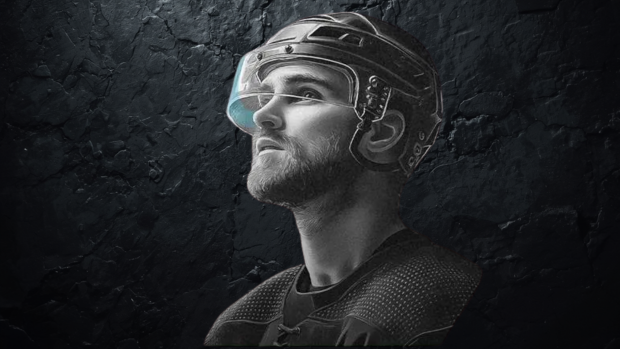
“I do artwork,” he says. “I draw. I do portraits of athletes in the heavens. So I’ll draw a picture of a hockey player taking a slap shot, for example. It’s on black paper outlined in white, and there will be a little bit of colour and some shading and the puck is a shooting star. It will go on a 16” by 24” size piece of paper because I don’t just want the player, I want the action of the puck, and then I’ll add the constellation of their birth year, the north star, the big dipper, and just fill it up and show a bunch more action than a normal picture shows.”
The concept is certainly unique and Ftorek explains how drawing has almost become therapeutic for him.
“I was a fine arts major in college and it’s a way for me to escape any pressures or stresses. I’ll get up at five in the morning, spend two hours drawing, and by that time the kids are getting up. I help them get ready for school and then I start my day and I’m free and clear of any negative thoughts.”
And that sort of perspective – the cleansing of negative thoughts – may be the ultimate reason for Sam Ftorek’s past and future success. It will certainly serve him well in a teaching capacity and as a leader. One could say his destiny is already in the stars.