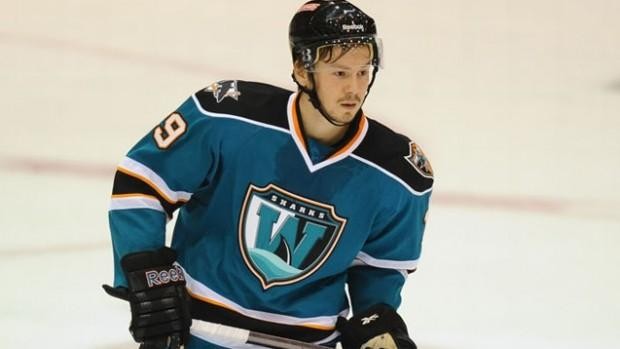
San Jose Sharks prospect Daniil Tarasov is an offensive and skilled force on the ice representing a new breed of Russian talent. Growing up, Tarasov played for Moscow’s legendary Spartak team where he developed in the Russian hockey system. At the age of 17, he made a decision to play junior hockey in North America, in the USHL. He bridged the Russian and North American hockey systems and the result was explosive offense. His talent for scoring led him to a contract with the Worcester Sharks of the American Hockey League (AHL) where he has been developing his all round game. Earlier this season, Tarasov made his NHL debut for the San Jose Sharks, and although an unfortunate injury cut his time in the NHL short, he and his Worcester teammates are currently battling in the Calder Cup playoffs with a drive and desire to win a championship.
Daniil Tarasov, from Moscow, Russia fondly remembers growing up and playing hockey in Russia. “It was very special for me,” he explains. “I started playing hockey when I was 4 years old on one of the Moscow’s biggest teams, Spartak”. The Spartak system is structured as a development program with different ages and tiers with the Spartak First Team being the professional level. “I would watch Spartak’s First team and it was very special for me to see the big club play.” Later, he moved to play for the Red Army team and after that for Dynamo Moscow.
Growing up, Tarasov’s biggest influence was his Mom. “My Dad passed away when I was young and my Mom took me to the hockey rink when I was four years old to try ice skating. I loved the game right away and I knew that hockey would be my passion for the rest of my life. My Mom was both my parents in one person, so she’s definitely the one who influenced me the most.”
Between the ages of 15 – 17, Tarasov played for Dynamo Moscow’s Second team, yet always sought to strive for the next level. “I wanted to grow as a hockey player and at the same time I knew it would be incredibly difficult for me to make the Dynamo First team. The team buys many foreign players. While for their own people, who were developed in the system, there are not a lot of chances to make the First team. While everything was going well on the Second team and my stats reflected that, I decided I had to leave, if I were to truly grow as a player.”
Tarasov does recall fond memories during his two seasons with Dynamo Moscow. “I remember how we went on trips to small cities like Saratov, Lipetsk and Voronezh. In those tournaments the atmosphere was so unique. Back then it was called First League and there were no age limits. I was 17 years old and playing with a face shield against men, some of them 30-35 years old. Now it is a bit different with the MHL, which acts as a junior league and after that the VHL which is for the most part an adult league. At the games, the stadiums were filled to the max. Everyone was yelling, cheering for their team and when you were in the penalty box these fans could spill their beer on you or say to you a few “kind” words. Overall, my experience was positive. We rode a lot of trains and busses throughout many cities in Russia. The team itself was comprised of enthusiastic guys so the whole experience was fun.”
During those times Tarasov played with some fellow Russian players who are now making an impact on the game. “I played against Evgeny Kuznetsov, Vladimir Tarasenko, Nikita Kucherov, Vladislav Namestnikov, Igor Bobkov, and Alexander Burmistrov to name a few. I played on the same team as Stas Galiev as well as Alexander Khokhlachov who is a good friend. Overall, it is very nice to see Russian players working hard to achieve their goals and going out and making it happen.”
During the 2009-10 season, Tarasov played his first North American hockey, however, the experience was tumultuous and not without controvery. “When I arrived in North America, my first game was in the Independent Junior Hockey League. I was told that I would play there for a couple of games and then the arrangement was such that Dynamo would release me and in turn I get to play in the USHL.” When he did finally play in the USHL for the Waterloo Black Hawks that year, it was for a mere two games. “I played for Waterloo for two games and then I got suspended for a year because I didn’t have a transfer card. Dynamo didn’t release me to the USHL team. To play in USHL independently you need to pay around $10 000, so I went back to playing in the Independent Junior Hockey League instead. We won the championship that year but that level wasn’t the step up for me that I was looking for.” The following season, Tarasov signed with the Indiana Ice of the USHL who paid for his transfer. He played there for the next two seasons.
The difference in hockey from Russia to the USHL as Tarasov explained, was that “USHL hockey is fast paced, physical, and based on puck possession, all on a small ice surface. Whereas, in Russia there is a large surface area and the style of play is based on passing and tactics. In Russia you can think for a couple of seconds before making a play as opposed to the USHL where it feels like guys are running at a torrent speed and there is no time to think.”
Although his initial experience playing hockey in North America was somewhat controversial, Tarasov feels he made the right decision. “If I didn’t go, I don’t even know where I would be today.”
Prior to the start of the 2011-12 season, Tarasov attended the Pittsburgh Penguins rookie camp hoping to make an impression on the Penguins brass. “NHL teams send newcomers from various junior leagues to play in a tournament to watch how they play. Well, I was called by Pittsburgh so they could watch me because the previous season I scored the most goals in the USHL. In that camp, we had three games and my team had scored only two goals in total. To stand out in that camp is very difficult because nobody passes and each player is trying to show off and showcase themselves. After the tournament, I was offered a contract in the ECHL but ended up returning to the USHL for another year.
After an impressive final season in the USHL where he registered 88 points in 60 games, the following year Tarasov signed a one-year, one-way contract with the Worcester Sharks of the AHL. “As I was playing for Indiana in the USHL, a scout for the Sharks was coming to watch another player on my team. That scout noticed how I was playing and liked my game. After the season the Sharks offered me a contract, which I signed without hesitation.”
That season didn’t exactly start as Tarasov had hoped. With the NHL-NHLPA lock-out in full effect at the start of the season, NHL clubs were permissibly assigning players on entry level NHL contracts to the AHL. As a result, Tarasov spent much of the early part of the season in the Sharks’ press box instead of on the ice. He would then be assigned to the Sharks’ ECHL affiliate at the time, the San Francisco Bulls, where he played 17 games, scoring 14 points. “Being sent to the ECHL wasn’t a problem because I knew I would get a chance to play and prove myself. To me it was good because I was already an adult professional hockey player. My time in the ECHL gave me a lot of confidence and when I was recalled to the AHL, I believed in myself and everything worked out.”
Tarasov had once led the USHL in scoring, but now, at the pro level, he was being instructed to adjust his game. “In the USHL, they only required goals from me and to be an offensive threat to the other team. When I made it to the AHL they said, ‘Daniil, if you want to play in the NHL you will need to learn to play in all three zones. We know that you can score goals but we need you to play defense and without the puck.’ I needed to learn all those small details before I had a chance to play in NHL. So I had to figure out how to play good without the puck, play defense, and how to play for the benefit of the team, not just for goals. In the AHL, it’s not always about goals and assists that gets players to the next level.”
This season, Tarasov made his much anticipated NHL debut for the San Jose Sharks, playing in Vancouver against the Canucks. “My coach phoned me and asked me where I was to which I replied, ‘resting at home’. That’s when he told me that I was being called up to the NHL. The video game controller that I was holding in my hands at the time of the call immediately fell to the ground. I just could not believe that I had finally earned the chance to play in the NHL. Coach told me that he did not know if I would play the next game or not. So the next day I flew out to join the team and when I arrived, I did not play but the Sharks won the first game. I ended up not getting to play the first five games I was there. I just skated and travelled with the team. I thought to myself, ‘when will I have a chance to play?’ It was so difficult waiting and watching. And then we went to Vancouver and I found out just before the game that I would play. When I saw my number in the lineup and knew I was playin, I quickly wrote to my best friend and my parents that I’m playing and for them to watch the game on TV. When I stepped on the ice, the energy I had was enormous and I skated like never before. In my first game, I earned my first point with an assist and later in the game somehow a stick hit me in the face which required a couple of stitches on my cheek. I could not expect a better debut and the experience was just unbelievable. Of course, it would have been even better if I would have scored. I did have a good chance but the puck just didn’t go in the net that time.”
The first assist and point Tarasov earned in the NHL was a result of a strange situation. “I broke my stick blocking a shot. I skated to my bench to grab a new stick but I don’t know what the equipment guy was doing, he ended up not giving me a stick. One of my teammates, defenseman, Brenden Dillon, gave me his stick but it was way too long for me. When I tried to make a pass from the offensive zone corner with his stick, I knew right away that this stick won’t work for me. I started skating back to the bench for a change but before I could get there the puck came right to me. I stopped and had the puck. I thought to myself, dump it back in and finish this change? But I saw my line mate Chris Tierney and I passed the puck to him. Tierney then passed the puck to Andrew Desjardins who scored. By that point I was already on the bench. Everyone started to celebrate and congratulated me on my first NHL point. I could not believe it because I got that point without my own stick.”
After playing his first NHL game, the San Jose coaches and management were delighted with his play. “I knew that my NHL debut was pretty good. And in the next game, in the first period, they let me play with Joe Thornton and Joe Pavelski. The Sharks give me a real chance to prove myself. We stepped on the ice and we almost scored a goal right away. Unfortunately, in my first shift of the second period, I injured my ankle and immediately I knew it was something serious. I tried to take the next shift but I could not play. I could not make a push off for a stride or turn fast. I finished the game by playing on pretty much one leg. For about a month after that I did not play. San Jose told me that they were sending me back to Worcester because I had not practiced for a long time. When I returned to Worcester, I did not feel the way I felt before the injury. My ankle still really hurt and I couldn’t play at my full strength. When the San Jose Sharks called me back to the NHL for the second time, my injury distracted me and for that reason I felt I could not show my full potential during that second call up. I played three games, and was then assigned back to Worcester. Now, I feel much better and confident on my skates, and am looking forward to proving myself in the NHL again.”
Despite his injury setback, there was another moment that was incredibly positive for Tarasov. The moment happened after a game the Sharks had played against the Detroit Red Wings. “I always wanted to meet Pavel Datsyuk. Pavel did not play that game because unfortunately he was injured. I talked to our assistant coach who is on good terms with Datsyuk and I asked him if he could set up a meeting for after the game as he is my favorite player. The coach replied ‘yes, of course.’ However, after the game our bus had to quickly depart so it didn’t work out to meet Pavel because he was running late. Then, on arrival in San Jose, in my stall where I gear up, there was a signed Datsyuk stick with a note saying: ‘I’m sorry we couldn’t meet, but here is my stick with an autograph’ to which I was very pleased.”
Tarasov has found his three years in Worcester as very positive for his development as a player. “Each year the team is slightly different. The relationship between players is always very good. This year especially, all players became friends and we push and support each other. It is nice to come to practice and see the guys and go to games together. It is a very positive atmosphere on the team. Outside of hockey it is also quite enjoyable. Worcester is a small town and the lifestyle reflects that. There is not much in Worcester to distract from hockey which allows me to focus on hockey, on my goals, and to work on the things I need to do to play in the NHL.”
Tarasov also holds the Professional Hockey Players Association (PHPA) in high regard and appreciates the work they do on behalf of AHL and ECHL players. “I know they help players with practically any problem. For example, they provide a great deal of guidance for players who suffer an injury. The PHPA also has programs in place that help players deal with personal problems, for example substance abuse, depression, relationship problems, etc.” What’s more Tarasov explains, “the PHPA also helps players plan for life after hockey through the Career Enhancement Program. They encourage players to seek their assistance when the need arises. In any instance, the PHPA makes the player feel comfortable and it is all confidential. The PHPA works for the players and it’s reassuring to know they are there.”
Perhaps next season Tarasov will be playing full-time in the NHL for the San Jose Sharks. He is working hard to develop his game at the AHL level and has honed in on the elements he has had to work on. He has demonstrated tremendous resolve and perseverance to battle through injury and get back to the level of play and confidence he was at prior to his injury. While the immediate future is unknown for Tarasov with his contract coming to an end after this season, he and his Worcester teammates are on the hunt for a Calder Cup Championship. He is confident that whatever happens will help him continue on his path back to the NHL.