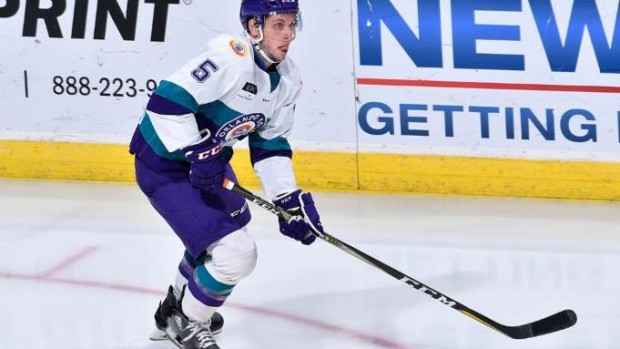
Behind all the goals, saves, and wins, the behind-the-scenes work which led to an unprecedented season often gets overlooked and forgotten. Not only the work of league and team staff as well as the Owners, but the players. Orlando Solar Bears defenseman Alexander Kuqali is one of the many players credited with aiding the launch of the 2020-21 ECHL season, and is grateful to be back playing the game he loves after an abrupt end last season.
Born in Pittsburgh, PA, Kuqali and his family moved to Dallas when he was six years old. He played minor hockey career in the area, impressing various scouts and coaches throughout the years, including Wayne Wilson, Head Coach of the Rochester Institute of Technology (RIT).
“When I spoke with Wayne, I got a really good feeling that he was interested in the complete player I considered myself,” recalls Kuqali. “He saw the potential in growing more of my offensive game. With their amazing staff and new arena, they really have the utilities to grow as a program.”
After four successful seasons with RIT, which included 2 NCAA Conference Championships, one of which as team captain, Kuqali joined head coach Greg Poss and the Florida Everblades of the ECHL immediately following his senior season. From there, he never looked back.
“The day after my senior season, I got a call from Greg and he asked if I wanted to come down and give it a shot for the remainder of the season. My brother Nicholas (Kuqali) was already playing in the ECHL with the Greenville Swamp Rabbits, which was pretty cool. So, I went down and got a couple points early before hurting my shoulder in the last game of the season. However, I impressed them enough to get invited back next season.”
Kuqali has been an ECHL regular since that 2015-16 season, having played over 200 games between the Everblades, Quad City mallards, Fort Wayne Komets, and Orlando Solar Bears and totalling over 60 points as a defenseman.
It was during the 2019-20 season, his second season with the Solar Bears, when the world took a turn. The emergence of COVID-19 seemingly shut down the world, including professional sports. The ECHL Season was cancelled on March 14th, 2020. Almost a year later, with sports making a comeback, Kuqali wanted to help make a difference in the League’s return to play efforts.
He began to take on more of a leadership role, volunteering to serve as Orlando’s Player Representative with the Professional Hockey Players’ Association (PHPA). Each Player Rep speaks to the PHPA on behalf of his teammates and brings forth any issues or questions, acting as a liaison between the team and union. Kuqali, along with Player Representatives from the other ECHL teams, were integral in getting this season started safely.
“Our Executive Committee definitely took charge in terms of communicating and working with the league and PHPA, but the Player Representatives were always part of the calls and could provide just as much input. The Reps were vital in communicating everything to their teammates consistently.”
“The situation was always fluid based on case numbers per region, meaning a lot of the talk early on was hypothetical. Once we started talking about which teams could play and have fans was when we began to see the season start to get some steam.”
A challenging aspect of this season was how to safely allow teams to operate and participate. Unfortunately, due to varying jurisdictional restrictions on fans as well as safety implications, not every team opted-in for the 2020-21 season. 12 of the 26 teams decided to opt-out and take a one-year voluntary suspension. Not only was that tough on each team and market, but also for the players who had signed and were now left to find another team.
A reason for optimism is the recent announcement of expansion teams with franchises in Coralville and Trois-Rivieres (2021-22), as well as Savannah (2022-23). However, that is not a solution to this current season.
“Essentially the more teams that opted-in, the more jobs that would be available to the players. It was unfortunate to see some really solid players, once their team opted-out and became a free agent, retire due to a lack of spots available. Obviously, they did not plan for it, but there is simply no work.”
“I know a lot of my friends are still waiting on a call for an opportunity. At the end of the day, there are only so many spots. Essentially, the pool got smaller and there is way more fish.”
After clearing several hurdles, the 2020-21 ECHL season was underway on December 11, 2020. Now, with most teams having played 14-16 games, Kuqali describes the levels of safety measures each player sees on a daily basis as consistent and noticeable.
“We each have an app and a personal thermometer, so each morning we check our temperature and fill out a questionnaire to outline any potential symptoms or concerns you may have. When we get to the rink, we are separated and tested using rapid tests on Mondays and Thursdays. Once we get the negative test we can enter the building and get ready for practice.”
“We are lucky to be partnered with Advent Health and the staff does an excellent job in terms of cleaning the facility consistently. As per their advice, we are always wearing a mask until our helmets go on, and we work with them and the team to have an approved list of restaurants we can go to. They do a very good job.”
The one question that seems to be asked consistently was asked again: Is playing this season worth it? Wouldn’t it have been easier to simply cancel the season and wait for the pandemic to slow down? Kuqali simply states, no.
“We all know what we signed up for. There will obviously be some hiccups along the way, but so far so good. We’re grateful for the opportunity to keep our love for the game going. It is also awesome for the communities; all the fans that support us each year. With people being isolated and bored, we can try and provide some optimism and entertainment through watching our games.”
Kuqali stated that each player in the league should feel comfortable reaching out to the PHPA with any questions or concerns. With this being an unprecedented season, it is important to utilize the outlets and resources given to them. This could include health insurance and off-ice benefits, housing, licensing, and other membership assistance programs.
“We know that door is always open for us. Every time I reach out, I always get a quick response, so it’s good to have that level of trust. It’s important that we simply keep that line of communication open, especially in a year like this.”
In a season like no other, it would be easy to forget the contributions from players and staff who worked tirelessly to get the season underway. Development leagues like the ECHL not only provide a value service for the American Hockey league and NHL, but also provide a livelihood for so many athletes. As Kuqali sums up, creating a safe environment to play the game can benefit so many.