He had 25 goals and 49 points in 49 games with Lowen Frankfurt, a team in Germany’s second division, when he last played in 2017-18.
“He just lives every day,” said Hunt, 33, a defenceman from Maple Ridge who signed on with the Canucks this summer after playing parts of the past eight seasons in the NHL with five different clubs. “What he went through, he beat, and to him it wasn’t a question of whether or not he was going to do it or not. It was ‘We’re just going to keep pushing forward,’ and that’s what he did.
“You come out here and you watch him and you’d just think he was a professional hockey player. If you heard his story afterwards, you’d have to be like, ‘Are you kidding me?’
“It’s an inspiration. We get to play a game and you take it for granted sometimes. When someone close to you has to go through something like that, it opens your eyes and makes you remember that you’re in a special spot to be able to do what you love.”
Once, MacLeod and Hunt “got acquainted” by dropping the gloves and fighting in their junior rookie seasons of 2005-06, when MacLeod was with the Port Coquitlam Buckeroos and Hunt was with the Ridge Meadows Flames of Pacific Junior B League. They laugh about it now, of course.
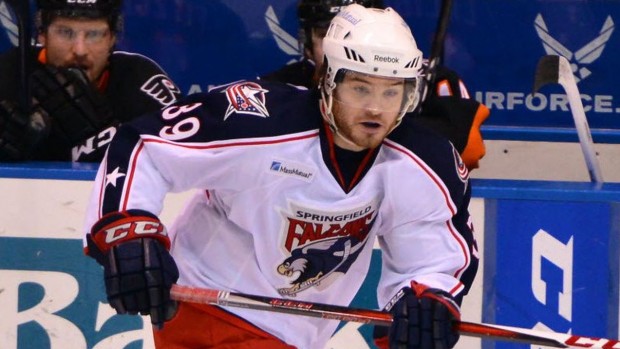
Coquitlam native MacLeod would move onto the B.C. Junior A Hockey League’s Merritt Centennials, where he finished fourth in league scoring in 2006-07 after amassing 105 points, including 51 goals. That led to him landing a scholarship at Northeastern University and four strong seasons there — 61 goals, 137 points in 149 games — led to him signing a deal with the American Hockey League’s Springfield Falcons.
In his second full season with Springfield in 2012-13, MacLeod took a heavy check along the boards in a game. He had a seizure. Doctors found the tumour in his brain as a result and he had surgery to remove it.
He underwent extensive therapy, including relearning to speak. He was fit and ready to to play again for the start of the 2013-14 season, and earned another AHL contract, this time with the Toronto Marlies.
The seizures continued. The tumours returned. There would be another three surgeries in subsequent years. There would be cancer treatments. There were hard, heavy discussions with doctors, including that one about having only three to five years to live.
“I was in denial at first,” admitted Heinonen, who has trained MacLeod in off-seasons since his college days. “After one brain surgery, we’d start working out again. After another brain surgery, we’d start working out again. It hit home when they said about the life expectancy.”
MacLeod just kept battling. He is quick to credit his wife Karly, quick to say how she’s driven so much of this. They have two daughters: Ava, 3, and Georgia, six months.
Along the way, there has been more physical, occupational and speech therapy. He changed his diet. He did hyperthermia treatments. All that was helped along by money raised via a GoFundMe effort.
He turned to Stephen Raghoobarsingh, a registered clinical counsellor who works with athletes. There were points where MacLeod didn’t have the strength to get out of bed and he would focus on goals he scored at the famed Brick Tournament when he was 10 years old, or games he had with Merritt or at Northeastern. He worked on keeping that positive mindset.
He said throughout that he wanted to go back to hockey. He did have doctors who questioned whether it was possible.
“I went along with them for the rest of that appointment and then I didn’t see them again after that,” MacLeod said. “I have a great team of doctors now and we’re all on the same page. They told me that if you can do this you can do anything, and if you want to try to play pro hockey again, then so be it.”
Through all this, MacLeod started up Headway Hockey a hockey camp that promises to help participants “make that next leap to a higher level of hockey.” It now includes online courses.
Playing with Manchester is his professional priority currently. General manager and coach Ryan Finnerty, 40, is a Lethbridge native who played in the BCHL, so he should have good background on MacLeod.
MacLeod said that his times in drills for Heinonen are continually improving and that he’s never felt better.
“I don’t want cancer to be the reason that I retire,” he said. “If I go back and I don’t have what I once had, that’s fine. But I feel like I’m fit and ready to go and my skills are there.”