You’d be hard-pressed to find someone with a better understanding of the American Hockey League, and the players within, than the Hershey Bears’ Vice President of Hockey Operations, Bryan Helmer.
“He just has such a wealth of knowledge with all the different things he’s seen in his career,” said Hershey Bears Head Coach Spencer Carbery. “He’s seen it all. When I say it all, I mean it all. He played in a ton of different organizations. He played for different coaches. He is a great resource for our organization to have as a leader of our team in the office, and at the rink every day.”
Helmer, who suited up for 1,116 AHL games throughout the course of his 20-year professional hockey career that ended in 2013, was a highly regarded leader during his playing days. With just a hair under 150 games played at the NHL level, Helmer was hardly bitter about a short NHL tenure. Rather, he embraced the idea of being a leader at the AHL level.
“He was great for the young guys because he wasn’t intimidating,” said goaltender Drew McIntyre, who split parts of the 2004-05 and 2005-06 seasons with the Grand Rapids Griffins, where Helmer was playing at the time. “He was always smiling and willing to help. I thought of guys like him when I was a veteran guy, with how he handled the younger guys when he was a vet. You learn more from those type of guys than you do from coaches.”
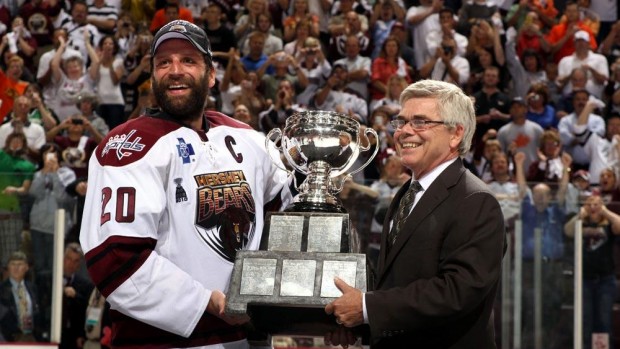
After Helmer wrapped up a very successful pro career that saw him hoist the Calder Cup on three separate occasions, transitioning into coaching seemed like a natural fit. After serving as an assistant for the OHL’s Peterborough Petes during the 2013-14 season, AHL teams had Helmer on their radar. In the summer of 2014, Troy Mann—who today is the head coach of the Belleville Senators, but at that time was running the Hershey Bears’ bench—saw Helmer at the NHL Draft in Philadelphia and he right away knew he had to zero in on his former veteran pupil. At the time, Mann thought Helmer’s positivity, among other things, would be a tremendous fit for an assistant coaching position at the AHL level.
I think one of Bryan’s biggest strengths is his people skills,” Mann told PHPA.com. “To me he was a no brainer. I thought his experiences would be instrumental for the young kids.”
After two seasons alongside Mann behind the Bears’ bench, Helmer was promoted upstairs. Since the start of the 2016-17 season, Helmer has been at the top of the Hershey Bears organization— one of the most storied organizations in the AHL’s history. Given that he’s served in so many capacities throughout a long career of working in the AHL, Helmer has an interesting perspective of the game today and how the league has evolved into a developmentally-focused league.
Helmer played in an era that was filled with veterans, later working in an AHL league that’s completely developmentally focused. As Carbery said, he’s seen it all. He understands the players of today. Because of that, Helmer is a huge advocate of the Professional Hockey Players’ Association (PHPA), the collective bargaining unit which has been representing AHL players since 1968.
We spoke with Bryan, via phone, for a Q&A:
The conversation has been edited for clarity and length.
How do you think your experience as a longtime AHL player helped you coach, and now manage, players at this level?
“I think having played so many years, towards the end of my career I was almost an extension of the coaching staff. Mentoring the young defenceman and players that I played with. It helped me transition into being an assistant coach. I can’t say enough about the American Hockey League. Obviously, I spent most of my career in it.
When you started your AHL playing career in 1993 with the Albany River Rats, the AHL was a very different league. What was the biggest difference in respect to how the league was back then, compared to now?
“It’s changed quite a bit. Back then, you had more veterans. A lot of older guys in that dressing room and it was kind of always about [the veterans] first and respecting them. I’d say over the years, that’s kind of dwindled a bit. I think there’s more younger guys in the dressing room that kind of takes over from having those groups of veterans that kind of run the show. It’s more-so a couple vets and then a big group of younger guys running the show. It’s definitely transitioned to a younger league in that way. Before, the veterans played a lot. You had to earn your ice-time as a younger player and now it’s kind of turned to the opposite where it’s more of a league where a younger guy has more opportunity to play, through the course of a season, then a veteran guy.”
What makes you so passionate about the PHPA?
“It’s an amazing organization and just to have that in hockey—I think it’s the only union within minor league sports—it helps a lot. My first couple years in the league, I was 21 years-old coming into the league you never think you’re going to be in the American Hockey League for long. I had great veterans in Albany, playing with the River Rats. I remember sitting through the PHPA meetings and they’re going through a 401K and you’re kind of like not even paying attention and then one of the veteran guys stands up and says, ‘pay attention, you young guys, because you need to invest in this because it’ll help you in the long run.’ The PHPA helped me a lot then and into the future.”
For the most part, the veterans are the ones spearheading PHPA initiatives. Sometimes, the veterans can be forgotten about by the typical fan given that they’re not prospects. But they’re still solid hockey players in their own right. Is that one of the reasons you’re so passionate about the PHPA? To be able to vouch for the veterans?
“Absolutely. One of the things that the PHPA brought in was the Career Enhancement Program. I think it was one of the best things they ever brought to the players. Hockey doesn’t last forever, playing wise. So whatever resourses they can give the players, it’s a huge benefit to them. The PHPA does a good job with taking guys step-by-step through the program and helping them find out what type of jobs would kind of fit their [skillset]. I did it towards the end of my career when I wasn’t sure what I was going to do at the end of hockey. It kind of put me in a position where I [was set up] to look at something outside of hockey, if that’s what I needed to do. I was very fortunate to be able to stay in hockey. But just having those resources for that sort of thing is going to help guys a great amount after their career.”
From your perspective, do you think today’s players fully appreciate what the PHPA is all about?
“I think they respect it for sure. 100%. It’s there to help them. But I think the younger guys coming in might not understand it. That’s why Larry Landon and the older players within dressing rooms kind of try to make sure guys understand it after the speech about the PHPA is given. There is a lot of benefits to using the PHPA and just the partners they have alone, outside the PHPA, can further help the players throughout the year and throughout their careers. I think the younger guys just don’t understand it at first, but I think after the older guys kind of explain it, they appreciate it a bit more.”
What do you think the AHL would be like if there was not a sustainable players association?
“I would hate to see it. You hear about how back in the day when they didn’t have one, there was a lot of crazy stories that almost make your hair stand up as a hockey player. I would think now, I wouldn’t say that teams would take advantage but what’s stopping them from not taking advantage if guys don’t have a union? A lot of players back in the day sacrificed a lot of their playing career to start this professional hockey players association. We owe a lot to those guys back in the day that didn’t want to put up with the way that teams were treating the players.”