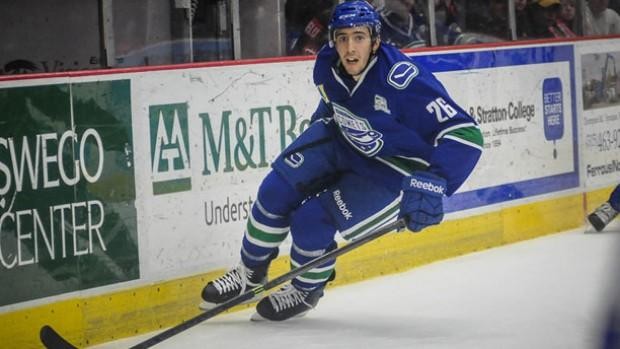
While the Vancouver Canucks will be battling for Lord Stanley’s mug this spring having recently clinched a playoff berth, their American Hockey League (AHL) affiliate, the Utica Comets, will be vying for their first Calder Cup in franchise history once the AHL playoffs get underway. Defenseman, Frank Corrado has played an integral role on both teams this season. His game doesn’t change much, whether playing in the AHL or NHL, but what makes Corrado successful is his confidence and ability to stick to his game plan. His journey from Junior, to the AHL, and onto the NHL draws on dedicated, blue collar work, representative of the proud and passionate people based in the cities where Corrado has developed his game.
Growing up in the Greater Toronto Area, at the age of 10, Corrado was already playing at a competitive level with the Toronto Junior Marlboros, which featured some notable players. “We had a really good team and I don’t think we lost a game that whole season,” recalled Corrado. “We had guys like Ryan Strome, Dougie Hamilton, and Ryan Murphy so we had a lot of good players and it was a great year. We won every tournament including the playoffs.”
Corrado cites his father as his biggest influence, having driven him to nearly every game or practice along the way. “My dad never really pushed me. He didn’t know much about hockey so he didn’t scold me or wasn’t a hard parent to deal with. He just said hockey is like anything in life you’re going to do. You just work hard at it and if you’re not going to work then maybe you shouldn’t do it.”
This sound philosophy can be applied to more than just hockey. “It was just his attitude toward the bigger picture. It wasn’t just about hockey it’s about your attitude towards whatever you do in life. You have to find your passion and for me it’s hockey so that’s what I stuck to.”
At the age of 16, Corrado was selected by the Sudbury Wolves in the second round, 25th overall, of the 2009 Ontario Hockey League draft. He admits to being nervous making the move to Sudbury and joining his new team, but remembers what it was like when he arrived at the rink for the first time. “It was a tight knit group with a lot of older guys. They made me feel right at home on my first day but still reminded me that I was a rookie, so they had some fun with that. They always had your back though and would invite you to whatever was going on like movie nights for example.”
Corrado enjoyed his experience with the Wolves noting that “Sudbury is known as a hard working, blue collared mining town. Our coach Trent Cull really wanted us to represent the city in the way we played. He wanted us to be a hardworking team who really represented the people of the city. I find when your team is representative of the city in the way you play then fans connect a little more. I have found that to be true here in Utica as well.”
Corrado has some fond memories from his experience in Sudbury and the success he shared with the Wolves. “I remember one year heading into the playoffs we were the 7th seed and we swept the second seeded Ottawa 67’s in the first round. I have never heard the Sudbury Arena so loud. Then it got even crazier when we were playing in the next round against Mississauga. Every game was sold out. Standing room only. We were the talk of the town for a long while. That’s one of my favorite moments in Sudbury. Just the way things came together even though it was a brief period of time. The fans there are unbelievably supportive. The bond in Sudbury between community and team was amazing and I loved my time there.”
In the summer of 2011, Corrado knew it was likely he would be drafted by an NHL team but at the same time, wanted to manage expectations. “I actually wasn’t ranked on Central Scouting’s list for most of the year but in the last ranking report I was placed around 155.”
Corrado and his family decided not to attend the NHL draft. Instead, he and his father played golf that day. “It was pretty nerve racking and although we tried not to do it, we were following a little on our phones. When we were on the 10th hole, I got a phone call saying that I had been selected by the Vancouver Canucks in the fifth round. We were so happy. We packed up our stuff, left the course and went home and celebrated. It was a great feeling and a little unexpected. I knew in my mind that I was probably going to be drafted but sometimes that doesn’t matter. All in all it was a nice feeling.”
After a successful first NHL training camp with the Canucks, Corrado signed a 3-year NHL entry level contract before being returned to Sudbury. Later that season, Corrado made his professional hockey debut when he was called up to the Canucks’ AHL affiliate at the time, the Chicago Wolves.
“I had just finished the season in Sudbury when Vancouver said I was going to go to Chicago to play the remainder of the year for the Wolves in the AHL.” Corrado flew out to Chicago and the next day took the morning skate. His first game was memorable but not exactly for the reason players remember their first game. “During the first period of the game, I took a shot right off the ankle. The team’s medical staff looked at it and said to not take my skate off because it will make it worse, so I kept my skate on for the entire game. I was on crutches at the airport the next day and the guys were kind of giving me a hard time, in a fun way of course.”
Midway through the 2012-13 season, Corrado was traded to the Kitchener Rangers to close out his Junior career. Following that season, he made his NHL debut against the eventual Stanley Cup Champion Chicago Blackhawks. “It was a crazy experience. I arrived in Vancouver the day before and when I got to the rink for the morning skate I was told I would be playing that night. I always had this thing in my head that I would be so nervous before my first NHL game, but it totally wasn’t like that. The guys were so nice and helped ease the nerves a little bit before the game. After my pregame routine, everything felt normal. I tried to get involved in the game as much as I could. I gave out a couple hits, which really helped me realize what was going on. I remember we won the game and clinched the North West division. It was a great feeling and very special.”
He also remembers trying to get a hit on Patrick Kane. “I think I got one decent hit on him. I remember Marian Hossa was out there and you’re lining up against him in the face off and going up against all their other great players and then you realize who they are. I think I just remember telling myself to keep skating and move my feet. You see these guys and there is a tendency to just watch and feel a little star struck so I kept telling myself to move.”
Then on April 14th, 2014, Corrado scored his first NHL goal against the Calgary Flames. “It was the last game of the year. I had been getting lots of shots off but nothing was going in, so I was saying to myself ‘keep shooting and one is going to have to go in’. It was such a relief to finally score. Their defenseman rimmed it around the boards, I picked it up and there was an open shooting lane and my shot found the back of the net. I have the puck and stick framed and put a couple pictures in it.”
WATCH: Frank Corrado score his first NHL goal
That season the Canucks kept Corrado for the opening round of the playoffs against the San Jose Sharks. Despite a disappointing sweep by the Sharks, Corrado gained a lot of positives from the experience. “It was crazy. Obviously I wish we could of have done better. It’s not fun to lose, and getting swept is never a good feeling. But you could feel the intensity and how important every battle and shift was. You could really see how guys laid everything on the line and how little room for error there was. It was similar to when I went to the World Junior Camp, where players play 3 games as hard as they can. There is no way anyone can play like that for an 82 game season but every playoff game is like that. It is definitely tough to match during the season which is why playoffs are so valuable for players and their learning.”
Commenting on transitioning from the AHL to NHL, Corrado explains “it isn’t so hard as they are both great leagues. I think as you get higher in the levels, the hockey does not get easier but everything is a little more structured and I think if you understand the game well then all you have to do is use your skills and use your toolbox and you will fit right in.”
Corrado describes the way he plays and regardless whether he is in the AHL or NHL he plays the same way. “I am a two way defenseman with a great first pass to transition the puck ahead quickly. I am a good skater, and play strong defensively. I can chip in offensively but probably won’t overload the blue line with points.”
This is the way he played when called upon by the Canucks earlier this season when integral members of the team’s blue line suffered from injuries. Corrado rose to the occasion playing 10 games, and taking on a big responsibility for the team.
“I think I have become more mature in how I play. At times in the past I would do a little too much and move the puck a little slow. Now I move the puck up very quickly. I am stronger in the corners to win battles. I think the more you play the more you find ways to win the little battles. There are just little subtle keys to the game that you have to learn on your own. With the Canucks this year I got more ice time which is great. When you’re playing a role in the top 6 you have to be really dedicated to a defense first mentality, especially in the NHL. When you can keep an opposing NHL team down to one or two goals in a game, then you have done your job as a defenseman.”
Corrado is proud to be a member of the Vancouver Canucks organization and explains what makes the team so special. “The team has so many great, class act guys. Some are older and have been through what you are going through. They are very welcoming and even the way they talk and treat each other as professionals, there is no negativity in that room. That’s why the young kids are thriving there. It is really easy to fit right in. We play soccer before the game to get loose, music is blasting before the game and after a win music again blasting. There are even some fun pranks played here and there to keep things loose. It’s a really good group to be a part of.”
Transitioning to different teams and leagues is something Corrado has experienced, including a unique situation during the 2012-13 season, where Corrado played in the OHL for Sudbury and Kitchener, in the AHL with Chicago, and the NHL with Vancouver all in the same season. “I find with hockey generally that when you get into a new dressing room, it doesn’t take long for guys to start talking to you, cracking jokes, and talking about times maybe you played against each other. There is always an ice breaker. If it’s a team with 20 new guys, then it has the potential for 20 new friendships. Hockey guys are class acts and it’s never too hard to enter a new room.”
Currently Corrado is enjoying his time in Utica with the Comets who are poised to make a strong run in the Calder Cup Playoffs. “Utica has a pretty cool thing going here. The team reminds me a lot like the way it was in Sudbury. It’s a hard working blue collar town and we are a hard working blue collar team. We don’t give up on any games, and we don’t give up on any loose pucks or battles. I think the fans are so proud of their city, they don’t chant ‘Lets go Comets!’ they chant ‘U-TI-CA!’ They are incredibly passionate about the team and they come to support us every night.”
He further explains the team dynamic and being part of a tight knit roster. “Everyone on this team, from the young guys to the veterans, have had a part in making this team a winner. Everyone plays a big role. All these guys here have the potential to play in the NHL. It is great to have such a dressing room where everyone knows that they bring something to the table regardless if they’re playing on the fourth or first line.”
Corrado also explained his interaction with the Professional Hockey Players Association (PHPA), the union for players in the AHL and ECHL. “PHPA staff visit each team at the start of every year and they are always sending us correspondence about certain things throughout the season. Now they have a PHPA mobile app where they can send messages directly to the players. So that’s been a pretty effective tool for the union. They do a lot for us, and there’s been a lot of good things they have put in place so it’s nice to know our union has our backs whether it would be the PHPA or NHLPA.”
The Canucks and their fans have a lot to be excited about in Frank Corrado. This season, a deep run into the playoffs would only solidify the progress and development of his game. And beyond being an excellent player, he is an incredibly humble, polite, and personable human being. He is extremely proud to have played in cities with passionate fans, and his game and the way he conducts himself both on and off the ice is reflective of that.