In an era where player safety has become of paramount importance in every professional sports league, we are seeing games begin to change. In hockey, the attempted change is to minimize, if not completely eliminate fighting from the game.
Some will agree that fighting does need to be taken out of the game. Others, like legendary enforcer Steve MacIntyre disagree.
“I don’t even watch hockey much anymore because it’s such a different game. They don’t hit. It’s actually painful for me to watch,” MacIntyre said. “When you play a game, and you play it the right way you play hard and you hit hard. Today it’s like everyone is wrapped in bubble wrap. That’s the sad part.”
MacIntyre made a 14-year professional career for himself by serving as ‘the enforcer,’ fighting and protecting teammates whenever his number was called upon. Now, a year into his retirement, MacIntyre is still utilizing those protective instincts as a he pursues a second career as a Firefighter and Emergency Medical Technician (EMT). Whether on the ice or off, Steve “Big Mac” MacIntyre has a passion for protecting others.
Like so many Canadian-born professional hockey players, present and former, MacIntyre was introduced to the game at a very young age simply because hockey is basically a rite of passage for young athletes growing up in Canada.
“Back home in Saskatchewan that was what you did. There really wasn’t much else to do other than farm, feed cows, and play hockey,” MacIntyre said.
MacIntyre admits that he was different than most hockey players in that he never said to himself, ‘I’m going to grow up and play hockey professionally.’
“I was probably 18 or so and I loved scrapping and I loved scoring goals,” MacIntyre recalls. “I realized I was better at scrapping than scoring goals and then it just continued from there.”
‘Continuing from there’ meant playing three seasons of junior in the Western Hockey League (WHL). MacIntyre played his first two seasons with the Saskatoon Blades, while his final season was split between the Red Deer Rebels and Prince Albert Raiders during the 1999-00 season. He also played a fourth season the following year with the Bay County Blizzard of the now defunct Continental Elite Hockey League (CEHL).
“Back then (in the late 1990’s), you didn’t really think or dream about playing college hockey. You were just focusing on getting drafted. It’s a different mindset,” MacIntyre said. “Now, you see people trying to go to college to get that scholarship and extra playing experience. Hindsight is 20/20.”
Reflecting on his three years in the WHL, MacIntyre says it had its ups and downs but overall was a great, very fun experience which prepared him for the next level. One memory that sticks out is being traded during his third year to Prince Albert, learning the ever valuable lesson that sports is a business.
“The first time I got traded was like a big kick to the stomach. It’s part of the game but ultimately you are in charge of yourself and you can control how you react,” MacIntyre said..”
For the first few years of his professional career MacIntyre bounced around among low-level and mid-level professional leagues. Though this time he kept putting in the time and effort honing his craft. MacIntyre quickly became known as one of the most feared fighters in professional hockey. A title he kept over the next decade as he saw action in all three major professional leagues; the ECHL, American Hockey League (AHL), and National Hockey League (NHL). A title he embraces today with mixed emotions.
“Well you know, it is what it is. It’s a good thing and a bad thing. I was respected as a fighter, but at the same time I was labeled as (just) a fighter,” MacIntyre said. “At the end of the day, I did a job I was good at, I was helping out my teammates and I was proud of it.”
It’s not surprising that as MacIntyre went from one level to the next throughout his career he noticed that there were obvious differences from league to league.
“Obviously, these guys are elite players who are on top of their game,” MacIntyre said. “When I got to the NHL and I would be sitting back watching some of these guys like Sidney Crosby practice I would just say to myself, ‘Wow, I don’t even belong on the same ice with these guys.’ They were good at what they did, I was good at what I did, and everyone had a different job. That’s how I started to look at it.”
Hindsight is in fact 20/20 as MacIntyre says, and if you look back on the career of Steve MacIntyre you would say almost instantaneously that he had a great career. Having managed a 14-year professional career, logged 91 NHL games, and was one of the NHL’s most feared and respected fighters wasn’t easy. There were many tough days during his lengthy tenure in the ranks of professional hockey.
One such tough day was the day of the NHL Draft when MacIntyre didn’t hear his game get called.
“Yeah going undrafted sucked, but you don’t take it personal. Sure, I was a little bitter but it does give you some extra incentive to work hard, be successful, and prove them wrong.”
Another tough wakeup call for the 6’5, 250-pound winger was his first NHL fight, which MacIntyre admits, did not go according to plan.
“My very first fight, I got destroyed. I went from fighting boys to men and was like ‘whoa’. These guys are a lot bigger, tougher, and stronger,” MacIntyre said. “I got my lip split open and needed seven stiches that first fight. It was a learning experience for sure, but I got that guy back two or three times during my career,” he chuckled.
But an NHL career is like anything in life having both ups as well as downs. Going undrafted, getting traded and getting beaten up in a first fight would be the low points. Outscoring NHL superstar Alexander Ovechkin in one game on the other hand would be one of the high points.
“I’m not going to shortchange myself, there was one game where I actually out-goaled Alexander Ovechkin. I had one goal and he had zero,” MacIntyre said laughing. “We ended up winning that game 5-2 I think but that was actually my first NHL goal so it was a very memorable game for me.”
WATCH: Steve MacIntyre score his first NHL goal
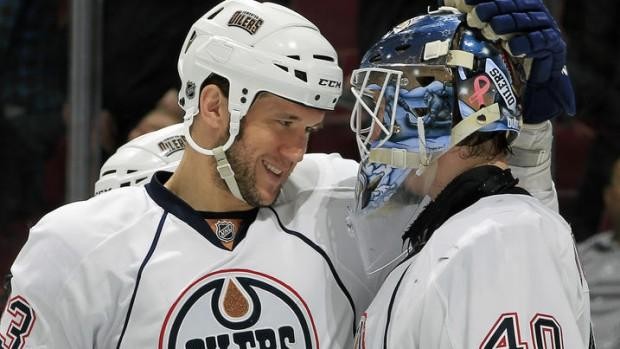
The “first NHL goal milestone “came on January 13, 2009 against the Washington Capitals when he was playing as a member of the Edmonton Oilers. Although that memory is certainly a special one that MacIntyre will never forget, it may not be as special as when he was picked up on waivers by the Edmonton Oilers and two days later, played his first NHL game on October 3rd, against the Oilers’ arch-rivals, the Calgary Flames.
“When I was picked up by Edmonton, I was like ‘I can’t believe this, this is great!’ They were always my favorite team growing up in Saskatchewan. It’s like being from Boston or New York and being able to play for the Red Sox or Yankees. Being able to play for the team I grew up rooting for and cheering for is the highlight of my career to be honest.”
Another added bonus of playing close to home and for the hometown team that MacIntyre relished was having the opportunity to play in front of friends and family more, especially his parents who he credits as the single biggest influence on his hockey career.
“I’d say my parents were the biggest influence on my career. Whenever I was going through a bad situation they were always the first ones to help or encourage me, just telling me to keep going, keep going,” MacIntyre said. “Just put your nose to the grindstone, just put your head down, and keep working. That was our family motto.”
Hockey is a dangerous game to begin with, and as an enforcer the game becomes inherently more dangerous. Admittedly, that increased risk that came with MacIntyre’s role as enforcer was worrisome for friends and family.
“Mom and Dad didn’t like it too much,” MacIntyre said. “But, it was one of those situations where, they didn’t like it, but they knew that if I wanted to continue my career, that was how it was going to be.”
He further credited his parents for the longevity of his career which lasted almost a decade and a half, a remarkable feat for any professional athlete let alone an NHL enforcer.
“Mom and Dad instilled in me that hard-working mentality. Plus, my own stubbornness, never wanting to leave my teammates out to dry. I think that all helped me have such a long career.”
In addition to all the help and support he received from friends and family he also commended his teammates for helping him through the tough days.
“Some days were definitely tougher than others and yeah there were certainly days when I said to myself, ‘man I wish I didn’t have to fight today,’” MacIntyre said. “But, on those days your teammates will help you out. The great teammates are the ones that will help you through it. My career was definitely tough at times, but I wouldn’t trade it for anything because it helped me become a better person in the end.”
MacIntyre elaborated further on some of the great life lessons he learned over his 14-year career, specifically the importance of hard work, dedication, perseverance, and not giving up and not taking no for an answer.
One thing that may surprise fans about Steve MacIntyre, a big powerful tough-guy, who had a reputation as one of the toughest guys in the league is that he was actually a little scared every time the fists began to fly.
“Every fighter out there is a tough fighter. Every dog has his day,” MacIntyre said. “I was always a little scared every fight I went into, if you can go into a fight and not be scared, then I think something might be wrong with you. Personally I was always worried any time I went into a scrap, who wouldn’t be?”
MacIntyre went on to say that the toughest fighter he battled with throughout his career had to be Eric Godard.
“Man, every time we fought, something was breaking. I’d break his nose, or he’d break my face. We fought, and we fought hard,” MacIntyre recalled. “Even though we battled a lot there was a mutual respect between us. He respected me and I respected him as a fighter.”
The toughest day in the life of any professional athlete is the day he or she must leave the game they love. In some instances this is the one that they have played for almost their entire life. This trend holds true for Steve MacIntyre.
“(When it’s time to retire), you just know. It’s sounds cliché, but things change throughout your career and you just know when it’s time. You have to move on.”
Moving on is exactly what MacIntyre has been able to do since leaving the game a little over a year ago. He is well on his way towards a second career as a firefighter. Thus, proving that whether on the ice or off, Steve “Big Mac” MacIntyre, is a team player with a deep passion for protecting others through team work.
“I’m trying to get a firefighting job. I have always been interested in firefighting, when I was younger I wanted to be a police officer or firefighter,” MacIntyre remembers. “I sat down with my dad and he went over the pros and cons of each job. I could never really see myself in a desk job.”
MacIntyre went on to say that when the Professional Hockey Players’ Association (PHPA) began to offer a firefighting program (Fire and Emergency Services Training Institute) customized for players, it was the perfect opportunity to live out another childhood dream.
“It was awesome to have a program that was built around us and our schedules,” MacIntyre said. “During my last year of hockey, I started thinking about the program and just decided, I’m going to do it, see what it’s all about and get my certification and go in that direction.”
With becoming a firefighter as the ultimate goal, a very competitive job, MacIntyre knew he must stand out and diversify himself from everyone else to reach his goal. He has taken steps to accomplish that by working to becoming a certified EMT.
“It’s hard to get a firefighting job since so many people want to be a firefighter, there’s a lot of competition for those jobs,” MacIntyre said. “I think by becoming EMT certified, it will help me stand out and also further prepare me for being a firefighter. I’m trying to build my resume so when I go in for my site testing or (firefighting) interview as a guy with my experience and being a little older the extra qualifications may lead them to take a chance on me.”
MacIntyre acknowledges that there are obvious parallels between his role as “the enforcer” and a firefighter.
“As firefighters we are going in there to help people in bad situations and for me it was a no brainer to do this. Going back to my (hockey) career that was my job to watch over my teammates and have their back,” MacIntyre said. “It’s the same thing with firefighting. You are part of a team and you are depending on each other. It has that team aspect, that team mindset.”
Though both careers have similarities, MacIntyre knows that there will certainly be a transition period, and it may not be a smooth one, but that does not intimidate him.
“I know there will be a transition and it may not be smooth necessarily because I am 35 years-old and younger guys are going to have more seniority so it will be an adjustment but everyone has to pay their dues. That’s not any different in hockey or firefighting. The best man will get the job,” MacIntyre said.
MacIntyre further elaborated that yet another way in which hockey and firefighting are analogous is the way in which they are very regimented.
“In firefighting, there is a routine. There are things that you do, and there are things that you do not do. That’s the same as hockey. That basic sense of structure is the same,” MacIntyre said.
Just as his journey to the NHL was a long and arduous one, his path to being a full-time firefighter will be the same.
“It takes a while to get in as a firefighter and even to just take all of your tests, the selection process is very tough. Everybody wants to do it since it’s such a great job,” MacIntyre said with pride.
At this point, it is easy to see that MacIntye is doing everything in his power to pursue a career as a firefighter. With firefighting certifications and EMT certification added to his resume, coupled with a 14-year professional hockey career, his ultimate goal is well within his reach. His resume is impressive, yes, but what is far more impressive is Steve “Big Mac” MacIntyre’s passion for protecting others, that is what makes him the person he is today, that desire to be a team player, to help and protect others.