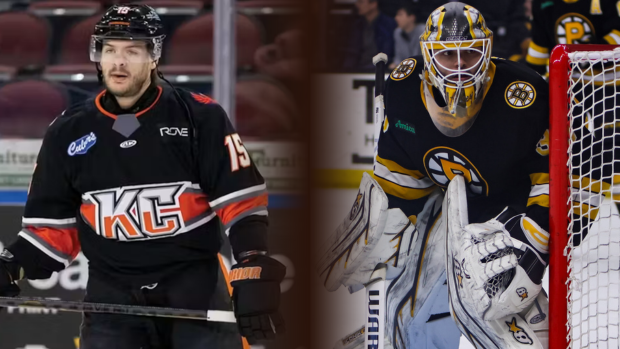
Stepping onto the ice at the Löfbergs Arena in the Swedish city of Karlstad, goaltender Justin Pogge finds himself a long way from his hometown of Penticton, BC. Fondly remembered by many for his outstanding gold medal winning performance for Canada at the 2006 World Junior Hockey Championship, and pegged as one of the next great future NHL talents, Pogge now plays for Färjestad BK of the Swedish Hockey League (SHL). Though linked with adversity throughout his career, Pogge’s transition to European hockey has brought about an inspired resurgence in the 29-year old goaltender, who is still eyeing a return to the National Hockey League.
Coming off a glowing junior career where Pogge posted a 79-49-13 record and was named the 2006 Western Hockey League Most Valuable Player, it was easy to see why the Toronto Maple Leafs were salivating over their ‘goalie of the future’. He would be assigned to the Toronto Marlies of the American Hockey League (AHL) to gain experience at the professional level. Although Pogge continued to impress, posting 71 wins over the next 3 seasons, he and the team were still searching for that consistent form.
At last, during the 2008-09 season, his third with the Marlies, Pogge was recalled to join the Leafs, and made his long awaited NHL debut on December 22, 2008, a 6-2 victory over the Atlanta Thrashers. “It was a complete honour to go up and play in the NHL,” explained Pogge. “It was a short time but I got to play games. I’ll always have that with me and I am still itching for a chance to get back.”
During his stint with the Leafs, Pogge posted a 1-4-1 record and would eventually be reassigned back to the Marlies. Reflecting on the earlier stage of his pro career, Pogge offers some insight into the pressure filled environment of playing in a hockey mecca. “I think I would have asked for more help while I was there. I kind of had this feeling when I was younger that Toronto would eat me alive if I stayed there over the summer. Toronto was such a big city and I was always tempted to go back home. In hindsight if I would have stayed more and worked with the tools that they had available it would’ve helped me a lot.”
The following season, Pogge was traded by the Leafs to the Anaheim Ducks, kick starting a number of moves which saw the young goaltender play for five teams over three seasons. Though sporting a .909 save percentage and a winning record with each of San Antonio (AHL), Bakersfield (ECHL), Albany (AHL), Charlotte (AHL) and Portland (AHL), Pogge could not seem to lock down a permanent home.
Facing an uphill battle, he made a strategic decision to leave North America ahead of an impending NHL lockout in 2012 to pursue opportunities overseas.
Pogge signed with Ritten Renon of the Italy-A league and quickly took a shining to European hockey, setting a career best 2.16 goals against average (GAA) and matching his best wins total (29). “I think the challenges along the way help you cope with every single situation that is thrown at you, because it is likely throughout your years you have faced a similar instance. You know what you can do. It definitely builds confidence,” said Pogge.
Confidence was at a surplus for the Canadian backstopper, who the following year turned heads again with an even lower GAA (2.01) and a stunning 8 shutouts with Bofors IK. One of those heads belonged to a scout with a top SHL team; Färjestad BK, who snapped up Pogge for the 2014-15 season.
A storied club in Sweden who in 2014 took on a team of American Hockey League All-Stars in St. John’s, Newfoundland as part of the AHL All-Star Classic, Pogge has noticed the positive community and club-like atmosphere of Färjestad BK. “In Europe, the top of the club is the team you strive to play for. The coaches teach the same program through all the levels of the club, and when players finally reach the top team they already have the systems in place, and have proven they deserve the opportunity.”
Pogge’s positive impact on different European squads showed he was deserving of an opportunity with Färjestad. “I feel that because of my journeyman status and experience, I’m such a different person now than what I was at 21 years old and getting my first shot in the NHL. I’ve come a long way since then and my game is proving the point.”
Now entering his second season in the SHL, it is clear Pogge is not willing to let up. “I’m looking forward to setting the tone for myself in this league.” While in Sweden’s top division in 2014-15, Pogge put up a .926 SV%, 2.01 GAA and 4 shutouts, continuing his run of great form in Europe. “When I did take the job in Italy, which is a long ways away when you are looking to get back to the NHL, I knew I eventually wanted to get to Sweden’s top division because of all the quality goaltenders coming out of that league. It’s amazing, the goalie coaches are great.”
The decision has clearly paid off for Pogge who has continuously developed his game in a European environment that differs from his North American home, something Pogge states has been a breath of fresh air. “The way of life in Europe creates a different transition. It almost makes the hockey side easier because you really only have to worry about yourself. You don’t have to wonder if the GM is watching, the (NHL) club watching, which scouts are in the building. You know you are there to do your job, to perform. Before you even step on the ice you know you have all that other stuff off your back.”
When asked what advice Pogge has for players coming over to Europe, he is quick to point out “There is a lot that North American players will face when heading to play in Europe. Contract negotiation is huge. Everything you want and need has to be in writing. Go over the contract with a fine-toothed comb. While I say that, many European clubs are very honorable, but if you don’t ask for it you won’t get it.”
It may seem like a challenge for North American players who are aided in the AHL and ECHL by the Professional Hockey Players’ Association (PHPA), which Pogge identifies as a great resource, having served as a PHPA Player Representative during his time with the Marlies. “The PHPA has done an excellent job at providing those basic needs for players. There is so much paperwork involved in our careers, and it’s difficult to deal with all of those things. The PHPA simplifies it. You can call the office and ask for help with anything. I still call and I’m not even a member anymore. They are very helpful and I’m grateful for all they’ve done.”
It isn’t all hockey and paperwork for the once heralded Pogge, who has embraced a move overseas with his wife, Christina. “For the most part the European life is great. You get a lot of downtime and opportunity to travel. Everything is so close, I think my wife and I have been to 14 countries in the last 3 years, and we plan on going to more.”
While the NHL and SHL are physically thousands of miles apart, Justin Pogge’s relentless drive has brought the reality of returning to the NHL that much closer. “I haven’t lost that dream of being a regular in the NHL. When I first came to Europe I set up a 5-year plan where I wanted to be back in North America and in the NHL at the conclusion of those 5 years.”
When asked how the plan is progressing, Pogge confidently responded, “Having goals in mind has been a helpful tool. I’m now in the 4th year of the plan, playing in the SHL, and right on par with where I want to be. I just have to make that last step.”
With his competitive drive, impressive play, and statistics to match, Justin Pogge’s long road home may very well lead back through the NHL, if given the opportunity he has been working toward.