The toughest man in hockey is tired and hurting, but he doesn’t want to talk about it. Doesn’t want to give his opponents, after all these years, a weakness to see or a bull’s-eye to target. Doesn’t willingly acknowledge the bumps, breaks and bruises of the past — the busted orbital bones, the blown MCLs, the sprained ACLs, and the like.
No.
Instead, he winces while he says he’s fine, and expresses great appreciation — for the chance to play the game, for the life hockey has given him, for the coach who told him after one of his first junior games that he “should give something else a try because you’re not going to make it in hockey.”
That was a couple of decades back, and big Steve MacIntyre is still making it in hockey. The colorful tattoo that wanders from his hefty right arm across his shoulder to his chest is emblematic of his career. It is a representation of the 23rd Psalm, with the whole Michael-and-angels-and-demons-and-walking-through-the valley-of-death thing. Only, in MacIntyre’s case, he’s skating through.
“I’ve skated through the hills and valleys,” he says. “Trying to keep a straight path.”
MacIntyre’s path has been anything but straight. He’s skated through — and for — the Saskatoon Blades, the Red Deer Rebels, the Prince Albert Raiders, the Medicine Hat Tigers, the Bay County Blizzard, the Muskegon Fury, the St. Jean Mission, the Charlotte Checkers, the Hartford Wolf Pack, the Jacksonville Barracudas, the Quad City Mallards, the Providence Bruins, the Rochester Americans, the Wilkes-Barre/Scranton Penguins, the Oklahoma City Barons, the Norfolk Admirals, and, now, finally, the Utah Grizzlies.
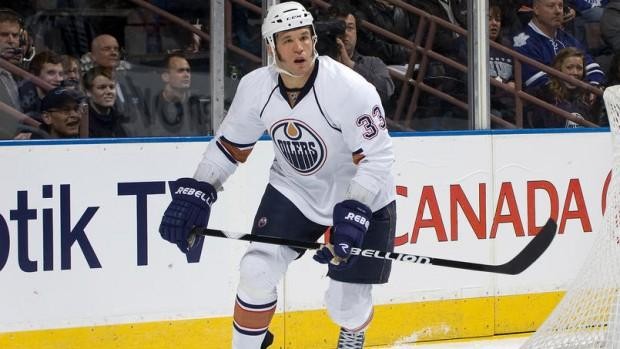
He also played for the Edmonton Oilers, the Florida Panthers and the Pittsburgh Penguins.
Utah is likely his last stop, and edging up on his 35th birthday — he’s older than his head coach, Tim Branham — MacIntyre alternates and undulates between anxiety and amazement, holding onto the present, and getting a bit misty-eyed over the past, reflecting on the far-flung places the ice has taken him.
“I’ve seen the good and the bad,” he says. “Playing hockey, it’s been fun and it’s been a job. I’ve played at low levels and at the highest level. There are hardships and sacrifices along the way. At some point, you realize that there will be life after hockey. It’s exciting and scary — in the twilight of my career.”
MacIntyre — known as “Big Mac” by his teammates — started playing hockey in his youth, growing up on a farm in Brock, Saskatchewan. There were basically two things to do there — play hockey and do rodeo, and MacIntyre did both: “You had to make your own fun,” he says.
The farm kid wasn’t the fastest skater or most gifted puck handler, but he was one of the strongest players. He grew to be 6-foot-5 and 250 pounds and started in professional hockey as a teenager. There were times when the speed of the game frustrated him and, at one juncture, he nearly quit. An influential coach, when MacIntyre informed him that he planned on packing up and going home, spoke words Mac never forgot. “He told me, ‘If you do that, you’ll quit and go on quitting the rest of your life.’ That was good to hear. Some people tell you, ‘You’re too big, you’re too slow, you’re too dumb.’ I found out for myself I could play this game.”
Not only could he play it, he could also police it. MacIntyre became known as an enforcer, a man who stood behind his more diminutive teammates, protecting them from the bullies on the ice. It’s a role that didn’t match his laidback personality, but one for which he understood the need.
“I take pride in playing hard-nosed hockey,” he says. “I’m not a bully. But if someone is in a bad situation, I take care of business. You want to make a name for yourself, you want respect. [Opponents] knew that if they took liberties with my teammates, they’d have to pay the piper. I was always proud of taking care of my guys, kind of like a mother hen, or, I don’t know, maybe a sheepdog.”
Nobody in the ECHL, hockey’s Double-A league where the Grizzlies play, messes much with MacIntyre. One club official says he is known as the “toughest man in hockey,” a title he laughs at — sort of. Even humble tough guys love being called tough.
He gained his rugged reputation long ago, from the game’s backwaters up through the NHL, and now, on the backside of the mountain, the younger players, younger opponents, want to keep peace with him. Standing on his blades, he looks massive on the ice, and his rep precedes him, long before he laces up.
His size and strength are manifested in more than the fight game. During a recent test, the Grizzlies determined that MacIntyre has the fastest slap shot of any of the club’s players, at 103 mph. He seems to take satisfaction at that because he never solely intended to go out of his way to beat people up.
“I like to play physical,” he says. “I’m not looking to create a circus sideshow, although, sometimes that kind of thing happens. Sometimes things get crazy. I just take care of my guys out there. We’re a family.”
Says the Grizzlies’ Branham: “Steve is a true professional. His leadership in the locker room is tremendous and his play on the ice has been great. He’s a huge part of our success this season.”
The highlight of MacIntyre’s career may have been when he was first called up to the Edmonton Oilers, the team for which he rooted as a kid. After laboring in the bushes for so many seasons, donning the Oiler sweater was an emotional deal.
“I said to myself, ‘This is so cool.’ I had tears in my eyes,” he says.
His year in Pittsburgh (2011-12), playing with Sidney Crosby, brought nightly highlights: “He is one of the most humble guys you’ll ever meet,” MacIntyre says. “But unbelievably talented. Sometimes, I’d just sit there and watch him. It was mesmerizing. He’s a competitor. He’ll do whatever it takes to win.”
The lowlight for MacIntyre, who is married and has three children, was being forced to move so often. Ever the journeyman, just as he’d get to know many of his teammates, get acclimated to a city or town, it was time to move on. “I think I went an entire year without going home,” he says. “You miss out on a lot of things. It’s a sacrifice you have to make.”
His wife and kids live during the season in North Carolina, where MacIntyre suspects he’ll end up retiring. He plans on learning to be a firefighter in the coming months and starting his second career.
Finishing up his hockey in Utah is a bonus for him, he says. He likes the state, enjoys hunting and fishing — if he ever had time for such recreation. He would love for some cowboy ranch or rodeo to allow him to do a little roping during whatever down time he can find.
Meanwhile, he’ll complete this season trying to give his teammates whatever instruction and advice and inspiration he can.
“Mostly, I just tell them to go play, and have fun playing,” he says, rubbing his shoulder. “I’ve had a great run doing this. It’s been a good time, a good career.”
A good life, despite the leftover aches and pains.
“Yeah,” he says. “I hurt everywhere.”