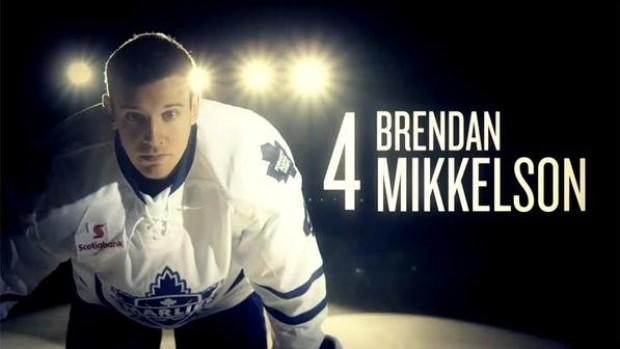
Veteran defenceman, Brendan Mikkelson is taking his game to Sweden this season to play for Luleå HF of the Swedish Hockey League (SHL) after eight seasons split between the American Hockey League (AHL) and NHL. Mikkelson is known for his passing, mobility, and quick transition game which will allow him to excel on the larger European ice this season where he has already begun playing.
Originally a second round pick, 31st overall, by the Anaheim Ducks in 2005, Mikkelson has had the great fortune of playing alongside some hockey legends such as Scott Niedermayer and Chris Pronger who he credits as helping develop his overall game. More recently, he has been mentoring promising young prospects such as Scott Harrington while playing together for the Wilkes-Barre / Scranton Penguins. Focused on his own professional development, Mikkelson decided to make the journey overseas.
Born in Regina, Saskatchewan but raised in St. Albert, Alberta, Mikkelson grew up playing on the outdoor rinks. “When I think back to my childhood, I think about all the time I spent out there on the outdoor rink. That is definitely a big reason why I am where I am now. Also, I remember summer hockey leagues that I played in. We always seemed to have pretty good teams.”
Brendan comes from a hockey family with a great legacy. His father, Bill Mikkelson played in the NHL for the Los Angeles Kings, New York Islanders, and Washington Capitals during the 1970’s. Brendan’s sister Meaghan played for team Canada and won gold at the 2010 and 2014 Olympics. Brendan’s great uncle Jim McFadden was awarded the Calder Trophy as NHL Rookie of the Year in 1948, while winning the Stanley Cup in 1950 with the Detroit Red Wings.
When asked who were his biggest influences growing up, Mikkelson had difficulty responding. “There have been so many people that influenced me. Obviously, I credit my parents. They worked and paid for everything so I could pursue my dream. They drove me to games and practices after their work, early in the mornings, on late nights and on weekends. Throughout the years all my coaches influenced me in some ways. They had different philosophies and different ways of seeing the game. You can take little bits from everyone and try to learn from that. In Vancouver, I played for Don Hay. He pushed me and made me work hard and expected a lot from everyone. I learned a lot from him as far as routine and discipline. It was not always fun at times, but he is there to make everyone better. In Junior, I was lucky enough to play with Braydon Coburn who now is in Tampa Bay. I really looked up to the way he carried himself and how professional he was. I was 16 and he was 18 years old so it really benefited me watching him work hard and learning from him.”
While excelling in Bantam, Mikkelson was noticed by the Portland Winter Hawks who selected him in the sixth round of the 2002 WHL Bantam Draft. He went on to play three seasons with the Winterhawks. “Portland is one of the nicest cities I have ever been to. It was a pretty awesome experience. I got to go to a big city with a strong team and the fans there were so great and supportive. On top of that going to school and living in the US was very exciting.”
Mikkelson was traded to the Vancouver Giants during the 2005-06 season where the team would go on to some memorable playoff runs. “The year I was traded I got injured and missed a lot of that season. That year the team went to the Memorial Cup Final but ended up losing to Moncton.”
The following season (2006-07) the Giants won the right to host the Memorial Cup Tournament, yet were determined to enter the event as WHL Champions. What Brendan remembers most was the show down in the playoffs for WHL supremacy between powerhouses Medicine Hat and his team, the Vancouver Giants. That battle of the titans series went to double overtime of Game 7 where the Tigers edged out a victory and became WHL Champions. But what Brendan remembers most from that game was similar “to that old clip at the old rink in Buffalo where they had the fog and the guys had to skate around to dissipate it. That happened in that double overtime game. It was such an unusual event that happened in such a dramatic game. It is something I will never forget.”
Despite losing to Medicine Hat in the WHL Finals, the Memorial Cup tournament would be a chance for redemption on home ice for the Giants. “Being on our home ice, and with the Canucks out of the playoffs at the time, we became Vancouver’s team. The building was full and we ended up winning it all against the same Medicine Hat Tigers team who had beaten us in the WHL playoffs. That is the moment that sticks out from Junior to me. As a team, we took a lot of pride that season, earning our way to the Memorial Cup and winning it all on home ice. It was such an amazing feeling that we will remember forever.”
Coming off his Memorial Cup Championship, the next season Mikkelson made his professional hockey debut, suiting up for the Portland Pirates of the AHL. “The jump from junior hockey to the American League is probably the bigger one than the jump from AHL to NHL. You always adapt though, and it really helps to listen to advice from other players who have been around the league. Also, there is a big change in lifestyle that you have to adjust to. In Junior you live with a host family, there are curfews, team meals, and quite a strict dress code. Where as in pro, you have to get your own place, get your own furniture, set up your own cable and cellphone, grocery shopping and cooking decent meals that are somewhat edible. There is a lot of responsibility involved.”
During his sophomore season in the AHL, Mikkelson would be recalled to the NHL where he played 34 games for the Ducks that year. “We had a game in Iowa which happened to be on New Year’s Eve and our team got destroyed, like 6 or 7 – 0. After the game, we went out for a team dinner. I was so upset about the game that I think I even went home early. And then I got a call from one of the assistant coaches. He told me that I might get called up tomorrow to play for the Ducks. Then early the next morning, I got the confirmation that I would be playing against Philadelphia the next night. My parents made it out to my first game. It was such a great feeling seeing them there.”
His first NHL goal didn’t come until three seasons later on March 17, 2012, against Jaroslav Halak of the St. Louis Blues. “First of all, I wasn’t sure if scoring a goal would happen at all. It took me about 160 games. I think I had the longest goalless streak among active players. On that night we lost a forward to injury in the third period. The coach decided to put me on forward. The thing was, I hadn’t played forward before, but you watch everyone play so you have an idea of what you are supposed to be doing. I came down to the offensive zone and the way the play developed the puck came across to me. I got a quick shot away and it went in under the goalie’s glove and above the pad. It was the 3-1 goal with only about 3 minutes left in the third period. I probably looked stupid celebrating so hard but it was nice to get that out of the way. It was my one and only goal in the NHL. I still have the puck!”
WATCH: Brendan Mikkelson score his first NHL goal
Over the years Mikkelson has noticed how the pace of the game and sheer talent of the players has dramatically evolved. “As a defenceman in the NHL you have to adapt and be able to slow the pace with a good stick. You have to be able to close the gap and time everything properly. Your angles have to be good and your reads have to be perfect. It is important to know who you will have to deal with. If it’s a guy from a third line, then you can be more aggressive towards him. If it’s the top line guy, he is going to be skating really well and you have to respect his skill and speed a little bit more but at the same time not back up too much. What I tried to do is leave the offensive blue line just half a second later so you can take the opposing players speed better.”
Having spent the past two seasons in the AHL without an NHL call up, Mikkelson decided that in the interest of his own professional growth it was time he took his game to Sweden. “I have not played an NHL game in two years. It’s a tough thing to go through the off-season wondering if you are going to get a job. I figured it was time for me to try and develop my game overseas.”
Another factor that influenced his decision to go to Sweden was the tough realities of playing professional hockey in North America. “There are no more than five spots on the team for a veteran player. When you reach 320 pro games, you are considered a veteran. Some teams don’t use all five and some teams have too many veterans. You are looking at max two or three veteran guys on a team. Basically, there are two jobs on every AHL team. There are guys that are turning into veterans every year. It comes fast.”
He also touched on the challenges and tolls of being a player who was routinely up and down between the AHL and NHL and going from one organization to another. “As a player, it is about developing mental resolve. For me, it is assessing what choices I have. I can’t just go home, I am a hockey player. We all signed up for this. There are some downsides, but we are very fortunate as hockey players too. I tried to accept it all as a learning experience.”
Having spent so much of his career in the AHL, Mikkelson is thankful for the Professional Hockey Players Association which represents players in the AHL and ECHL. Considering life after hockey Brendan has been able to utilize the PHPA Career Enhancement Program services to take online classes, where he is currently studying financial accounting as part of his business program. Brendan also stresses the importance of the PHPA. “They touch on very important things like healthcare, family care, moving expenses, filing receipts for certain purchases among many other things. They are very helpful and do a lot of good work. Many things are made easy for us as players. It allows us to focus on playing. They keep us posted on PHPA items and come to us for a team meeting at the beginning of each year. Also they are on twitter where you can follow them and stay up to date which I encourage you to follow.”
The sport of hockey has given Mikkelson so much that he is thankful for. Having already played several games in Sweden, he has been embracing the lifestyle change and new style of professional hockey, focusing on the next chapter of his career, which appears far from over.